
- Home
- Technical Products
Enterprise Cloud IT Solutions
Test Measurement
Industrial Measurement
- Solutions
Enterprise Cloud IT Solutions
Test Measurement
- Latest Articles
- About Us
 EN
EN
EN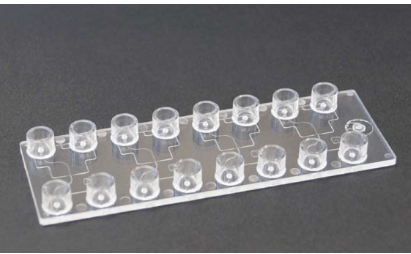
A range of droplet generator chips of different designs can generate droplets of different sizes and frequencies. Integrated wafers that go beyond the droplet generation function, e.g. by combining droplet generation with droplet storage for subsequent optical analysis, allow a wide variety of experiments to be performed. All droplet generators have a microscope slide format and can be operated in pumping and aspiration mode. In addition, our droplet generator wafers have a Mini Luer or Luer interface, which makes it easy to connect the wafers to the appropriate pumping system. Please note data compatibility when setting up droplet generation experiments: Topas wafers are recommended when using silicone-based oils, while mineral oils require PC-made wafers.
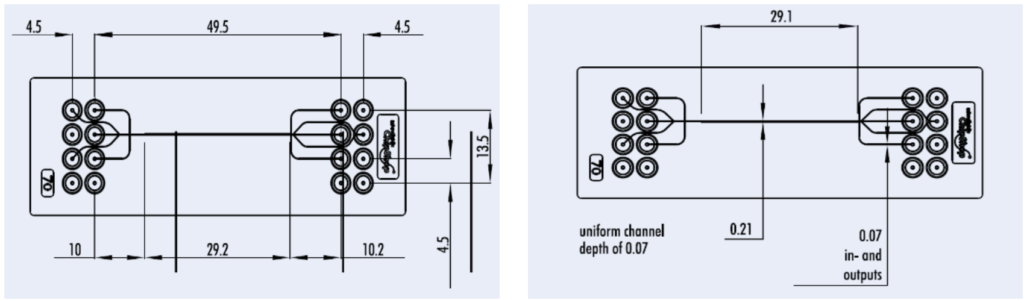
The Fluidic 162 and Fluidic 163 are similar in design and have multiple inlets and outlets with Mini Luer interfaces. The Fluidic 162 and Fluidic 163 are similar in design and have multiple inlets and outlets with Mini Luer interfaces, the main difference being the channel width. Like most droplet generators with double-crossing geometry, they can also be used for single-crossing experiments by simply closing their interfaces with a plug instead of connecting the respective channels.
Single cross geometry: This type of droplet generator chip provides multiple functional droplet generator units with the same geometry on a single chip. The Fluidic 537 droplet generator chip with single cross geometry and Luer interface was developed specifically for use in pumping and suction mode. The chip contains four identical droplet generating units with a nozzle size of 38 μm. In comparison, the Fluidic 912 has a Mini Luer interface and eight identical droplet generating units with a channel size of 80 μm in the droplet forming region.
② Dual cross geometry: Droplet generator wafers with a dual cross geometry allow for the generation of double emulsions, e.g. another droplet shell at the second channel crossing point contains droplets or cells from the first channel crossing point. We offer two different designs, the Fluidic 536 and Fluidic 1032, which have different channel/nozzle sizes. Note that although the general layout is very similar, the Fluidic 536 has a Luer interface while the Fluidic 1032 is equipped with a Mini Luer interface.
③Multiple design options: With this multi-channel design, several design options for generating droplets with different volumes are realized. The different diameters of the main channel and the inlet channel allow for a large number of experiments. The Fluidic 285 has a Mini Luer interface.
④ Droplet size variation: These droplet generators incorporate a size variation design for evaluating the generated droplet size under desired conditions. For this purpose, two droplet generator wafers of similar design are provided for droplet size evaluation. Each chip has eight independent droplet generator units and a Mini Luer interface. The Fluidic 440 is designed to generate larger droplets, with droplet-forming region channel sizes of 80 μm, 70 μm, 60 μm, and 50 μm channel width and height. In contrast, the Fluidic 947 generates smaller droplets, with droplet-forming region channel sizes of 30 μm, 20 μm, 15 μm and 10 μm channel width and height. Each size version has two different exit channel widths.

These droplet generation chips combine droplet generation with storage and capture of individual droplets for optical analysis.