Search

AVB/Car Ethernet Switch IP Core

Product Overview

The demand for higher bandwidth in automobiles is growing rapidly. On the one hand, all entertainment and connectivity elements, on the other hand, all control-related electronics.


As a result, automakers have added many computer-based systems that require interconnectivity. From a technical and economic point of view, the use of the latest innovations in Ethernet is the best option to meet this challenge.


Historically, automakers have avoided using packet-switched networks for multimedia applications due to their uncertainty. However, deterministic Ethernet solutions, such as AVB, can provide data streams with guaranteed bandwidth and deterministic latency for, for example, highly reliable and low-latency applications in automobiles.


Audio Video Bridging (AVB) is the generic name for a group of technical standards that allow time-synchronized, low-latency data streaming services over Ethernet. They were developed by the Audio Video Bridging Task Force of the Institute of Electrical and Electronics Engineers (IEEE). These include:


  • IEEE 802.1BA: Audio Video Bridging (AVB) Systems
  • IEEE 802.1AS: Timing and Synchronization for Time-Sensitive Applications
  • IEEE 802.1Qat: Stream Retention Protocol (SRP)
  • IEEE 802.1Qav: Forwarding and Queuing of Time-Sensitive Data Streams (FQTSS)

AVB works by reserving a small portion of the available Ethernet bandwidth for AVB traffic, and those types of packets are sent periodically in the allocated time slots. Since the bandwidth is reserved, there are no surges.

The AVB/Car Ethernet Switch (AVBES) IP core implements an Ethernet switch that supports all AVB-compliant standards. It can be optimally implemented according to the application, from simple 2-port endpoints to complex multi-port switches.

The following Xilinx FPGA families support AVBES IP

Audio/Video Bridging Support

  • IEEE 802.1AS Timing and Synchronization for Time Sensitive Applications (gPTP)
    Time Synchronization Layer
  • IEEE 802.1Qav Forwarding and Queuing for Time-Sensitive Streams (FQTSS)
    For Reserved Traffic
    Credit-based shaper: bandwidth reservations can be configured for each traffic class
  • IEEE 802.1Qat Data Stream Reservation Protocol (SRP)
    For Network Resource Management

Reference Design Supported Boards

  • AVB ES Kit

connector

  • Full-duplex 10/100/1000 Mbps Ethernet interface
  • Full-duplex 2.5/5/10 Gbps Ethernet uplink interface
  • Configurable 3 to 32 Ethernet ports
  • MII/RMII/GMII/RGMII/SGMII/QSGMII/USXGMII Physical Layer Device (PHY) Interface
  • Each port supports different data rates

exchange

  • Dynamic MAC table with automatic MAC address learning and aging (up to 4096 entries)
  • Static MAC table (up to 4096 entries)
  • Giant Frame Management
  • Broadcast/multicast storm protection per port rate limiting (broadcast, multicast and unicast traffic)
  • port-based VLAN support.

Configuration

  • MDIO, UART, AXI4-lite or CoE (Configuration over Ethernet) management interface
  • Configuration over Ethernet (COE): Full access to internal registers via the same Ethernet link to the CPU
  • Drivers are provided with the purchase of IP cores

Keeping up with the times and innovating - Explore more potentials of TSN with Hongke

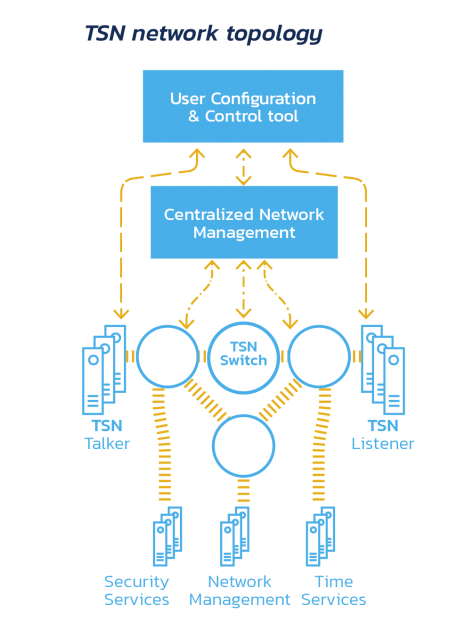
Time Sensitive Networking (TSN) is a new generation of network technology based on the evolution of the standard Ethernet architecture. It takes traditional Ethernet as the network foundation and provides a data link layer protocol specification for deterministic data transmission capability through mechanisms such as clock synchronization, data scheduling, and network configuration. Compared with traditional Ethernet, TSN can provide microsecond-level deterministic services, reduce the complexity of the entire communication network, and realize the convergence of information technology (IT) and operation technology (OT). With its precise clock synchronization, deterministic traffic scheduling, and intelligent and open operation and maintenance management framework, TSN can ensure the high-quality transmission of multiple business traffic in a common network, and it has both performance and cost advantages, and it is the development trend of the future network. This is the future trend of network development.

Currently, TSN technology has a high level of discussion in the automotive, industrial, rail transportation, and aerospace fields. As a non-vendor-bound real-time communication protocol, we believe that TSN technology has a good application prospect.

Welcome to contact us to explore and learn the integration of TSN technology with various industries, and actively promote more applications on the ground to jointly build a new world of intelligent interconnection.

Contact Hongke to help you solve your problems.

Let's have a chat