
Hongke Case
【虹科方案】歐盟AI 法案( EU AI Act )解讀:企業AI素養(AI Literacy)培訓如何落地
隨著《歐盟人工智能法案》(EU AI Act)逐步落地,AI治理正在從企業自律走向強制合規。根據法案第4條要求,AI系統的提供者和使用者必須采取措施確保員工具備足夠的AI素養(AI Literacy)。企業需要通過分層培訓體系、角色化課程設計以及持續追蹤機制,將AI知識轉化為可執行的合規流程。

 EN
ENAbstracts:
This article focuses on the digital transformation of the financial industry. Fintech companies and Internet giants are capitalizing on cutting-edge technology to transform the financial industry.Reinventing the Customer ExperienceThe digital transformation of the financial services industry is being driven by the need to improve the quality of the services provided by banks. At present, most bank customers have already become accustomed to using digital channels.Older systems are a major obstacleThe customer is interested in theReal-time Service ExperienceWith the rising demand for new technologies, practitioners are well aware of the need for transformation.Overhauling the technology architecture, including the data layerThe
Looking ahead, financial services should realize real-time interactive experiences, reorganize core business processes, and accelerate cloud deployment.Redis Enterprise This can be empowered withExcellent performance, high availability and scalabilityand provideDiversified Data Modelingto support different application scenarios. Relying on the cloud database architecture, it can efficientlyAccelerate new product launchesIt has been proven to be effective in a number of successful cases.
Fintech startups and Internet giants are using cutting-edge technologies toReinventing Customer Experience and ExpectationsThe financial services industry is therefore going through an unprecedented period. As a result, the financial services industry is experiencing unprecedentedMassive Digital TransformationThe
80%'s Bank AccountsAt least one digital channel will be involved in the financial interactions
Retail Bank of 57%Considering the old system as the biggest obstacle to the digitalization process
Customers of 35%Used online banking services several times during the COVID-19 outbreak
Financial services customers are now interested inContactless Payments, Mobile Banking, Credit Decision Making and Fraud DetectionThere is a general expectation that services such asInstant ExperienceThe financial institutions must therefore realize the digital transformation of their businesses in order to remain competitive in the market. Therefore, financial institutions must realize the digital transformation of their business in order to remain competitive in the market.
In the past, many practitioners have adopted a wrong and inefficient approach to transformation, and they have come to realize that digital transformation is definitely not just aboutAdding a modern website to the traditional infrastructureIt's as simple as that. To achieve the speed of service that customers expect, financial institutions must have a clear understanding of what they are doing.Modernization of the entire software ecosystemThese include the all-importantData LayerThe
RequirementsReal-time performance and high scalabilityThe data layer is the only way to satisfy the contemporary consumer's need for an interactive experience.
Financial institutions can useModern Data ModelingContinued business reorganization. Some businesses in the financial sector (e.g.Fraud Detection) is now available throughArtificial Intelligence, Machine Learning, Fast Graphics and Instant SearchThe technology will be reconfigured.
The hope is to gain a competitive edge and toShorten time-to-marketBusinesses that are not in a position to do so can do so through theCloud DeploymentBuild applications faster.
Financial institutions need a whole new set of capabilities to meet the growing demands of today's financial services customers.Redis Enterprise Providing multiple data models with real-time performance and reliability in any environment, it is designed to help organizations toMaximize the value of its data layerThe
Redis Enterprise OwnershipLinear ExpansionandZero downtimefeatures that provide reliablehigh throughputandSub-millisecond latency. itsNo Shared Cluster ArchitectureThroughAutomatic Failover Mechanismand the configurableDurability and Disaster Recovery OptionsThis ensures fault tolerance in the face of all levels of disaster.
Case Study: Deutsche Börse Realizes High-Speed Data Processing with Redis Enterprise
Deutsche Börse is required to assure the regulators and clients that the systemThroughput and Latency PerformanceRedis Enterprise provides strong support for this.
--Maja Schwob, Head of Data IT, Deutsche Börse
Redis Enterprise SupportInstant Search, Graphics, Event StreamingandAI/ML Modeling ServicesThe capabilities are suitable for applications such asFraud Detection, Wealth Management, Quantitative Tradingand other innovative solutions in a variety of application scenarios.
Case Study: Redis Enterprise Enables Simility to Realize Real-Time Fraud Detection Service
Simility is a service from PayPal that combinesMachine Learning and Human AnalyticsSimility is a cloud-based fraud detection service. With Redis Enterprise processing billions of transactions per day, Simility can deliver fraud detection faster than ever before. 30% Introducing new features and improving overall performance by nearly 90%The
Redis Enterprise as aCustody ServicesIt is available on all major cloud provider platforms, helping organizations to launch new products more quickly and strengthen compliance management.
for example Multi-live Geographic Distributionand other features that allow applications to be deployed globally while providingLocal Level Delayed ExperienceThis makes cloud applications easier to adopt and, in any case, more efficient to use.Maintaining business continuityThe
隨著《歐盟人工智能法案》(EU AI Act)逐步落地,AI治理正在從企業自律走向強制合規。根據法案第4條要求,AI系統的提供者和使用者必須采取措施確保員工具備足夠的AI素養(AI Literacy)。企業需要通過分層培訓體系、角色化課程設計以及持續追蹤機制,將AI知識轉化為可執行的合規流程。
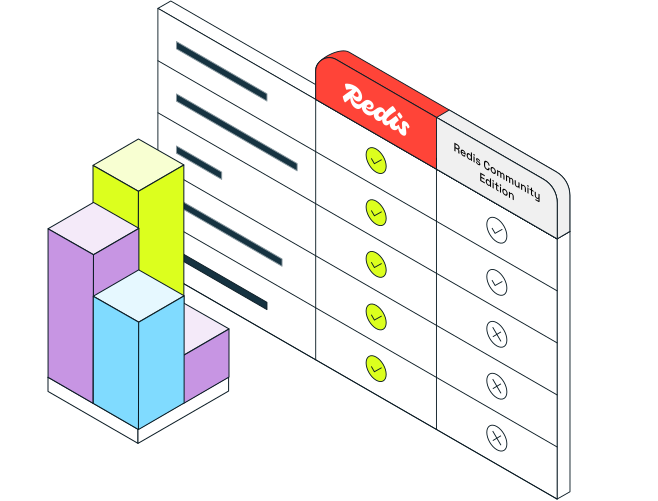
隨著香港《保護關鍵基礎設施(計算機系統)條例》實施,核心功能持續性與恢復時間目標(RTO)成為法定責任。Redis Enterprise 透過 99.999% 高可用架構、單秒級自動故障轉移與 Active-Active 多活技術,將恢復時間與恢復點目標趨近於零,在高負載下仍維持毫秒級延遲,幫助金融、電信與能源行業實現真正的零中斷數據合規。
2026 年初 Crunchbase 證實發生重大資料外洩,再次證明一次成功釣魚即可引爆數百 MB 檔案外流。除了外部攻擊,企業更常忽略「郵件誤寄」與內部外傳風險。本文解析釣魚產業化趨勢、合規壓力(如 HIPAA、GDPR、GLBA),並提供整合式 DLP、行為式 AI 與郵件加密的三位一體防護策略,協助企業在資料寄出前即時攔截風險。