- Home
- Technical Products
Enterprise Cloud IT Solutions
Test Measurement
Industrial Measurement
- Solutions
Enterprise Cloud IT Solutions
Test Measurement
- Latest Articles
- About Us
EN
MultiSync IP Core
Time-synchronized redundancy
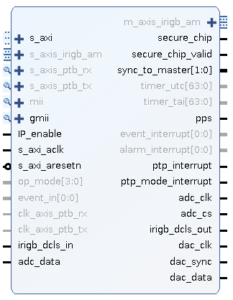
The MULTIsync IP core is a multi-protocol redundant time synchronization core that provides sub-microsecond time synchronization, thus providing maximum flexibility for every situation. It is capable of providing time synchronization using IEEE 1588-2008 (PTPv2) and IRIG-B time synchronization protocols.
The MULTIsync IP core supports the following synchronized input sources:
- PTP: Ethernet. PTP Slave on Input
- IRIG-B: IRIG-B compliant signal. IRIG-B slave on input
- Free-running timer: digital inputs
MULTIsync IP Core supports the following synchronization output options:
- PTP: Ethernet. PTP master on the output
- IRIG-B: IRIG-B compliant signals. IRIG-B slave on the outputs
- Free Run Timer: Digital Outputs
This versatility allows the different use cases of MULTI synchronization to complement each other:
- It can provide time synchronization redundancy so that the IP can be connected to both the PTP network and the IRIG-B master. Users can select one of the three available time sources (PTP, IRIG-B, free-running timer).
- It can act as a PRIG to IRIG-B or IRIG-B to PTP bridge when the IP is synchronized with a selected master.
- It can act as a PTP or IRIG-B master.
MULTI Synchronization can be used to introduce Ethernet traffic switching functionality or HSR and PRP redundancy in SoC-E HSR-PRP switches, TSN switches, unmanaged Ethernet switches, or IP core combinations for managed Ethernet switches.
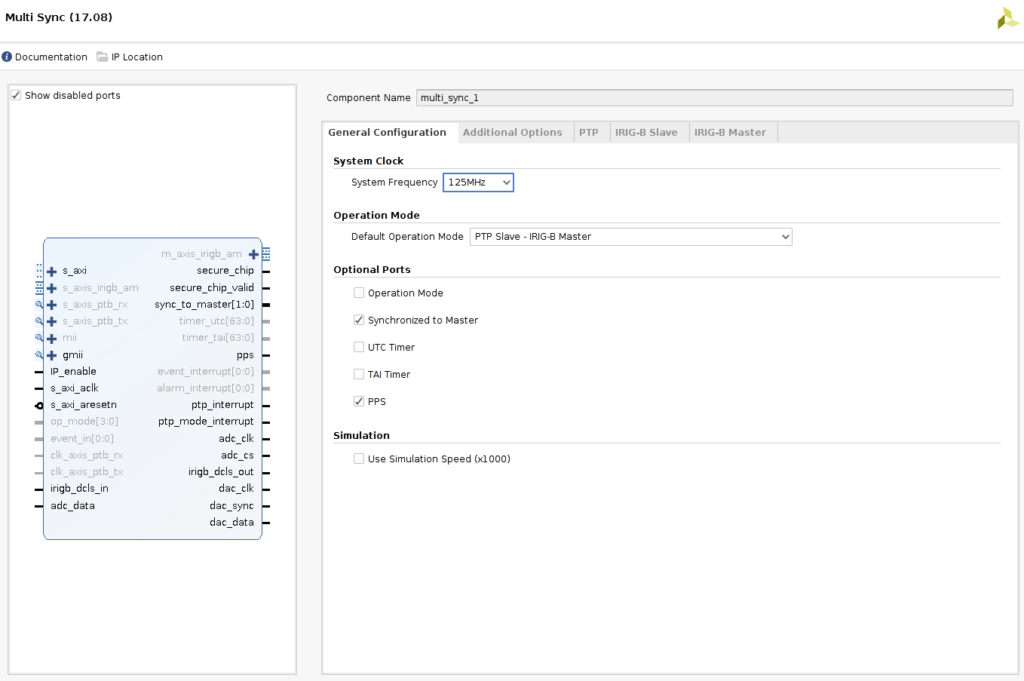
Easily integrate MULTIsync into your FPGA designs with the new Xilinx Vivado tool, which allows IP cores to be used in a graphical user interface and IP parameters to be configured in an easy way.
MULTIsync IP core key features
- Multi-protocol redundant time synchronization
- Also supports IEEE 1588-2008 (PTPv2) and IRIG-B time synchronization protocols.
- 12 different operating modes
- 3 independent 64-bit adjustable timers associated with each slave. 32-bit
- Sub-nanosecond frequency adjustment
- One pulse per second output
- Supports event timestamping (up to 4 different events at the same time)
- Supports alarm detection (up to 4 different alarms at the same time)
PTP function
- Supports 10/100/1000 Mbps Ethernet operation
- Supported AXI-S interfaces:
⚪1 Gigabit Ethernet: 8-bit Data Width
⚪10 Gigabit Ethernet: 64-bit Data Width
⚪Select whether the Ethernet frame contains a pre-synchronization code - 16 position FIFO depth. Old timestamp values are stored to avoid overflows.
- Supports end-to-end and point-to-point delay mechanisms
- PTP is supported on both Layer 2 (Ethernet) and Layer 3 (IPv4) interfaces
- Support for VLAN-tagged PTP messages
- IEEE1588 Profile: Default, Power, Power Facilities (IEC61850-9-3), AS
IRIG-B slave function
- Supports DCLS and AM modulation
- Internal filtering of AM signals
- Supports all IRIG-B encoded expressions, including year information, control functions and linear binary seconds
- IEEE-1344 extension support
- Input type (IRIG-B time code) can be configured before implementation and during operation
- Realizes universal ADC controller compatible with SPI, QSPI and MICROWIRE protocols
IRIG-B Master Functions
- Supports DCLS and AM modulation
- Supports all IRIG-B encoded expressions, including year information, control functions and linear binary seconds
- IEEE1344 extension support
- Output type (IRIG-B time code) can be configured before implementation and during operation
- Realizes universal DAC controller compatible with SPI, QSPI and MICROWIRE protocols.
Arbitrary Run Timer Function
- Fully managed by the user (time and frequency adjustment)
Keeping up with the times and innovating - Explore more potentials of TSN with Hongke
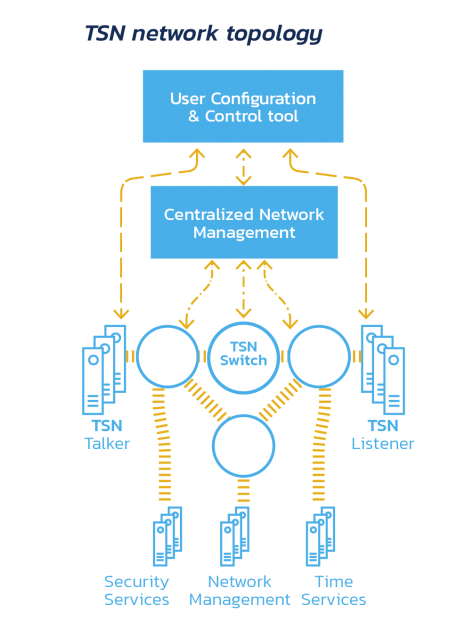
Time Sensitive Networking (TSN) is a new generation of network technology based on the evolution of the standard Ethernet architecture. It takes traditional Ethernet as the network foundation and provides a data link layer protocol specification for deterministic data transmission capability through mechanisms such as clock synchronization, data scheduling, and network configuration. Compared with traditional Ethernet, TSN can provide microsecond-level deterministic services, reduce the complexity of the entire communication network, and realize the convergence of information technology (IT) and operation technology (OT). With its precise clock synchronization, deterministic traffic scheduling, and intelligent and open operation and maintenance management framework, TSN can ensure the high-quality transmission of multiple business traffic in a common network, and it has both performance and cost advantages, and it is the development trend of the future network. This is the future trend of network development.
Currently, TSN technology has a high level of discussion in the automotive, industrial, rail transportation, and aerospace fields. As a non-vendor-bound real-time communication protocol, we believe that TSN technology has a good application prospect.
Welcome to contact us to explore and learn the integration of TSN technology with various industries, and actively promote more applications on the ground to jointly build a new world of intelligent interconnection.