【虹科方案】助力 dSPACE 實現 GNSS 駕駛功能 HIL 仿真,加速自動駕駛測試革命
虹科助力 dSPACE 構建基於 GNSS 的駕駛功能 HIL 仿真系統,支援自動駕駛、V2X、智慧座艙等多場景測試。透過 GNSS 模擬器與 ASM 模型,實現精準定位仿真、RF 射頻輸出、高一致性 HIL 驗證,加速自動駕駛演算法開發與測試效率。
Lorem ipsum dolor sit amet, consectetur adipiscing elit. Ut elit tellus, luctus nec ullamcorper mattis, pulvinar dapibus leo.
With the rapid development of Software-Defined Vehicles (SDV) and centralized E/E Architecture, traditional CAN buses can no longer support the increasing volume of data and real-time control requirements.
Leveraging our deep experience in automotive network communication, embedded systems and FPGA technology, we have proposed a new technology based on CAN XL × TSN (Time-Sensitive Networking) It is a total solution that enables vehicle manufacturers and Tier-1 suppliers to build efficient, reliable and scalable in-vehicle communication networks of the future.
CAN XL (Controller Area Network eXtended Layer) is the third-generation protocol for CAN networks, combining the three core advantages of "low cost," "high stability," and "strong compatibility," and realizing a cross-generation performance leap through the new design of the physical and protocol layers.
Its main technical features include:
Ultra-high-speed transmission capability: Data rate up to 1-20 Mbit/s (arbitration domain ≤1 Mbit/s, data domain 1-20 Mbit/s)
Data length extension: Supports 1-2048 Byte, far exceeding CAN FD's 64 Byte limit.
Virtual CAN Network (VCID): Supports up to 256 logical virtual networks for greater isolation and flexibility
Multi-Protocol Compatibility: New SDT (Service Data Unit Type) field for interoperability with protocols such as Ethernet.
Hao Chen, Head of Technology at Rainbow Technology, pointed out that CAN XL is a new technology in the ADAS and in-vehicle radar systems This is a significant advantage in the current 2M CAN FD architecture. In the current 2M CAN FD architecture, for example, radar data needs to be split into multiple frames and re-synchronized by the ADAS controller, whereas CAN XL can utilize Single frame 2K payload Transmits all object data at once, dramatically improving synchronization and real-time performance.
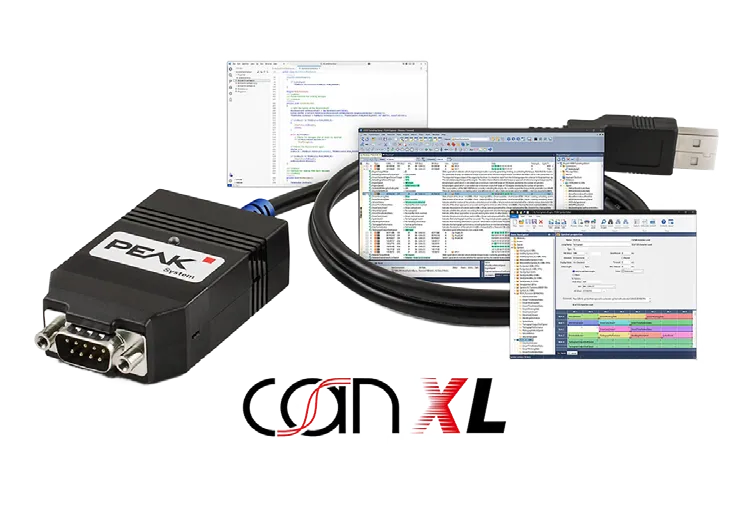
In order to help the industry to experience this new standard quickly, HONGKE launched the PCAN XL KitThe content:
USB-to-CAN XL Interface Module
Professional CAN Analysis Software PCAN-Explorer 7
PCAN-Basic SDK programming interface
The kit fully supports CAN CC / FD / XL communications and implements the core functionality of the CAN XL protocol in an FPGA, providing a complete environment for development, test and verification.

As the electrification and intelligence of automobiles increase, the E/E architecture is moving from the traditional decentralized ECU to the "domain controller" and "central computing" forms. In this process, vehicle communication faces five major challenges:
Explosive growth in arithmetic demand
Slow hardware iteration
Fragmentation of communication interfaces and protocols
Increased real-time and functional safety requirements
Cost and Flexibility Contradictions Highlighted
Mr. Law Hin-chi, Senior TSN Engineer of HTC, pointed out thatFPGAs are the "software" of hardware.The three characteristics of "parallel processing", "low latency" and "reconfigurability" can precisely meet the above challenges.
Unlike CPU/GPU time-sharing, FPGAs use space-sharing, where each task is executed simultaneously by independent circuits, realizing true hardware-level certainty.
The FPGA-based TSN (Time Sensitive Networking) solution brings three core values to the automotive E/E architecture:
Breaking the performance bottleneck: Hardware latency in microseconds for ultra-low jitter communication
Unified Communications Architecture: Single chip replaces multiple discrete controllers, supports any-to-any protocol conversion
Upgrade for the future: Adaptation of new standards through OTA reorganization to perfectly match software-defined vehicle requirements
The complete range of FPGA TSN solutions from SOC-E / RelyUm Series TSN IP Cores and Boards,TSN Switches until (a time) Test and Verification Kits The product supports 10M / 100M / 1G / 2.5G multi-rate. The product supports 10M / 100M / 1G / 2.5G multi-rate, and built-in IEEE 802.1AS time synchronization, 802.1Qbv time-aware shaping, and other key TSN standards, which makes it easy to build a highly reliable and accurate in-vehicle network.

CAN XL and TSN are not in competition, but complement each other and work together. The former provides high bandwidth and low cost for low and medium-speed control layers, while the latter provides certainty and high reliability for high-speed backbone networks. In the Central + Zonal Architecture, the combination of the two is driving the automotive industry towards a more efficient and reliable network. Software-Defined Mobility A New Era.
As the automotive E/E architecture evolves from distributed ECUs to domain control, and then to a "centralized computing + domain control" system, the deep convergence of CAN XL and TSN will become a key force in the evolution of in-vehicle networks, laying the foundation for in-vehicle communication, safety and sustainable innovation.

虹科助力 dSPACE 構建基於 GNSS 的駕駛功能 HIL 仿真系統,支援自動駕駛、V2X、智慧座艙等多場景測試。透過 GNSS 模擬器與 ASM 模型,實現精準定位仿真、RF 射頻輸出、高一致性 HIL 驗證,加速自動駕駛演算法開發與測試效率。

面向電動車 BMS 的通信升級方案:虹科 10BASE-T1S 媒體網關支援 CAN/CAN FD ↔ 10BASE-T1S 雙向轉換、PLCA 確定性延遲、單對線多點拓撲與 10 Mbps 帶寬,簡化佈線、提升採樣速率,並透過 Web Server、DIP、C SDK 靈活配置,兼顧成本與可擴展性。

PCAN-Explorer 6 is a cost-effective alternative to CANoe with modular plug-ins for CAN/CAN FD analysis, analog transmit/receive, record playback, script automation, and J1939 communications; and support for .dbc/.ARXML, Plotter curves, and Dashboard Panels for fast diagnostics and deliveries in automotive and industrial scenarios.