
Search

Hongke's latest articles

HongKe

Lorem ipsum dolor sit amet, consectetur adipiscing elit. Ut elit tellus, luctus nec ullamcorper mattis, pulvinar dapibus leo.

How CAN XL and TSN Drive Next-Generation Automotive E/E Architecture Innovations

With the rapid development of Software-Defined Vehicles (SDV) and centralized E/E Architecture, traditional CAN buses can no longer support the increasing volume of data and real-time control requirements.

Leveraging our deep experience in automotive network communication, embedded systems and FPGA technology, we have proposed a new technology based on CAN XL × TSN (Time-Sensitive Networking) It is a total solution that enables vehicle manufacturers and Tier-1 suppliers to build efficient, reliable and scalable in-vehicle communication networks of the future.

Next Generation CAN XL Technology

Breaking through the traditional CAN bus performance boundary, opening a new era of high-speed in-vehicle control.

CAN XL (Controller Area Network eXtended Layer) is the third-generation protocol for CAN networks, combining the three core advantages of "low cost," "high stability," and "strong compatibility," and realizing a cross-generation performance leap through the new design of the physical and protocol layers.

Its main technical features include:

  • Ultra-high-speed transmission capability: Data rate up to 1-20 Mbit/s (arbitration domain ≤1 Mbit/s, data domain 1-20 Mbit/s)

  • Data length extension: Supports 1-2048 Byte, far exceeding CAN FD's 64 Byte limit.

  • Virtual CAN Network (VCID): Supports up to 256 logical virtual networks for greater isolation and flexibility

  • Multi-Protocol Compatibility: New SDT (Service Data Unit Type) field for interoperability with protocols such as Ethernet.

Hao Chen, Head of Technology at Rainbow Technology, pointed out that CAN XL is a new technology in the ADAS and in-vehicle radar systems This is a significant advantage in the current 2M CAN FD architecture. In the current 2M CAN FD architecture, for example, radar data needs to be split into multiple frames and re-synchronized by the ADAS controller, whereas CAN XL can utilize Single frame 2K payload Transmits all object data at once, dramatically improving synchronization and real-time performance.

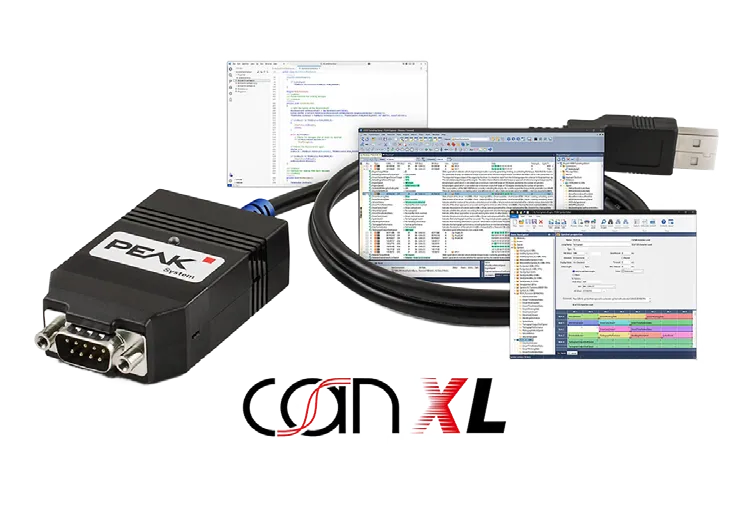
In order to help the industry to experience this new standard quickly, HONGKE launched the PCAN XL KitThe content:

  • USB-to-CAN XL Interface Module

  • Professional CAN Analysis Software PCAN-Explorer 7

  • PCAN-Basic SDK programming interface
    The kit fully supports CAN CC / FD / XL communications and implements the core functionality of the CAN XL protocol in an FPGA, providing a complete environment for development, test and verification.

FPGA-based TSN Solutions

Constructing a Multimodal Vehicular Network with Confidence and Flexibility

As the electrification and intelligence of automobiles increase, the E/E architecture is moving from the traditional decentralized ECU to the "domain controller" and "central computing" forms. In this process, vehicle communication faces five major challenges:

  1. Explosive growth in arithmetic demand

  2. Slow hardware iteration

  3. Fragmentation of communication interfaces and protocols

  4. Increased real-time and functional safety requirements

  5. Cost and Flexibility Contradictions Highlighted

Mr. Law Hin-chi, Senior TSN Engineer of HTC, pointed out thatFPGAs are the "software" of hardware.The three characteristics of "parallel processing", "low latency" and "reconfigurability" can precisely meet the above challenges.
Unlike CPU/GPU time-sharing, FPGAs use space-sharing, where each task is executed simultaneously by independent circuits, realizing true hardware-level certainty.

The FPGA-based TSN (Time Sensitive Networking) solution brings three core values to the automotive E/E architecture:

  • Breaking the performance bottleneck: Hardware latency in microseconds for ultra-low jitter communication

  • Unified Communications Architecture: Single chip replaces multiple discrete controllers, supports any-to-any protocol conversion

  • Upgrade for the future: Adaptation of new standards through OTA reorganization to perfectly match software-defined vehicle requirements

The complete range of FPGA TSN solutions from SOC-E / RelyUm Series TSN IP Cores and Boards,TSN Switches until (a time) Test and Verification Kits The product supports 10M / 100M / 1G / 2.5G multi-rate. The product supports 10M / 100M / 1G / 2.5G multi-rate, and built-in IEEE 802.1AS time synchronization, 802.1Qbv time-aware shaping, and other key TSN standards, which makes it easy to build a highly reliable and accurate in-vehicle network.

CAN XL × TSN Collaborative Evolution

Building a future-oriented automotive network ecosystem

CAN XL and TSN are not in competition, but complement each other and work together. The former provides high bandwidth and low cost for low and medium-speed control layers, while the latter provides certainty and high reliability for high-speed backbone networks. In the Central + Zonal Architecture, the combination of the two is driving the automotive industry towards a more efficient and reliable network. Software-Defined Mobility A New Era.

As the automotive E/E architecture evolves from distributed ECUs to domain control, and then to a "centralized computing + domain control" system, the deep convergence of CAN XL and TSN will become a key force in the evolution of in-vehicle networks, laying the foundation for in-vehicle communication, safety and sustainable innovation.

Other Articles

Hongke Case

AI Recognition and AR Workflow: Reinventing PCB Quality Assurance and Digital Factory

Facing PCB Quality Inspection Yield Bottleneck? HongKe HongKe provides AR standardized workflow + AI recognition solution to reduce visual inspection rate by 50% and shorten new employee training to 1 day. Applicable to Hong Kong and Southeast Asia electronics manufacturing transformation, helping you realize efficient quality control and quality traceability.

Read more
Hongke Case

[Hongke Case] Saving 2 million dollars of quality loss every year! How Hisense Hitachi discovered the hidden problems of large equipment transportation with MSR vibration recorder?

Hongke MSR Impact Vibration Recorder can provide high-precision and reliable impact vibration monitoring solutions for logistics and transportation, rail transportation, power and energy, industrial automation and other fields. Through the introduction of HONGKE MSR165 Impact Micro Vibration Recorder, Hisense Hitachi has successfully constructed a set of scientific data monitoring system, realizing the precise quantification of equipment transportation environment and the continuous optimization of product design.

Read more

Contact Hongke to help you solve your problems.

Let's have a chat