Hongke Case
【虹科案例】從60%到5%: Anglo-Eastern 如何用一年時間築起網路安全防線
Anglo-Eastern Ship Management 是一家管理超過750艘船舶的全球船舶管理公司。面對分布在世界各地的32000多名海員和不斷增長的網絡攻擊風險,公司通過部署 KnowBe4 HRM+ 安全意識培訓平台,實施持續的員工網絡安全教育和模擬釣魚測試。僅用一年時間,員工釣魚攻擊易感率從60%降至5%,培訓完成率超過90%,員工每天主動上報約200封可疑郵件。

 EN
ENLorem ipsum dolor sit amet, consectetur adipiscing elit. Ut elit tellus, luctus nec ullamcorper mattis, pulvinar dapibus leo.
Lorem ipsum dolor sit amet, consectetur adipiscing elit. Ut elit tellus, luctus nec ullamcorper mattis, pulvinar dapibus leo.
As Artificial Intelligence (AI) is gradually penetrating into every industry and everywhere, how can embedded smart devices achieve efficient and reliable collaboration between massive data and real-time demands? The answer may not come from a new and disruptive technology, but from a classic, mature, and still very much alive cornerstone....CAN busThe
Here, we share CiA's authoritative viewpoints and bring you an in-depth discussion on how CAN, with its core features of "high reliability, real-time performance, and distributed architecture," can reshape its own positioning in the rising tide of embedded AI.
Have you noticed that AI is gradually sinking from the "cloud" and quietly embedding itself into all kinds of terminal devices around you? This trend is the so-called "embedded AI", which allows devices to have the ability to sense, reason, judge and act autonomously locally.
However, a new question arises: how can these "small intelligences" scattered at the periphery be stably, securely, and with low latency linked together to form a reliable collaborative system?
The answer, perhaps, lies in the widely validated and continuously evolving communications technology - theCAN busThe
The latest article of CiA (CAN in Automation), an international authority, will reveal how the technology combination of "CAN + AI" will lay a stronger foundation for future intelligent systems. It's about a more efficient, autonomous and intelligent embedded world, and this future is approaching at an alarming speed.
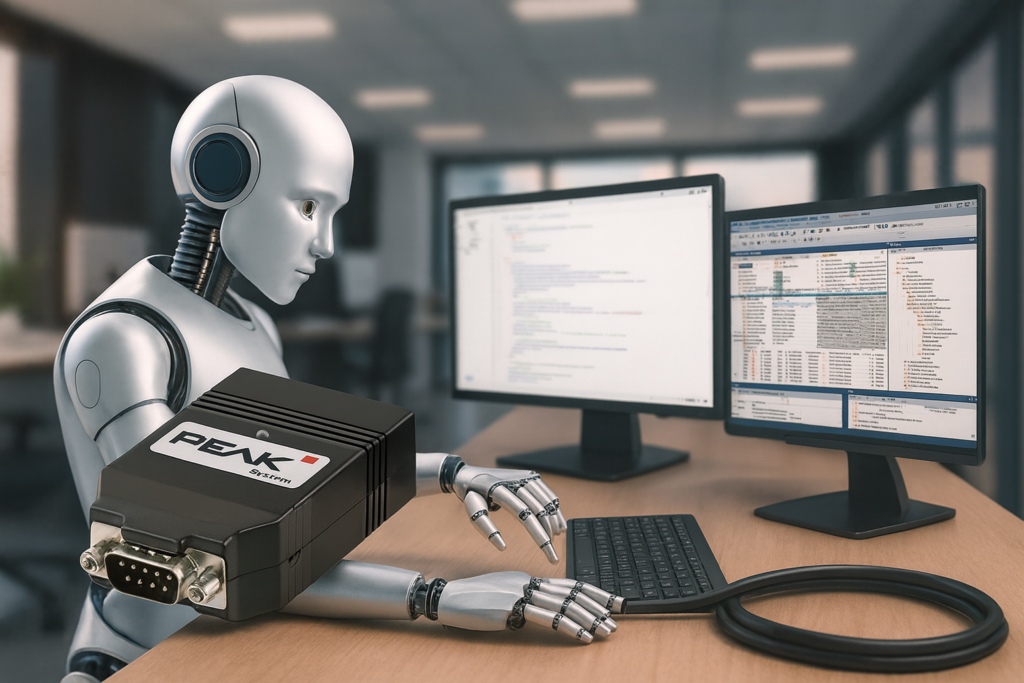
Google AI defines embedded AI as "the deep fusion of artificial intelligence with physical devices and systems". Through this convergence, devices no longer have to rely on cloud connectivity and can process data, analyze intelligence, make decisions and even execute actions locally.
To achieve these capabilities, "lean" AI models need to be run on highly efficient hardware to improve computational efficiency, accuracy and real-time response. Typical applications include autonomous robots, smart sensors, medical devices, and smart manufacturing.
Embedded AI is seen as the next stage in the evolution of embedded control networks. Back in the early days of AI, AI relied on large clusters of remote computers with high energy consumption and was fed by sensors in embedded networks, which were computed in the cloud and sent back to front-end actuators for control.
However, with the increasing demand for real-time performance, cloud-based architectures are no longer sufficient for latency-sensitive embedded control scenarios that must respond quickly. This has led the industry to deploy Edge AI ControllerThe AI calculations are performed closer to the scene to minimize latency.
The next step for embedded control networks is to allow AI to be decentralized to the AI-based sensors and AI-based actuators themselves, allowing them to choose whether or not to communicate with local edge AI controllers on demand, making the entire system more flexible and autonomous.
In the development of new technologies, centralized architectures are often the starting point; as they mature, they usually move towards decentralized architectures. The benefits of decentralization are clear: trained, pre-processed data is smaller, and true real-time communication is possible even on low-bandwidth networks.
This is crucial for all autonomous equipment, such as AGVs, AMRs, drones, self-driving agricultural machinery, forestry equipment, construction machinery, earthmoving equipment, etc.
Looking back at historical applications, we can see that these autonomous systems have generally adopted a distributed network architecture based on CAN buses; this is also true in areas such as medical equipment and laboratory equipment. In addition, the decentralized architecture brings an extra security advantage: Embedded AI networks do not have to rely on remote interfaces, so they are more immune to external network attacks, which significantly improves system security.
The first batch of embedded AI devices to hit the ground are expected to focus on two areas:
Multi-sensor fusion equipment for navigational purposes-Output intelligent data processed by AI algorithms
Condition Monitoring Equipment-Predictive Analytics and Health Diagnostics with Embedded AI
In terms of actuators, intelligent power drives that support self-configuring and self-optimizing will become typical applications for embedded AI. In addition, predictive maintenance and AI status monitoring of electrical equipment are also the focus of various industries.
While using an embedded real-time AI host controller is an option, integrating the AI software directly into the actuator effectively lowers the system design threshold and saves engineers significant development and integration costs.
There is reason to believe that chipmakers will soon introduce more AI-friendly hardware with lower power consumption and more reasonable costs, making it easier to deploy embedded AI in battery-powered devices.
In the author's opinion:The CAN bus-based network architecture is optimal for connecting AI sensors, AI actuators and master controllers in series.
The high stability, high reliability and excellent scalability of CAN are the most essential core features of an embedded AI real-time control system.
The first CANopen protocol designed specifically for embedded AI devices is the first CANopen protocol for item inspection devices. CiA 462The
Rather than relying on specific sensing technologies (e.g., camera, radar, ultrasound, etc.), it explicitly defines the data format that can be mapped to PDO (Process Data Object) reports, allowing multi-sensor fusion devices to output intelligent data processed by AI.
In addition, other CiA protocols will be expanded with the development of embedded AI, especially in the areas of status monitoring and device health parameters, which will see more comprehensive upgrades.
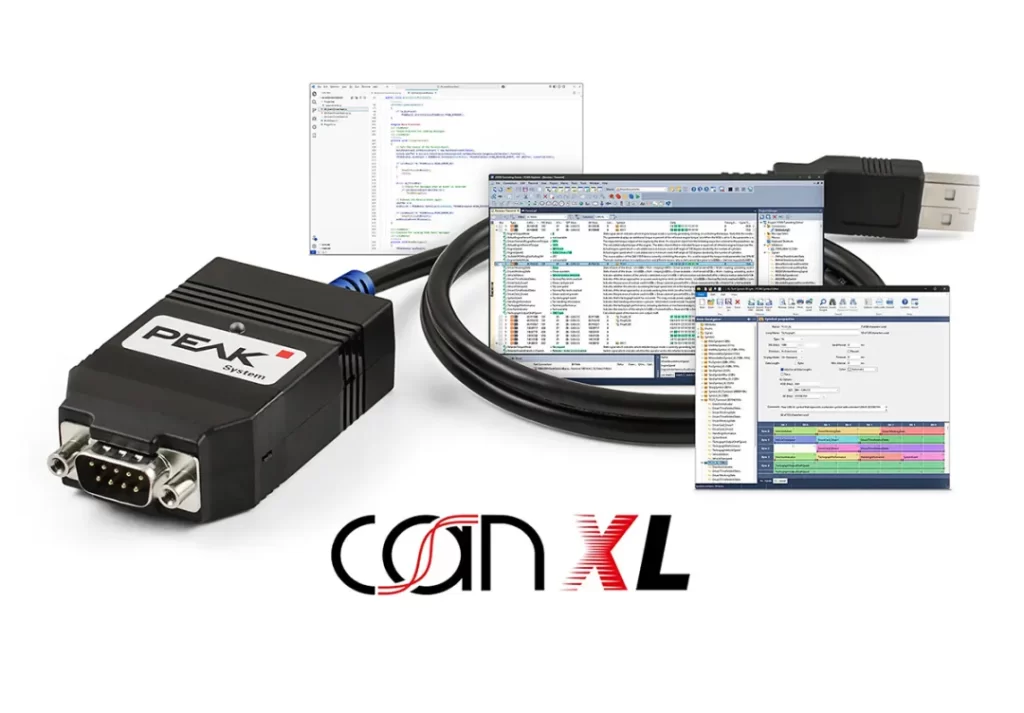
Embedded AI is accelerating to the edge, and a stable, reliable, and highly real-time communications architecture is a critical foundation for it to take hold. As this paper reveals, theCAN and CANopen are becoming the ideal "neural network" for embedded AI.The next generation of highly autonomous smart devices will be supported by the next generation of highly autonomous smart devices.
In the face of this wave, Avision is committed to delivering products that range from the classic to the cutting edge (including the latest 👉). Rainbow PCAN XL KitWe are looking forward to working with our industry partners to usher in the era of "Embedded AI × Real-time Control Network" convergence. We look forward to working with our industry partners to embrace the new era of "Embedded AI × Real-time Control Network" convergence.
Anglo-Eastern Ship Management 是一家管理超過750艘船舶的全球船舶管理公司。面對分布在世界各地的32000多名海員和不斷增長的網絡攻擊風險,公司通過部署 KnowBe4 HRM+ 安全意識培訓平台,實施持續的員工網絡安全教育和模擬釣魚測試。僅用一年時間,員工釣魚攻擊易感率從60%降至5%,培訓完成率超過90%,員工每天主動上報約200封可疑郵件。

隨著《歐盟人工智能法案》(EU AI Act)逐步落地,AI治理正在從企業自律走向強制合規。根據法案第4條要求,AI系統的提供者和使用者必須采取措施確保員工具備足夠的AI素養(AI Literacy)。企業需要通過分層培訓體系、角色化課程設計以及持續追蹤機制,將AI知識轉化為可執行的合規流程。
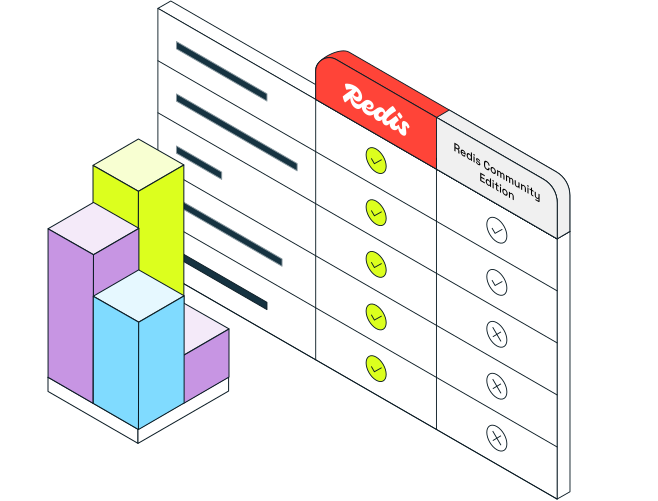
隨著香港《保護關鍵基礎設施(計算機系統)條例》實施,核心功能持續性與恢復時間目標(RTO)成為法定責任。Redis Enterprise 透過 99.999% 高可用架構、單秒級自動故障轉移與 Active-Active 多活技術,將恢復時間與恢復點目標趨近於零,在高負載下仍維持毫秒級延遲,幫助金融、電信與能源行業實現真正的零中斷數據合規。