Search

10G Managed Ethernet Switch IP Cores

Product Overview

The 10G Managed Ethernet Switch (MES) IP core features a full-speed, HOL-free arbitrary cross-matrix for continuous transmission between all ports. It supports up to 32 ports with different line speeds. The switch employs a store-and-forward methodology to fully satisfy the Ethernet standard policy regarding frame integrity checks.


The internal microarchitecture includes destructive enhancements to ensure reliable switch operation even in critical use cases. For example, the mirrored MAC tables of the virtual output queue combinations allow simultaneous access to the matrix at maximum data throughput. the IP does not require any external storage.


The 10G MES is a multi-speed (100M/1G/2.5G/5G/10Gs) switch IP with support for the IEEE 1588 V2 transparent clock feature. This feature modifies PTP event messages and takes into account the time spent traveling through the switch. The solution improves distribution accuracy by compensating for delivery variations across the network. Specifically, 10G MES also supports IEEE 1588 V2 One Step Transparent Clock Peering (P2P) by allowing each port to use independent hardware. This feature compensates not only for dwell time, but also for the latency of each link.


The IP includes MII/GMII/RGMII native interfaces for Ethernet PHY devices and can be combined with Xilinx IP to support interfaces such as RMII/SGMIIQ/SGMII and USXGMII. It also provides an AXI4-Stream interface to simplify connectivity to other IP cores such as SAS crypt for wire-speed security.


10G managed Ethernet switch IP core for Xilinx Vivado tools.


The 10G managed Ethernet switch IP is fully integrated on the Xilinx Vivado IPI tool. The graphical interface allows configuration of common parameters of the IP from a high-level view. Due to this flexibility at synthesis time, it is feasible to obtain an optimized implementation in terms of functions and ports for a given application and device. In addition, the IP can be directly instantiated using any HDL language.

connector

  • Full Duplex 100M/1G/2.5G/5G/10G Ethernet Interface
  • Configurable from 3 to 32 Ethernet ports
  • MII/RMII/GMII/RGMII/SGMII/QSGMII/USXGMII Physical Layer Device (PHY) Interface
  • Each port supports different data rates
  • Copper and Fiber Media Interfaces: 100M/1G/2.5G/5GBase-T, 100MBase-FX, 1GBase-X, 10GBase-SR, 10GBase-LR, 10GBase-BX

configure

  • MDIO, UART, AXI4-Lite or CoE (Configuration over Ethernet) management interface
  • Configuration over Ethernet (COE): Full access to internal registers via the same Ethernet link to the CPU
  • Drivers are provided with the purchase of IP cores.

exchange

  • Dynamic MAC table with automatic MAC address learning and aging features
  • Static MAC Table
  • Giant Frame Management
  • Ethernet-based switching
  • Port mirroring
  • Broadcast/Multicast Storm Protection
  • Rate limiting per port (broadcast, multicast and unicast traffic)

Distribution management

  • Multicast Frame Filtering
  • Switching Port Mask: User-defined frame forwarding to specific ports.
  • Port-based VLAN support
    Quality of Service (QoS)
    Priority (PCP-802.1p, DSCP TOS, Ethernet type)
  • IEEE 802.1X EAPOL hardware processing
  • DSA (Distributed Switching Architecture) Tagging: Ideally, the use of DSA would be ideal if the Ethernet switch supports “switch tagging”, which is a hardware feature that allows the switch to insert a specific tag for each Ethernet frame that is received on a specific port to help determine the management interface:
    Which port is the frame from?
    What is the reason for forwarding this frame?
    How to send CPU-initiated traffic to a specific port

Redundancy Agreement

  • M/RSTP (requires software stack)
    Hardware support for M/RSTP
    Linux Reference M/RSTP Stack included with IP kernel
    Provides Posix-compatible RSTP stacks

Time Synchronization

  • IEEE 1588v2 stateless transparent clock function (P2P-Layer 2/E2E-Layer 2)
  • SoC-e IEEE 1588 IP core compatible (1588Tiny, PreciseTimeBasic)

Supported Xilinx FPGA Families and Evaluation Boards

Our TGES IP cores can be deployed in the following Xilinx families. You can find the different Xilinx product sheets and selection guides in the links below:


7-Series

Ultrascale

Ultrascale+

Versal ACAP


Refer to the boards supported by the design:

existhardware platformIn terms of SoC-e, we have also developed theSystem-on-Module (SoM)We can provide the best possible service for our Preloaded design of IP coresWe provide these modules. In this case, our SoMs are developed specifically for networking applications. We have SoMs based on the 7 series, Ultrascale or Ultrascale+ Xilinx FPGA families.

For our 10G Ethernet switches, we recommend the following hardware:


  • SoC-e 10G MES KIT: Xilinx ZU106 board; SFP+ caged FMC; 10G fiber SFP+; fiber bi-directional LC tail.

Keeping up with the times and innovating - Explore more potentials of TSN with Hongke

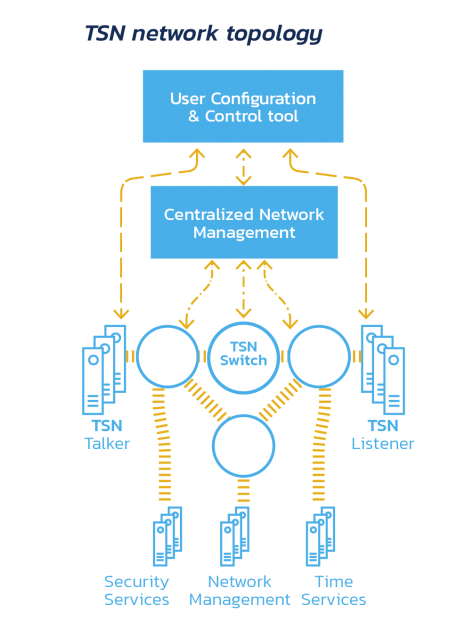
Time Sensitive Networking (TSN) is a new generation of network technology based on the evolution of the standard Ethernet architecture. It takes traditional Ethernet as the network foundation and provides a data link layer protocol specification for deterministic data transmission capability through mechanisms such as clock synchronization, data scheduling, and network configuration. Compared with traditional Ethernet, TSN can provide microsecond-level deterministic services, reduce the complexity of the entire communication network, and realize the convergence of information technology (IT) and operation technology (OT). With its precise clock synchronization, deterministic traffic scheduling, and intelligent and open operation and maintenance management framework, TSN can ensure the high-quality transmission of multiple business traffic in a common network, and it has both performance and cost advantages, and it is the development trend of the future network. This is the future trend of network development.

Currently, TSN technology has a high level of discussion in the automotive, industrial, rail transportation, and aerospace fields. As a non-vendor-bound real-time communication protocol, we believe that TSN technology has a good application prospect.

Welcome to contact us to explore and learn the integration of TSN technology with various industries, and actively promote more applications on the ground to jointly build a new world of intelligent interconnection.

Contact Hongke to help you solve your problems.

Let's have a chat