Hongke Case
【虹科案例】從60%到5%: Anglo-Eastern 如何用一年時間築起網路安全防線
Anglo-Eastern Ship Management 是一家管理超過750艘船舶的全球船舶管理公司。面對分布在世界各地的32000多名海員和不斷增長的網絡攻擊風險,公司通過部署 KnowBe4 HRM+ 安全意識培訓平台,實施持續的員工網絡安全教育和模擬釣魚測試。僅用一年時間,員工釣魚攻擊易感率從60%降至5%,培訓完成率超過90%,員工每天主動上報約200封可疑郵件。

 EN
ENLorem ipsum dolor sit amet, consectetur adipiscing elit. Ut elit tellus, luctus nec ullamcorper mattis, pulvinar dapibus leo.
With the rapid development of Software-Defined Vehicles (SDV) and centralized E/E Architecture, traditional CAN buses can no longer support the increasing volume of data and real-time control requirements.
Leveraging our deep experience in automotive network communication, embedded systems and FPGA technology, we have proposed a new technology based on CAN XL × TSN (Time-Sensitive Networking) It is a total solution that enables vehicle manufacturers and Tier-1 suppliers to build efficient, reliable and scalable in-vehicle communication networks of the future.
CAN XL (Controller Area Network eXtended Layer) is the third-generation protocol for CAN networks, combining the three core advantages of "low cost," "high stability," and "strong compatibility," and realizing a cross-generation performance leap through the new design of the physical and protocol layers.
Its main technical features include:
Ultra-high-speed transmission capability: Data rate up to 1-20 Mbit/s (arbitration domain ≤1 Mbit/s, data domain 1-20 Mbit/s)
Data length extension: Supports 1-2048 Byte, far exceeding CAN FD's 64 Byte limit.
Virtual CAN Network (VCID): Supports up to 256 logical virtual networks for greater isolation and flexibility
Multi-Protocol Compatibility: New SDT (Service Data Unit Type) field for interoperability with protocols such as Ethernet.
Hao Chen, Head of Technology at Rainbow Technology, pointed out that CAN XL is a new technology in the ADAS and in-vehicle radar systems This is a significant advantage in the current 2M CAN FD architecture. In the current 2M CAN FD architecture, for example, radar data needs to be split into multiple frames and re-synchronized by the ADAS controller, whereas CAN XL can utilize Single frame 2K payload Transmits all object data at once, dramatically improving synchronization and real-time performance.
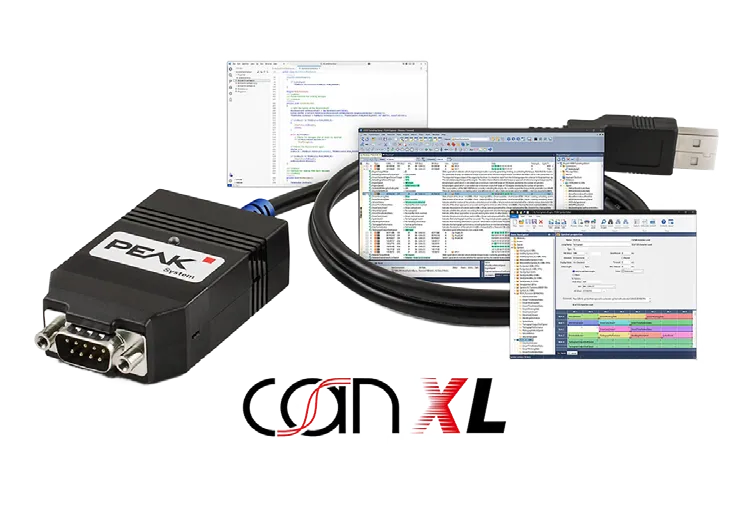
In order to help the industry to experience this new standard quickly, HONGKE launched the PCAN XL KitThe content:
USB-to-CAN XL Interface Module
Professional CAN Analysis Software PCAN-Explorer 7
PCAN-Basic SDK programming interface
The kit fully supports CAN CC / FD / XL communications and implements the core functionality of the CAN XL protocol in an FPGA, providing a complete environment for development, test and verification.
As the electrification and intelligence of automobiles increase, the E/E architecture is moving from the traditional decentralized ECU to the "domain controller" and "central computing" forms. In this process, vehicle communication faces five major challenges:
Explosive growth in arithmetic demand
Slow hardware iteration
Fragmentation of communication interfaces and protocols
Increased real-time and functional safety requirements
Cost and Flexibility Contradictions Highlighted
Mr. Law Hin-chi, Senior TSN Engineer of HTC, pointed out thatFPGAs are the "software" of hardware.The three characteristics of "parallel processing", "low latency" and "reconfigurability" can precisely meet the above challenges.
Unlike CPU/GPU time-sharing, FPGAs use space-sharing, where each task is executed simultaneously by independent circuits, realizing true hardware-level certainty.
The FPGA-based TSN (Time Sensitive Networking) solution brings three core values to the automotive E/E architecture:
Breaking the performance bottleneck: Hardware latency in microseconds for ultra-low jitter communication
Unified Communications Architecture: Single chip replaces multiple discrete controllers, supports any-to-any protocol conversion
Upgrade for the future: Adaptation of new standards through OTA reorganization to perfectly match software-defined vehicle requirements
The complete range of FPGA TSN solutions from SOC-E / RelyUm Series TSN IP Cores and Boards,TSN Switches until (a time) Test and Verification Kits The product supports 10M / 100M / 1G / 2.5G multi-rate. The product supports 10M / 100M / 1G / 2.5G multi-rate, and built-in IEEE 802.1AS time synchronization, 802.1Qbv time-aware shaping, and other key TSN standards, which makes it easy to build a highly reliable and accurate in-vehicle network.

CAN XL and TSN are not in competition, but complement each other and work together. The former provides high bandwidth and low cost for low and medium-speed control layers, while the latter provides certainty and high reliability for high-speed backbone networks. In the Central + Zonal Architecture, the combination of the two is driving the automotive industry towards a more efficient and reliable network. Software-Defined Mobility A New Era.
As the automotive E/E architecture evolves from distributed ECUs to domain control, and then to a "centralized computing + domain control" system, the deep convergence of CAN XL and TSN will become a key force in the evolution of in-vehicle networks, laying the foundation for in-vehicle communication, safety and sustainable innovation.
Anglo-Eastern Ship Management 是一家管理超過750艘船舶的全球船舶管理公司。面對分布在世界各地的32000多名海員和不斷增長的網絡攻擊風險,公司通過部署 KnowBe4 HRM+ 安全意識培訓平台,實施持續的員工網絡安全教育和模擬釣魚測試。僅用一年時間,員工釣魚攻擊易感率從60%降至5%,培訓完成率超過90%,員工每天主動上報約200封可疑郵件。

隨著《歐盟人工智能法案》(EU AI Act)逐步落地,AI治理正在從企業自律走向強制合規。根據法案第4條要求,AI系統的提供者和使用者必須采取措施確保員工具備足夠的AI素養(AI Literacy)。企業需要通過分層培訓體系、角色化課程設計以及持續追蹤機制,將AI知識轉化為可執行的合規流程。
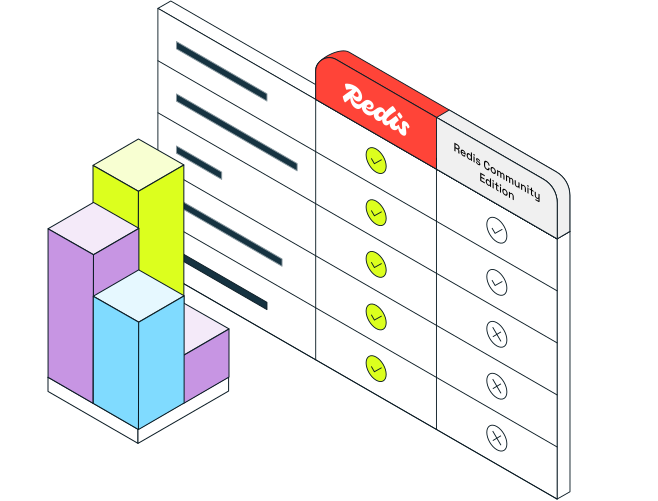
隨著香港《保護關鍵基礎設施(計算機系統)條例》實施,核心功能持續性與恢復時間目標(RTO)成為法定責任。Redis Enterprise 透過 99.999% 高可用架構、單秒級自動故障轉移與 Active-Active 多活技術,將恢復時間與恢復點目標趨近於零,在高負載下仍維持毫秒級延遲,幫助金融、電信與能源行業實現真正的零中斷數據合規。