- Home
- Technical Products
High-Performance Data and Automation
ADAS Simulation and Testing Framework
In-Vehicle Network Communications
Industrial Internet of Things and Digital Factories
AI Machine Vision
Pharmaceutical Cold Chain and Environmental Monitoring
Laboratory Automation and Microfluidics
Environmental Monitoring and Facility Management
Critical Infrastructure Communications and Remote Collaboration
Professional Electronic Testing and Measurement
- Solutions
High-Performance Data and Automation
ADAS Simulation and Testing Framework
In-Vehicle Network Communications
Industrial Internet of Things and Digital Factories
AI Machine Vision
Pharmaceutical Cold Chain and Environmental Monitoring
Laboratory Automation and Microfluidics
Environmental Monitoring and Facility Management
Critical Infrastructure Communications and Remote Collaboration
- Latest Articles
- About Us
EN
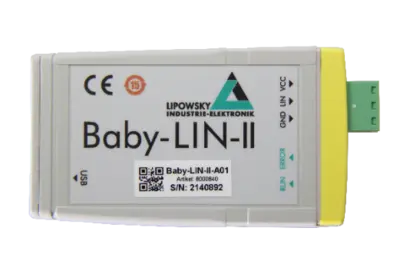
Baby-LIN-II
Baby-LIN-II
Function Overview:
- Professional LIN bus test tool that can emulate one LIN master node and multiple slave nodes at the same time. Fully compatible with the Baby-LIN-E06 generation and more powerful.
- Small but powerful system for controlling the LIN bus via USB. Emulates LIN master or LIN slave nodes. Isolated LIN interface to avoid ambient noise.
- The device also supports stand-alone use without a computer. Thus the durability test sequence can be defined as macros and the connection to the LIN bus is automatically activated without the need for a computer.
- PC software development based on DLLs, with secondary development routines for C#, Visual C, Visual Basic and LabView.
- Supports WINXP, VISTA, WIN7 (32/64 Bit) and WIN8 (32/64 Bit) and Linux.
- Main Applications
- Key Specifications
- Contents and Specifications
- Local monitoring, real-time reading, recording, sending and displaying of LIN data.
- Supports LIN device diagnostics and DTL (Diagnostic Transport Layer) such as 3C/3D services.
- Local modification and testing of all control parameters, message signals, frame timing, program timing
- The Baby-LIN-II LIN bus transceiver supports baud rates up to 200K. Although standard LIN devices support up to 20K, there are a growing number of high-speed LIN devices that exceed 20K communication rates, use non-LIN standard protocols, or are swiping a node at a higher baud rate, and require a supporting device to monitor and communicate. Baby-LIN-II can realize these applications in ASCII-Mode.
- One price covers the functionality of many devices on the market: such as LIN Bus Emulator, LIN Bus Diagnostic, LIN Bus Tester, LIN Bus Analyzer, LIN Bus Adapter, etc...
- Master-slave simulation and analysis of LIN nodes/systems to simulate bus participants that do not actually exist. For example, it simulates ECUs and other outgoing data, and supports virtual simulation, semi-physical simulation, and "listen-only" mode.
- Supports event-based signal configuration, sequence control, error determination, and triggering actions.
- Trigger actions to be performed (e.g. run or stop, send another message, change a signal value, etc.) by various event triggering conditions (signal events, message frame events, changed events, etc.)
- Signal events include the result of comparison between signal values, the result of comparison between signal values and constants, and the range of signal changes.
- Frame events include selected frames appearing on the bus, errors in frames (e.g. checks and errors, nodes not responding, etc.)
- Changed events include a change in a signal value, or a change in a message frame.
- Typical tests include: for example, when the product under test has an abnormality, detecting the error through LIN telegrams and stopping the equipment or triggering the sending of a certain command by Baby-LIN-II; for example, after a fixed period of time, starting the cycle of testing for 8,000 times: forward and backward rotation, start-up operation, different angles of openness, etc.; for example, when the production line workers activate Baby-LIN-II. For example, a production line worker activates the Baby-LIN-II module to automatically complete a series of tests before the product is shipped out of the factory: from startup to running to stopping the continuous test.
- Baby-LIN-II is a LIN bus controller that can be used for LIN bus simulation, ECU testing, and self-testing.
- Automation test system, secondary development, etc.
- Can be connected to a computer via USB; or run independently offline to emulate a LIN node.
- Supports LIN bus versions 2, 1.3, 2.0, 2.1 and 2.2.
- Electrical isolation between LIN device and computer
- Used to emulate LIN bus master and slave nodes, multiple slave nodes can be emulated at the same time.
- Real-time access to LIN signal and message data (read and write)
- Time stamped for monitoring and recording
- LIN diagnostic support, DTL (Diagnostic Transport Layer) support
- Baby-LIN-II operating voltage 8-28V (12V recommended)
- LINWorks software includes an LDF file editor; device configuration tools and a fully customizable user interface;
- PC software development based on DLL, with secondary development routines for C#, Visual C, Visual Basic and LabView.
- Very compact and portable device: 85 x 45 mm
- Supports WINXP, VISTA, WIN7 (32/64 Bit) and WIN8 (32/64 Bit) and Linux.
- One Baby-lin-II module
- One with 1.5 meter USB cable
- One CD-ROM: with device drivers, documentation, hosting software LINWorks for windows and linux (for configuration, monitoring, analysis, etc.)
Accessories Package Solution
Item No. : Baby-LIN-II
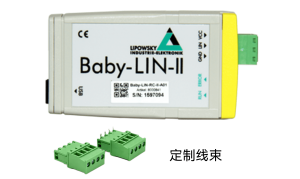
Basic Set
- Terminal block (3/4)
- Wire Harness
Please consult Hongke sales staff for the price of accessories set
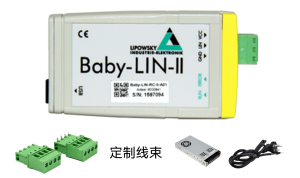
Standard Set
- Terminal block (3/4)
- Wire Harness
- Power Supply (12V)
- USB Data Cable
Please consult Hongke sales staff for the price of accessories set
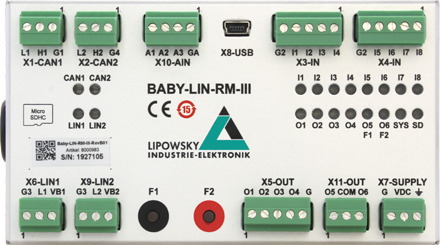
Baby-LIN-RM-Ⅲ
LIN, CAN bus simulation test tool for automated test systems
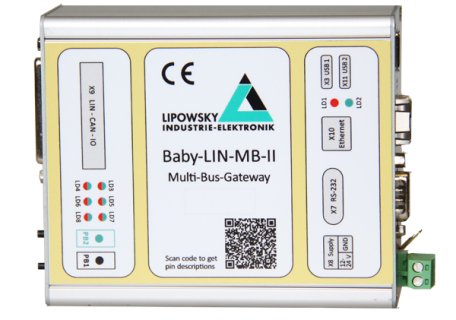
Baby-LIN-MB-II
LIN to RS232/Ethernet module for automated test systems or EOL devices
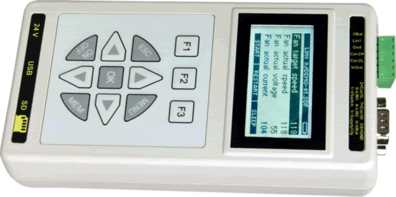
Harp-5
Handheld CAN, LIN bus simulation test tool
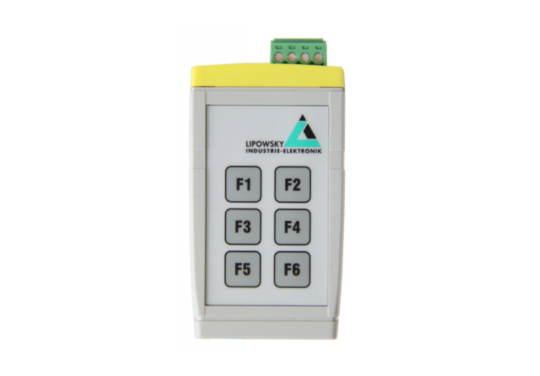
Baby-LIN-RC-II
Simultaneous emulation of one LIN master node and several slave nodes with 6 customizable numeric keys.