- Home
- Technical Products
Enterprise Cloud IT Solutions
Test Measurement
Industrial Measurement
- Solutions
Enterprise Cloud IT Solutions
Test Measurement
- Latest Articles
- About Us
EN
Hi-Tech Automotive GNSS Simulation Test Solution
Industry Development and Background
In recent years, the development direction of Intelligent Networked Vehicles (INVs) has become clearer, and the technological evolution has continued to deepen, demonstrating enormous market potential. At this stage, the industry has basically formed the core technology framework of "perception - communication - planning and control". Among them, GNSS positioning, as a key component of the perception layer, is currently the only sensing method that can provide absolute location information.
Typical applications such as remote vehicle control, smart cabin, in-vehicle entertainment systems, V2X Box, high-precision positioning, and V2X roadside units (RSUs) rely on high-precision GNSS positioning modules. As a result, the market demand for GNSS positioning accuracy, stability and verifiability is increasing.
GNSS Testing Status and Challenges
There are three main types of GNSS test methods in use today:
- Testing with GNSS signals in a real environment (Live Sky)
- Record GNSS signals and playback for testing (RF Record / Playback)
- Simulation and testing of GNSS signals through software or hardware
| Test Method | Real Sky Signal | Signal Recording / Playback | Signal Emulation / Simulation |
|---|---|---|---|
| Repeatable test | × | √ | √ |
| Controlled environmental conditions | × | portion | √ |
| Can be done anytime, anywhere | × | × | √ |
| Simulates future signals and events | × | × | √ |
| Realistic signal simulation | √ | √ | portion |
Most of the GNSS simulation devices in the market still have the following problems:
- Inadequate capacity to update and iterate
- Complicated software operation and long learning cycle
- High cost of traditional hardware
- Wide range of options at extra cost
- HIL simulation delay is high
Smart Internet GNSS Testing Requirements
High-performance, high-openness and cost-effective test solutions
On the one hand, smart internet vehicles need to test the performance of various types of GNSS receivers, which often involves large-volume validation, so the test system must be reproducible, controllable, easy to use and cost-effective.
On the other hand, in smart grid applications, GNSS often needs to be tested together with other modules for in-the-loop simulation (HIL). This requires test platforms with near real-time processing power, low latency performance, and flexible embedding and integration capabilities, while also catering to future upgrades and expansion needs.
Hongke GNSS simulation test program
HONGKEI has launched a complete and integrated GNSS simulation test solution for Smart Internet Vehicles, which can effectively cover the common application scenarios of GNSS receiver test, HIL test, RTK test and anti-interference test at this stage.
Based on the Skydel GNSS simulation engine, the solution constructed by Avision is based on the core concept of "relying on the software engine, opening up the hardware platform, and efficiently completing the GNSS simulation", which can provide users with a more flexible, better integrated and more forward-looking GNSS test platform, and is a truly future-oriented GNSS simulation test solution.
TSGSGStarter
GNSS Simulation Test Starter Kit
- 1 constellation/1 band GNSS signal analog output capability
- Simulation of up to 700 satellites
- Software-defined architecture with high flexibility and scalability
- 1 constellation/1 band GNSS signal analog output capability
- Simulation of up to 700 satellites
- Software-defined architecture with high flexibility and scalability
TSGSGB
Automotive GNSS Simulation and Testing Basic Package
- 1 constellation/1 band GNSS signal analog output capability
-Simulates up to 700 satellites
-Software definition architecture for flexibility and scalability
-With HiL API
- 1 constellation/1 band GNSS signal analog output capability
-Simulates up to 700 satellites
-Software definition architecture for flexibility and scalability
-With HiL API
TSGSGAD
Automotive GNSS Simulation Test Premium Package
- 2 constellation/2 band GNSS signal analog output capability
- Simulation of up to 1200 satellites
- Software definition architecture with flexibility and scalability
- HiL API, RTK testing, dual instance outputs
- 2 constellation/2 band GNSS signal analog output capability
- Simulation of up to 1200 satellites
- Software definition architecture with flexibility and scalability
- HiL API, RTK testing, dual instance outputs
TSGSGPRO
Automotive GNSS Simulation Test Master Package
- 4 constellation/3 band GNSS signal analog output capability
- Simulation of up to 1200 satellites
- Software definition architecture with flexibility and scalability
- HiL API, RTK testing, multiple (4) example simulation outputs, advanced interference simulation
- 4 constellation/3 band GNSS signal analog output capability
- Simulation of up to 1200 satellites
- Software definition architecture with flexibility and scalability
- HiL API, RTK testing, multiple (4) example simulation outputs, advanced interference simulation
Solution Benefits and Features
Industry-leading 5 ms HIL delay
The system receives track information and converts it to RF signals with a delay of less than 10 ms and even up to 5 ms, a market-leading performance that is particularly suitable for HIL test scenarios where real-time performance is critical.
Multi-antenna and multi-application support
The system supports multi-track and multi-antenna test scenarios, which can be realized without stacking multiple devices, thus effectively controlling the system cost and equipment size.
Turnkey program with multiple options
HONGKE provides one-stop GNSS test solutions and configures corresponding test packages according to different application requirements and test contents to assist users in choosing the right solution.
1000 Hz simulation iteration rate
With a simulation iteration rate of up to 1000 Hz, the system can meet the high update frequency requirements of applications such as INS, aerospace and high-precision high-speed testing.
Visualization and Analysis Interface
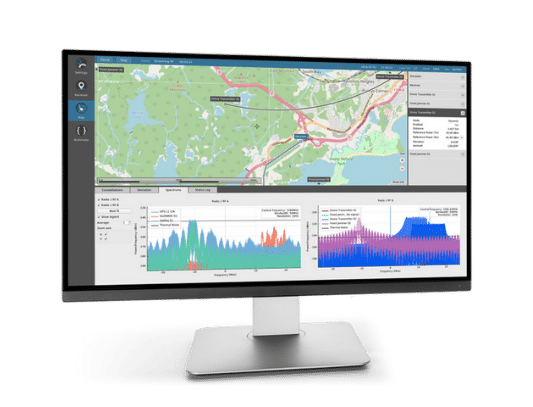
The system provides an intuitive visualization and analysis interface, which helps users to identify anomalies and unquantified problems faster, improving testing efficiency and analysis depth.
Performance Comparison
| Basic Framework | A conventional GNSS simulator | HONGKE GNSS Simulator Kit | HONGKE GNSS Simulator Kit |
|---|---|---|---|
| Model | A | TSGSG Starter & TSGSGB | TSGSGAD & TSGSGPRO |
| RF Output | 1 | 1 | 1, 2, 3, 4 |
| Channel / Star Search | 1 | 500 | 500-1000 |
| Supporting Constellations | GPS, Beidou, Galileo, GLONASS | GPS, Beidou, Galileo, GLONASS, QZSS, IRNSS / Navic | GPS, Beidou, Galileo, GLONASS, QZSS, IRNSS / Navic |
| Simultaneous Output Band | 1 | 4 | 4 |
| Simulation Iteration Rate | 10 Hz | 1000 Hz | 1000 Hz |
| Multiple Examples | N | N | Y |
| HIL Delay | >130 ms | <10 ms | <10 ms |
| Spurious Transmission | ≤40 dBc | -65 dBc | <-45 dBc |
| harmonic (wave) | ≤40 dBc | <-50 dBc | <-45 dBc |
| Maximum Relative Speed | 20000 m/s | 1,500,000 m/s | 1,500,000 m/s |
| Maximum relative acceleration | 4g (unlimited with expansion) | No limits | No limits |
| Maximum Relative Rush | 20 m/s3 | No limits | No limits |
| power accuracy | +1.0 dB | ±0.5 dB | ±0.5 dB |
| Output Signal Level | -65 to -160 dBm | -80 to -50 dBm, 0.1 dBm res. | -80 to -50 dBm, 0.1 dBm res. |
| Hypocenter Accuracy | 1 mm | ±0.001 m | ±0.001 m |
HONGKE GNSS Simulation Series Products
HONGKE GNSS Simulation Series provides a series of GNSS turnkey solutions such as GNSS simulators and simulation software.
Main characteristics
- Panoramic satellite simulation up to 700 channels
- Flexible and scalable software definition architecture
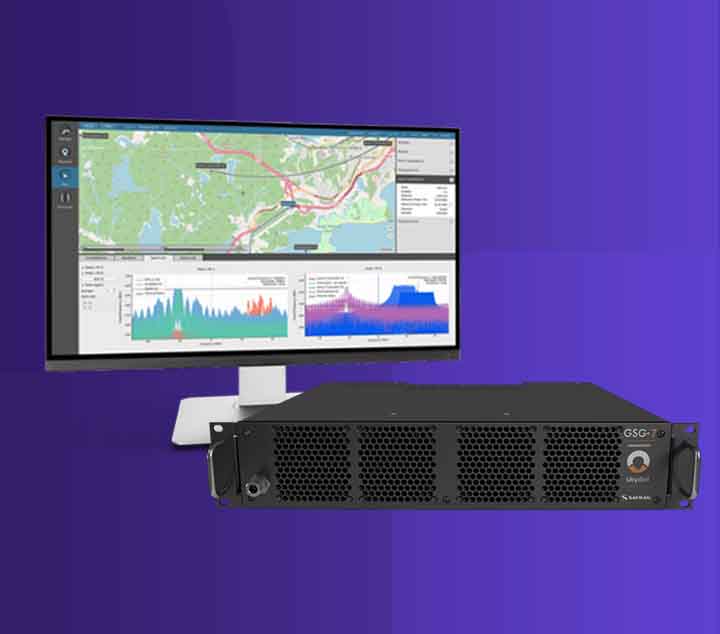
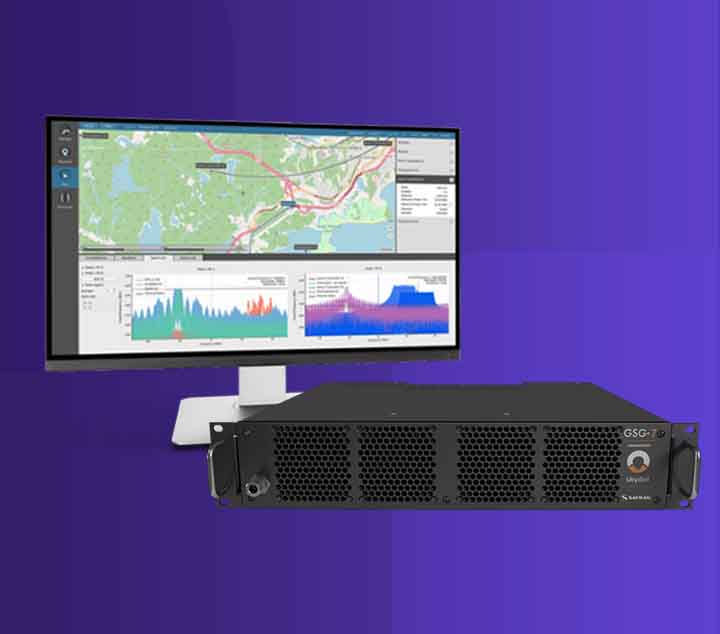
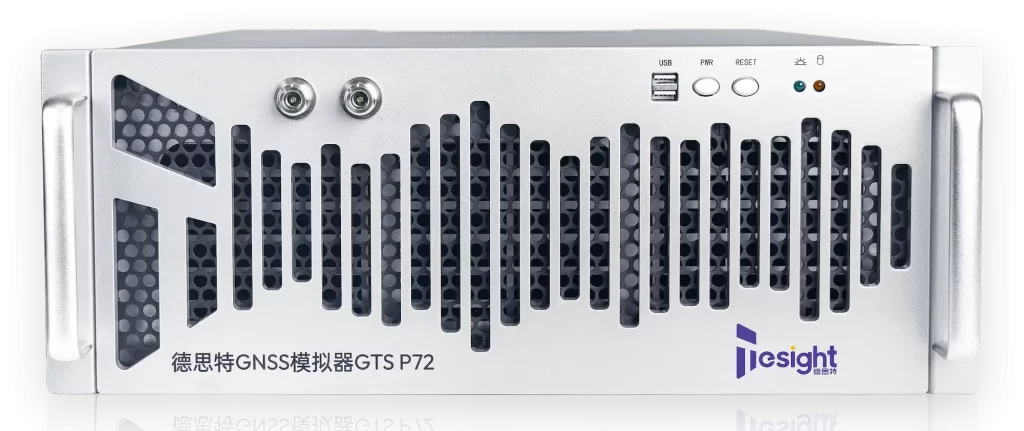
The GTS P7 is a Skydel-based Positioning, Navigation and Timing (PNT) test solution that provides the industry's highest standard of Global Navigation Satellite System (GNSS) signals in an easy-to-use, one-stop, compact design. Designed to provide the industry's highest standard of Global Navigation Satellite System (GNSS) signal testing in an easy-to-use, one-stop-shop, miniaturized form factor, the GTS P7 delivers high-end performance with simulation iterations up to 1000 Hz and supports up to 700 channels (number of simultaneous searches) to simulate high-dynamics, real-time synchronization, and full-field satellite signals. It supports multi-constellation and multi-frequency GNSS simulation and can be programmed to simulate all existing and future GNSS signals.
Main characteristics
- Multi-case high-performance hardware that supports simulation of 6 independent GNSS scenes simultaneously
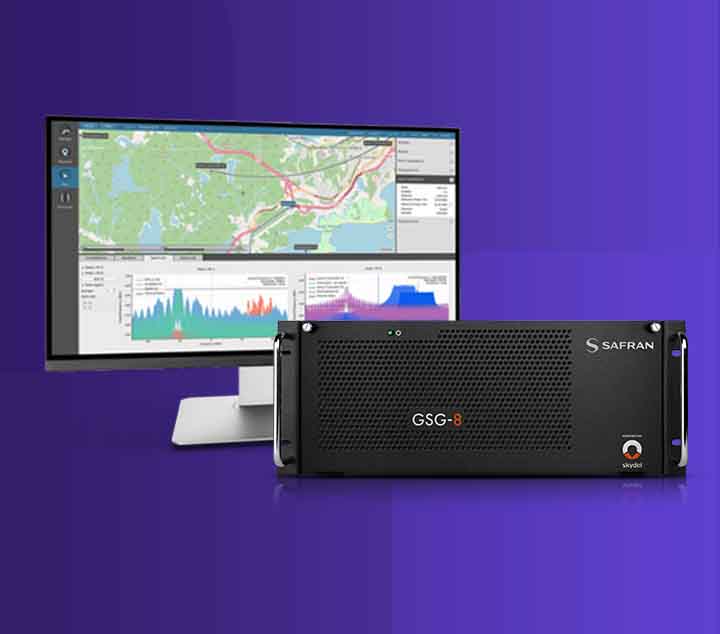
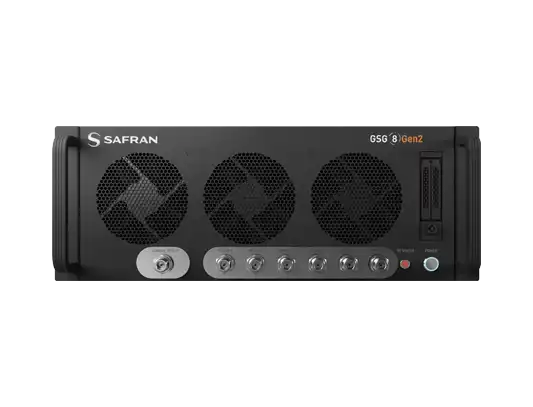
The GSG-8 Gen2 is an evolution of the GSG-8, an expert Positioning, Navigation and Timing (PNT) test solution and the latest addition to the Skydel-based simulator family. Equipped with six high-quality GNSS RF outputs and a ready-to-use merge output covering all GNSS bandwidths, the GSG-8 Gen2 offers excellent performance, supporting high simulation iteration rates up to 1000 Hz, high dynamics and real-time synchronization, as well as the ability to simulate all visible satellite signals. test and system integration projects in multi-vehicle/multi-antenna environments.
Provide automated testing that meets industry standards.
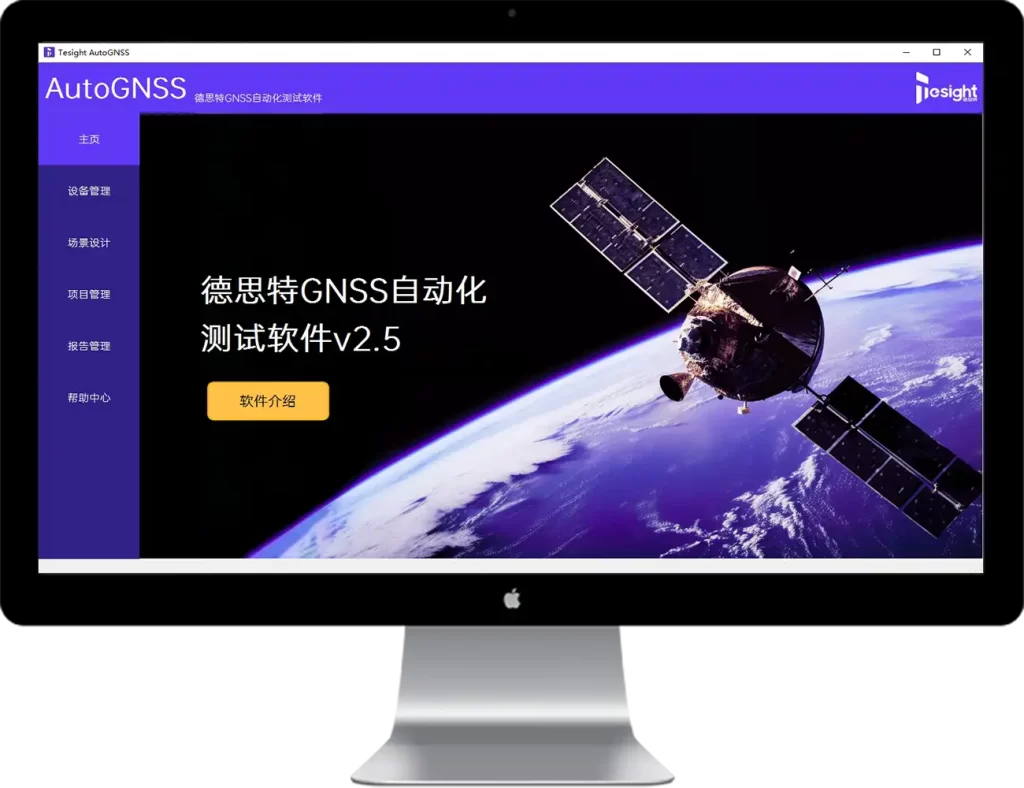
The HONGKE GNSS simulator can be flexibly selected for discrete or embedded installation in Dexter's automation standard validation tools. It provides one-click scene configuration and full-area control for the following standards, realizing standard-based validation and testing, and supporting automatic test report generation and export functions for easy archiving and documentation:
- GB/T 45086.1-2024 Technical Requirements and Test Methods for Vehicle-mounted Positioning System Part 1: Satellite Positioning
- GB/T 44088-2024 Technical Requirements and Test Methods for Measuring Module of BeiDou Satellite Navigation System
- GB/T 42427-2023 Technical Specification for the Testing of Positioning Enhancement Module for Traffic and Transportation Satellite Navigation
Main characteristics
- Supports all major constellations and frequencies worldwide
- Multi-vehicle, multi-antenna simulation
The Skydel simulation engine combines the high-end performance of a GNSS simulator with the economy and flexibility of a software-defined architecture. With a rich feature set supporting up to 1000 channels (number of simultaneous searches), 1000 Hz simulation iteration rate, remote control of user-defined scripts, and a highly scalable architecture based on software definitions, Skydel supports multiple RF channels and thousands of simulated satellite channels, and supports high-level integration and software development, providing excellent flexibility and scalability.
Main characteristics
- Automatic Antenna Mapping
- Automatic time delay calibration
- Software Definition Architecture (SDA)
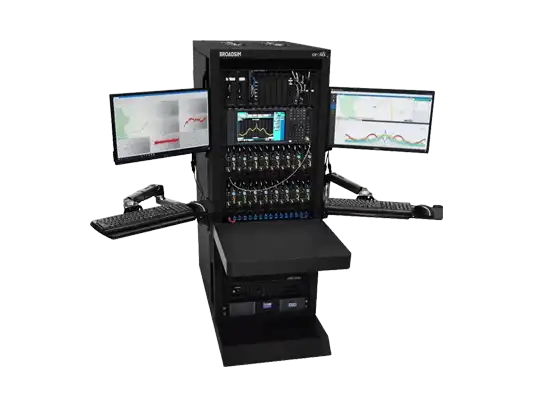
The Skydel Anechoic GNSS simulator allows users to accurately reproduce real-world GNSS environments in darkroom environments. With 32 independent RF outputs, the system can drive up to 16 dual-band antennas simultaneously. Revolutionary features such as automatic antenna mapping, automatic time delay calibration and automatic power loss calibration make the Skydel Anechoic one of the most advanced GNSS darkroom simulation systems on the market today.
GNSS Solutions Customer Group
GNSS Simulator Integrates Automotive HIL/C-V2X and Other High-End Test Solutions for Top Industry Solution and Service Providers
Professional technical support from HONGKEI to help you succeed in your project.
HONGKEI is committed to providing you with a wide range of paid technical services related to this product, designed to help you succeed in your project in the most cost-effective manner. Please contact us if you need technical services related to this product!