
Search

Hongke's latest articles

HongKe

Lorem ipsum dolor sit amet, consectetur adipiscing elit. Ut elit tellus, luctus nec ullamcorper mattis, pulvinar dapibus leo.

HONGKE SOLUTIONS] BIM-SCADA's "precious ally", realizing the integration of real and virtual worlds

The emergence of BIM (Building Information Modeling) around 2011 has brought a major breakthrough to the construction industry. Today, the technology has matured to the point where it can be applied to other areas in addition to the construction phase.

So, how do you integrate BIM into a SCADA system?

BIM - Bridging the gap between building design and building maintenance

In the past, project managers used AutoCAD to produce simple drawings, but BIM has three key features that go beyond traditional drawing design:

  • Used objects can be easily copied
  • 3D modeling instead of 2D drawings
  • Objects can be combined (e.g. doors can be embedded in walls)

The primary goal of BIM is to improve and deepen the design phase. Better design means fewer construction errors and easier maintenance. The '1-20-60 rule', as it is known in the construction industry, states that a €1 error in design can lead to an additional €20 in construction costs, and ultimately a €60 increase in maintenance costs.

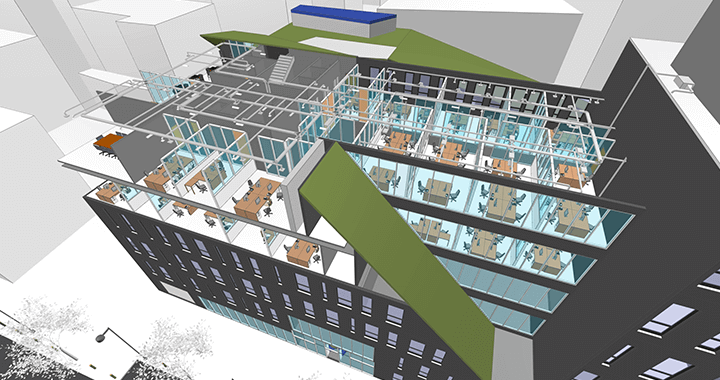
In the broadest sense, BIM is a complete description of a building. Often misunderstood as a mere 3D representation, which is a stereotype, the key to BIM is that it is a collection of all the information about a building. This information is not only useful to the project manager, but also to the operations, maintenance and integration teams.

BIM provides stakeholders with all the information needed for building equipment and operations and maintenance, ensuring a seamless transition from the construction phase to the operations and maintenance phase of the building.

BIM can integrate three types of data:

  • Static data: information describing the building (e.g., technical data sheets, floor plans, BIM models)
  • Semi-static data: actions performed by the operator (e.g., service requests)
  • Dynamic Data: Measurements of various equipment (e.g. air-conditioning) in buildings

The correlation of these data constitutes a digital symbiosis: a fusion of the physical and virtual worlds in a two-way system (where information can be retrieved and returned).

Operationally oriented BIM for building SCADA systems

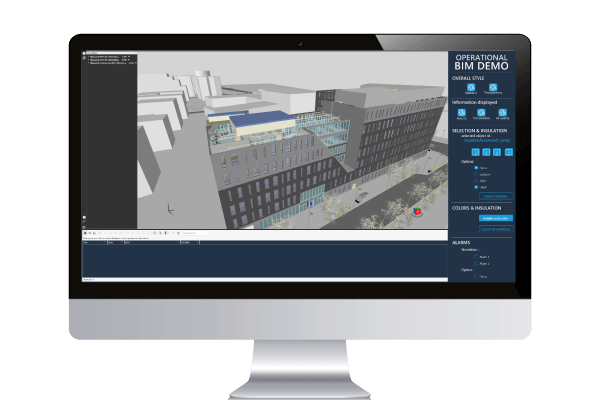
With BIM becoming a key element of SCADA, we have integrated it into our Panorama SCADA solution to make the HONGKEI Panorama SCADA system BIM-enabled for operations.

BIM building data can be imported into Panorama Studio, the integrated development environment for Panorama SCADA. This is done through relay data in IFC files (OpenBIM Common Format).Panorama Studio recognizes various building components and adds them as design "objects" (digital instances of physical objects), thus speeding up the development of applications.

3D models can be integrated into SCADA applications and animated to provide spatial context for building information, making it easier for operators to navigate and locate equipment components or related information.

Example:
When the operator receives an alarm indicating a valve failure and wishes to view it in the application:

  1. Select Alert Notification

  2. The application shows the exact position of the valve in the 3D model.

  3. Valve faults can be intervened in by the operator

BIM is a complete description of the building and therefore requires structured processing of the displayed information. The user view is essential for the accurate application of the data.

The following are examples of SCADA applications based on user roles:

  • Maintenance staff: Heating and ventilation systems, mechanical rooms, alarms
  • Director of EngineeringSpace, Zoning, Furniture, Energy Consumption, Comfort Settings, etc.
  • building and property companiesOccupied area, common area management, water, electricity and energy consumption, environmental management, monthly occupancy rate, etc. by space type.

With BIM operational capabilities, HONGKEI Panorama puts BIM at the heart of its operations and becomes a valuable "ally" in the implementation of SCADA solutions for its customers.

Other Articles

Hongke Dry Goods

[Hongke Insights] Plug the Gaps Before Deploying AI: Minimize Data Breach Risks with “Real-Time Monitoring + Access Control”​

As generative AI and AI agents are widely adopted in enterprises, behaviors such as prompt injection, over-agency, and unintentional data leaks by employees continue to amplify data leakage and compliance risks, creating an urgent need for proactive security solutions. This article leverages the Lepide Data Security Platform to build a comprehensive protection system centered on “pre-deployment governance + in-operation monitoring.” Through real-time sensitive data monitoring, fine-grained permission controls, end-to-end auditing, and automated incident response capabilities, it can integrate with SIEM and SOAR systems to form a closed-loop risk management system. The platform automatically consolidates excessive permissions, and abnormal behavior triggers rapid response measures such as account freezing and system isolation. This addresses the challenges of excessive AI permissions and confidential data leaks while meeting compliance requirements under regulations such as GDPR, thereby establishing a robust data security defense for enterprises implementing AI.

Read more
Hongke Dynamic

[Hongke Solutions] From Passive Defense to Proactive Prevention: Easily Handle Annual Risk Assessments and Security Audits with KnowBe4

Hong Kong’s “Protection of Critical Infrastructure (Computer Systems) Ordinance” requires companies to conduct annual cybersecurity risk assessments and complete independent audits every two years. However, most companies focus solely on technical vulnerabilities while overlooking human-related risks, which account for 80 percent of cybersecurity incidents. KnowBe4 quantifies employee risk through simulated phishing tests, establishes a dynamic risk scoring mechanism, comprehensively retains data on testing, training, and improvements, and enables one-click export of regulatory-grade reports, helping enterprises implement continuous risk management and easily navigate annual assessments and security audits.

Read more
Hongke Dynamic

[Hongke News] Why Rule-Intensive Businesses Are Better Suited for Low-Code: Making Decision Logic “Configurable” Instead of “Hard-Coded”

Many rule-intensive enterprises often face challenges during digital transformation, such as business rules being tightly coupled with underlying code, cumbersome tuning processes, and difficulties in unifying logic across systems. Low-code solutions can transform decision logic into visual configurations, shortening rule iteration cycles and clarifying the division of responsibilities between business and IT. The Decisions platform integrates a low-code environment with a rules engine to independently build a shared decision-making layer. It supports drag-and-drop rule management and cross-system integration and invocation, balancing operational flexibility with IT governance and regulatory requirements.

Read more

Contact Hongke to help you solve your problems.

Let's have a chat