Search

Hongke's latest articles

HongKe

Lorem ipsum dolor sit amet, consectetur adipiscing elit. Ut elit tellus, luctus nec ullamcorper mattis, pulvinar dapibus leo.

HONGKE SOLUTIONS] BIM-SCADA's "precious ally", realizing the integration of real and virtual worlds

The emergence of BIM (Building Information Modeling) around 2011 has brought a major breakthrough to the construction industry. Today, the technology has matured to the point where it can be applied to other areas in addition to the construction phase.

So, how do you integrate BIM into a SCADA system?

BIM - Bridging the gap between building design and building maintenance

In the past, project managers used AutoCAD to produce simple drawings, but BIM has three key features that go beyond traditional drawing design:

  • Used objects can be easily copied
  • 3D modeling instead of 2D drawings
  • Objects can be combined (e.g. doors can be embedded in walls)

The primary goal of BIM is to improve and deepen the design phase. Better design means fewer construction errors and easier maintenance. The '1-20-60 rule', as it is known in the construction industry, states that a €1 error in design can lead to an additional €20 in construction costs, and ultimately a €60 increase in maintenance costs.

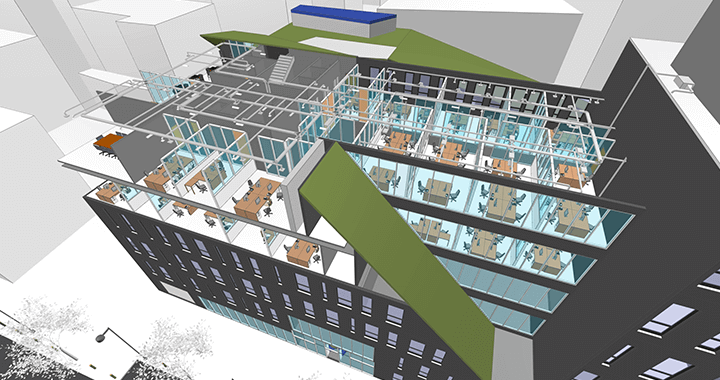
In the broadest sense, BIM is a complete description of a building. Often misunderstood as a mere 3D representation, which is a stereotype, the key to BIM is that it is a collection of all the information about a building. This information is not only useful to the project manager, but also to the operations, maintenance and integration teams.

BIM provides stakeholders with all the information needed for building equipment and operations and maintenance, ensuring a seamless transition from the construction phase to the operations and maintenance phase of the building.

BIM can integrate three types of data:

  • Static data: information describing the building (e.g., technical data sheets, floor plans, BIM models)
  • Semi-static data: actions performed by the operator (e.g., service requests)
  • Dynamic Data: Measurements of various equipment (e.g. air-conditioning) in buildings

The correlation of these data constitutes a digital symbiosis: a fusion of the physical and virtual worlds in a two-way system (where information can be retrieved and returned).

Operationally oriented BIM for building SCADA systems

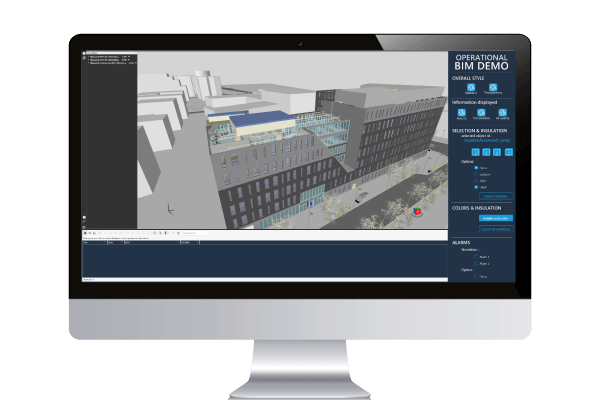
With BIM becoming a key element of SCADA, we have integrated it into our Panorama SCADA solution to make the HONGKEI Panorama SCADA system BIM-enabled for operations.

BIM building data can be imported into Panorama Studio, the integrated development environment for Panorama SCADA. This is done through relay data in IFC files (OpenBIM Common Format).Panorama Studio recognizes various building components and adds them as design "objects" (digital instances of physical objects), thus speeding up the development of applications.

3D models can be integrated into SCADA applications and animated to provide spatial context for building information, making it easier for operators to navigate and locate equipment components or related information.

Example:
When the operator receives an alarm indicating a valve failure and wishes to view it in the application:

  1. Select Alert Notification

  2. The application shows the exact position of the valve in the 3D model.

  3. Valve faults can be intervened in by the operator

BIM is a complete description of the building and therefore requires structured processing of the displayed information. The user view is essential for the accurate application of the data.

The following are examples of SCADA applications based on user roles:

  • Maintenance staff: Heating and ventilation systems, mechanical rooms, alarms
  • Director of EngineeringSpace, Zoning, Furniture, Energy Consumption, Comfort Settings, etc.
  • building and property companiesOccupied area, common area management, water, electricity and energy consumption, environmental management, monthly occupancy rate, etc. by space type.

With BIM operational capabilities, HONGKEI Panorama puts BIM at the heart of its operations and becomes a valuable "ally" in the implementation of SCADA solutions for its customers.

Other Articles

Hongke Case

How Redis Enterprise Helps Hong Kong's Critical Infrastructure Compliance? Single-Second Failover Achieves Zero-Disruption Core Functionality Assurance

With the implementation of the Hong Kong Protection of Critical Infrastructure (Computer Systems) Ordinance, which makes core functionality continuity and recovery time objectives (RTOs) a statutory obligation, Redis Enterprise approaches zero recovery time and recovery point objectives with its 99.999% highly available architecture, single-second automatic failover, and Active-Active multi-activity technology. With millisecond latency under high load, Redis Enterprise helps the financial, telecommunications, and energy industries achieve true zero-disruption data compliance.

Read more
Hongke Case

Hongke Solutions] Enterprise Mail Security from Crunchbase Leakage: How to Prevent Misdelivery and Sensitive Data Exfiltration?

In early 2026, Crunchbase confirmed a major data breach, proving once again that a single successful phishing attempt can result in hundreds of megabytes of file exfiltration. In addition to external attacks, organizations often overlook the risks of "misdirected mail" and internal outbound communications. This article analyzes the trend of phishing industry, compliance pressure (e.g., HIPAA, GDPR, GLBA), and provides a three-pronged protection strategy of integrated DLP, behavioral AI, and email encryption, which can help enterprises to stop the risk immediately before the data is sent.

Read more
Hongke Case

HONGKE Solutions] HONGKE ArangoDB Graph Database - The Power of Graph Data: Financial Anti-fraud from Rule Gaming to Relationship Insight

ArangoDB plays a key role in the financial anti-fraud space, helping organizations move from traditional rule-based approaches to deep relationship insights. In the face of increasingly complex and insidious fraud networks, traditional risk control systems have been overwhelmed by the lack of a global perspective, lagging rule updates, and challenges in cross-system integration, ArangoDB, through its unique native multi-model (graphs, files, vectors) capabilities, integrates fragmented customer information, transaction behavior, and device fingerprints to achieve an integrated analysis of "Relationships + Behavior + Patterns Identification". This not only significantly improves the speed and accuracy of fraud identification, reduces decision-making delays and maintenance costs, but also empowers financial institutions with the ability to proactively prevent and comprehensively understand risks, opening a new chapter in financial anti-fraud.

Read more

Contact Hongke to help you solve your problems.

Let's have a chat