Hongke Case
【虹科方案】從 Crunchbase 外洩事件看企業郵件安全:如何防止誤寄與敏感資料外流?
2026 年初 Crunchbase 證實發生重大資料外洩,再次證明一次成功釣魚即可引爆數百 MB 檔案外流。除了外部攻擊,企業更常忽略「郵件誤寄」與內部外傳風險。本文解析釣魚產業化趨勢、合規壓力(如 HIPAA、GDPR、GLBA),並提供整合式 DLP、行為式 AI 與郵件加密的三位一體防護策略,協助企業在資料寄出前即時攔截風險。

 EN
ENLorem ipsum dolor sit amet, consectetur adipiscing elit. Ut elit tellus, luctus nec ullamcorper mattis, pulvinar dapibus leo.
With the rapid development of Software-Defined Vehicles (SDV) and centralized E/E Architecture, traditional CAN buses can no longer support the increasing volume of data and real-time control requirements.
Leveraging our deep experience in automotive network communication, embedded systems and FPGA technology, we have proposed a new technology based on CAN XL × TSN (Time-Sensitive Networking) It is a total solution that enables vehicle manufacturers and Tier-1 suppliers to build efficient, reliable and scalable in-vehicle communication networks of the future.
CAN XL (Controller Area Network eXtended Layer) is the third-generation protocol for CAN networks, combining the three core advantages of "low cost," "high stability," and "strong compatibility," and realizing a cross-generation performance leap through the new design of the physical and protocol layers.
Its main technical features include:
Ultra-high-speed transmission capability: Data rate up to 1-20 Mbit/s (arbitration domain ≤1 Mbit/s, data domain 1-20 Mbit/s)
Data length extension: Supports 1-2048 Byte, far exceeding CAN FD's 64 Byte limit.
Virtual CAN Network (VCID): Supports up to 256 logical virtual networks for greater isolation and flexibility
Multi-Protocol Compatibility: New SDT (Service Data Unit Type) field for interoperability with protocols such as Ethernet.
Hao Chen, Head of Technology at Rainbow Technology, pointed out that CAN XL is a new technology in the ADAS and in-vehicle radar systems This is a significant advantage in the current 2M CAN FD architecture. In the current 2M CAN FD architecture, for example, radar data needs to be split into multiple frames and re-synchronized by the ADAS controller, whereas CAN XL can utilize Single frame 2K payload Transmits all object data at once, dramatically improving synchronization and real-time performance.
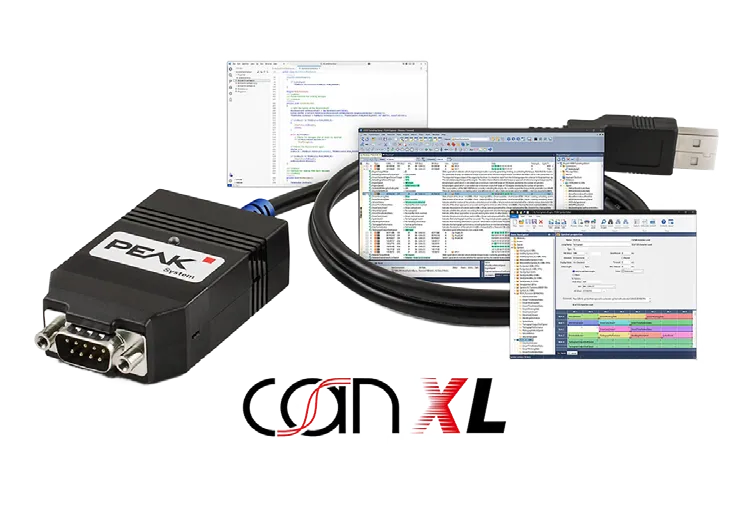
In order to help the industry to experience this new standard quickly, HONGKE launched the PCAN XL KitThe content:
USB-to-CAN XL Interface Module
Professional CAN Analysis Software PCAN-Explorer 7
PCAN-Basic SDK programming interface
The kit fully supports CAN CC / FD / XL communications and implements the core functionality of the CAN XL protocol in an FPGA, providing a complete environment for development, test and verification.
As the electrification and intelligence of automobiles increase, the E/E architecture is moving from the traditional decentralized ECU to the "domain controller" and "central computing" forms. In this process, vehicle communication faces five major challenges:
Explosive growth in arithmetic demand
Slow hardware iteration
Fragmentation of communication interfaces and protocols
Increased real-time and functional safety requirements
Cost and Flexibility Contradictions Highlighted
Mr. Law Hin-chi, Senior TSN Engineer of HTC, pointed out thatFPGAs are the "software" of hardware.The three characteristics of "parallel processing", "low latency" and "reconfigurability" can precisely meet the above challenges.
Unlike CPU/GPU time-sharing, FPGAs use space-sharing, where each task is executed simultaneously by independent circuits, realizing true hardware-level certainty.
The FPGA-based TSN (Time Sensitive Networking) solution brings three core values to the automotive E/E architecture:
Breaking the performance bottleneck: Hardware latency in microseconds for ultra-low jitter communication
Unified Communications Architecture: Single chip replaces multiple discrete controllers, supports any-to-any protocol conversion
Upgrade for the future: Adaptation of new standards through OTA reorganization to perfectly match software-defined vehicle requirements
The complete range of FPGA TSN solutions from SOC-E / RelyUm Series TSN IP Cores and Boards,TSN Switches until (a time) Test and Verification Kits The product supports 10M / 100M / 1G / 2.5G multi-rate. The product supports 10M / 100M / 1G / 2.5G multi-rate, and built-in IEEE 802.1AS time synchronization, 802.1Qbv time-aware shaping, and other key TSN standards, which makes it easy to build a highly reliable and accurate in-vehicle network.

CAN XL and TSN are not in competition, but complement each other and work together. The former provides high bandwidth and low cost for low and medium-speed control layers, while the latter provides certainty and high reliability for high-speed backbone networks. In the Central + Zonal Architecture, the combination of the two is driving the automotive industry towards a more efficient and reliable network. Software-Defined Mobility A New Era.
As the automotive E/E architecture evolves from distributed ECUs to domain control, and then to a "centralized computing + domain control" system, the deep convergence of CAN XL and TSN will become a key force in the evolution of in-vehicle networks, laying the foundation for in-vehicle communication, safety and sustainable innovation.
2026 年初 Crunchbase 證實發生重大資料外洩,再次證明一次成功釣魚即可引爆數百 MB 檔案外流。除了外部攻擊,企業更常忽略「郵件誤寄」與內部外傳風險。本文解析釣魚產業化趨勢、合規壓力(如 HIPAA、GDPR、GLBA),並提供整合式 DLP、行為式 AI 與郵件加密的三位一體防護策略,協助企業在資料寄出前即時攔截風險。
ArangoDB plays a key role in the financial anti-fraud space, helping organizations move from traditional rule-based approaches to deep relationship insights. In the face of increasingly complex and insidious fraud networks, traditional risk control systems have been overwhelmed by the lack of a global perspective, lagging rule updates, and challenges in cross-system integration, ArangoDB, through its unique native multi-model (graphs, files, vectors) capabilities, integrates fragmented customer information, transaction behavior, and device fingerprints to achieve an integrated analysis of "Relationships + Behavior + Patterns Identification". This not only significantly improves the speed and accuracy of fraud identification, reduces decision-making delays and maintenance costs, but also empowers financial institutions with the ability to proactively prevent and comprehensively understand risks, opening a new chapter in financial anti-fraud.
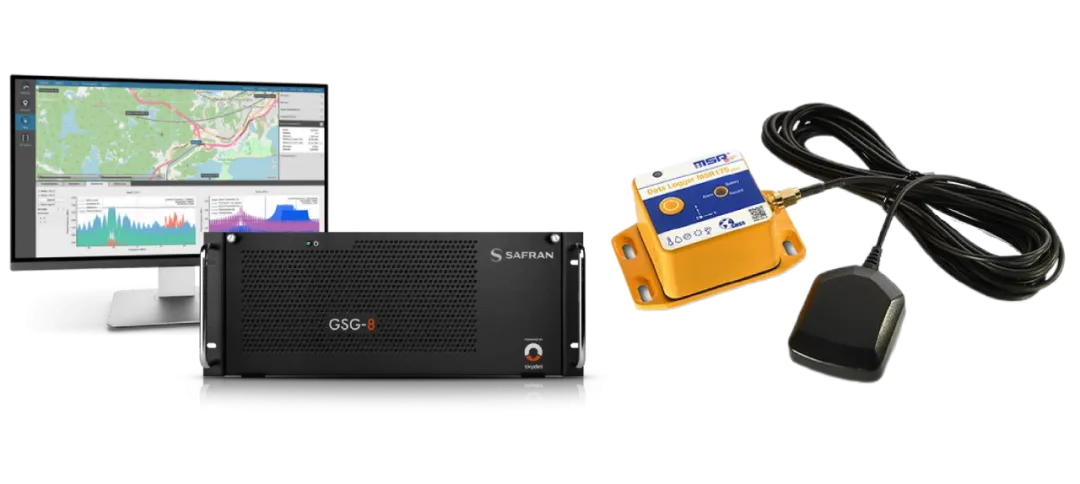
虹科 GNSS 模擬器協助 HK-MSR175Plus 運輸數據記錄儀完成定位精準度與抗干擾測試,提升物流運輸監測效率,支援全球路徑模擬與異常情境驗證。