Search

Hongke's latest articles

HongKe

Add your title text here

I. Introduction: Strategic Changes at the Data Layer under the Critical Infrastructure Legislation

Hongke Solutions] Enterprise Mail Security from Crunchbase Leakage: How to Prevent Misdelivery and Sensitive Data Exfiltration?

In late January 2026, Crunchbase, a leading market intelligence firm, confirmed a major data breach. The incident was traced back to a sophisticated social engineering attack on Google, Microsoft and Okta environments in December 2025; the attackers used customized phishing toolkits and voice phishing to compromise corporate networks. After unsuccessful extortion attempts, a criminal group called ShinyHunters publicly released hundreds of megabytes of zip files containing large amounts of personally identifiable information (PII), contracts, and other sensitive corporate data. This incident is yet another expensive reminder that a single successful phishing attempt is enough to ignite the fuse for a large-scale breach.
 
And this is not just one case. As the global information security situation continues to heat up, phishing attacks are becoming "industrialized and service-oriented," and even borrowing the trusted domains of legitimate platforms such as Vercel as a cover to make the letters look even more like the real thing. What's more, government agencies in many countries have warned that personal information flowing out of large-scale leaks will be used by criminals for the next round of more sophisticated phishing and fraud, creating a vicious cycle.
 
While organizations struggle to prevent external threats, another equally critical, yet often underestimated, breach is growing: the leakage of sensitive data through the "outbound" use of email.
 
Every day, employees send thousands of e-mails containing confidential information - patient information, financial statements, legal documents, personal information (PII), etc. Almost every day, emails are misdirected due to wrong recipients, misplaced attachments, and wrong address autocompletion.
 
For organizations, misdirected mail is more than just embarrassing. It can lead to compliance violations, regulatory audits, and reputational crises. For highly regulated industries such as healthcare, finance, legal, and insurance, a misdirected letter can lead to investigations, fines, lawsuits, and even outright loss of customer trust.

The risk of misdirected mail is rising at an accelerated rate.

Email is still the main channel for business communication and sensitive data transfer; the problem is that human error has long been a major cause of data leakage, especially in the mail context. 
 
According to the Personnel Risk Profile Report 2025: A New Paradigm for Keeping People Safe in the Age of AI (mentioned in the original article), email is the number one risk channel in the case of non-malicious, unintentional mistakes by employees. Nearly half (49%) of information security executives said they had experienced security incidents caused by misdirected emails. At the same time, regulatory enforcement is getting tougher: privacy regulations such as HIPAA, GDPR, GLBA, and data protection requirements around the world are setting higher standards for sensitive data protection and designing progressively heavier penalties for non-compliance (including leakage due to misdirected mail).
 
Mailing errors are common and costly. Auto-insertion errors, misspelled addresses, wrong attachments, or just plain old busy work continue to create data exposure risks on a daily basis. When protected health information (PHI), PII, or trade secrets are involved, the consequences can be severe.
 
In addition, internal risks are on the rise: disgruntled employees, departing employees taking proprietary information with them, or malicious insiders sending out information via email are often difficult to stop immediately with traditional controls.
 
More realistically, the boundaries of compliance are expanding. New regulations and an expanded definition of protected data mean that more information is being regulated and companies must be able to "prove" that they are proactively preventing unauthorized disclosure.

Risk Impact: If it happens, it will affect the whole business.

Once sensitive data leaves an organization due to misdirection, the impact can quickly spread: regulatory sanctions, legal liabilities, mandatory notification obligations, loss of competitive advantage, damage to professional relationships, and disruption of operations due to incident response.
 
In the case of a medical organization, for example, the misdirection of patient data may trigger a HIPAA notification; a law firm's accidental disclosure of privileged information may trigger professional negligence claims; and a financial institution's leakage of its clients' financial information often steps on multiple regulatory frameworks at once and shakes the foundation of trust.

Third, the establishment of a full range of protection: technology + staff + process is indispensable

A multi-layered and integrated strategy is required to effectively address such risks.
 
First, it is critical to implement intelligent Data Leakage Protection (DLP). Behavioral AI-based solutions learn each employee's normal communication patterns and, in conjunction with corporate mail policies, instantly detect anomalies such as wrong recipient typos, unusual attachments, first-time contact with an external recipient, and inconsistent recipients and callouts. This technology intercepts misdirected mail before risk occurs, blocks suspicious outbound traffic, alerts on mail sent to newly registered domains or known threat domains, and supports customizable sensitive word rules and "ethical wall" settings to meet corporate internal control and compliance needs.
 
Second, technology must be paired with continuous employee education. No amount of advanced controls can eliminate data loss through systems alone; regular security awareness training helps employees identify what data needs to be protected, establish proper secure mailing habits, and cover company policies, compliance requirements, and best practices through contextualized exercises.
 
Third, process and operational efficiency are equally important. Security teams need clear, centralized management consoles and in-depth analytical reports to target high-risk users, identify compliance gaps, and adjust policies. At the same time, solutions should minimize disruption to employees' work by providing immediate, accurate alerts only when errors or breaches are "imminent," so that security and efficiency can be established at the same time.

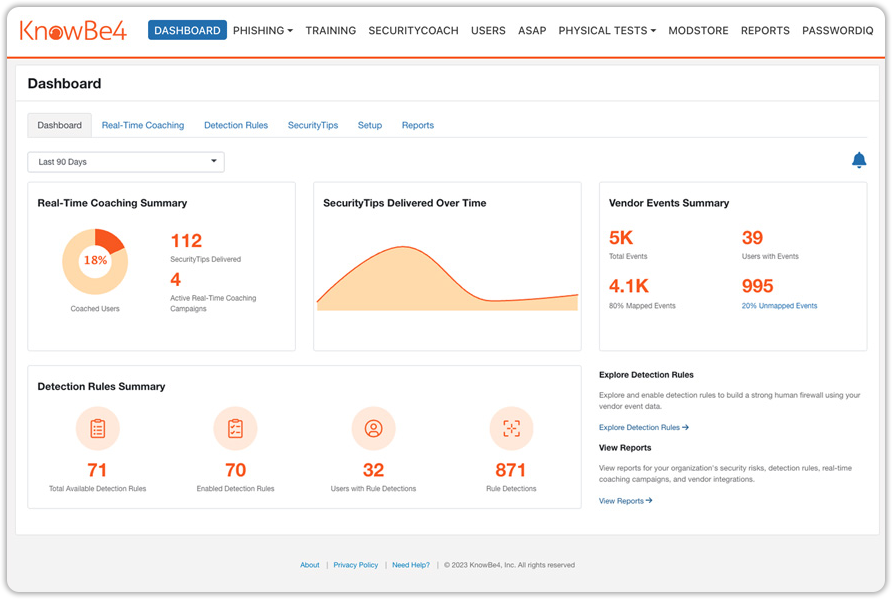
KnowBe4 Cloud Mail Security Suite: Three-in-One Protection

Facing the two-way threat of "external attack and intrusion" and "internal data leakage", fragmented tools often leave gaps. A complete cloud mail security program should cover inbound threats, outbound leakage and secure transmission.

3.1 Defend: Intercepts high-level threats before they enter the inbox.

The module focuses on blocking all types of inbound attacks. A behavioral AI engine analyzes headers, content, links and attachments to accurately identify complex phishing, BEC and ransomware that traditional mail gateways may miss. Combined with real-time URL analysis, attachment sandboxing, and sender reputation assessment, it reduces the chances of employee fraud at the source.

3.2 Prevent: Intelligent Outbound Protection + Data Leakage Protection (DLP)

This is the core of preventing "internal leakage". Instead of just doing keyword comparisons, it uses behavioral AI to learn employees' normal mailing patterns (e.g., common recipients, delivery times, language styles and data types). When significant deviations from the baseline are detected-such as first-time mailings to external addresses with sensitive attachments, name discrepancies with recipients (which can be misdirected), or bulk mailings to private mailboxes-the system pops up an alert right before sending, giving employees a chance to fix it on the spot. It also works with information systems such as Microsoft Purview. It can also be integrated with information protection platforms such as Microsoft Purview for more precise control with sensitivity labels.

3.3 Protect: Seamless Mail Encryption

For sensitive information that must be sent externally, strong and usable encryption is a compliance essential. The module can automatically encrypt or allow users to manually trigger based on default policies, such as the inclusion of certain keywords, financial information or PII. Recipients often have secure access without the need to install additional software or create complex accounts, and the overall experience remains within the familiar mail interface, reducing the risk of employees switching to insecure alternatives due to process hassles and ensuring confidentiality of transmissions.

Integrating Protection: Covering the Full Lifecycle of Mail Security

Modern mail security must deal with both inbound and outbound risks: on one hand, defend against inbound threats such as complex phishing and BEC to prevent attacks from reaching end-users; on the other hand, intercept sensitive data leakage caused by misdirected mail or malicious transmissions. The integration of these two components reduces overall risk by covering the entire threat chain and avoids the complexity of managing multiple, isolated tools.
 
True security comes from the collaboration of "human defense" and "technological defense": using intelligent controls to keep an eye on critical moments, and continuous employee risk management and education, so that every employee can be the first line of defense in protecting data. Because the best time to stop data leakage is always before it happens.

Other Articles

Hongke Dry Goods

Rainbow Solutions] 2026 Procurement Committee Must-Have: Hong Kong Bank Redis Procurement Checklist (Open Source vs Enterprise Decision Framework)

The HKMA has repeatedly emphasized risk-based and principle-driven requirements in recent years, and has brought the risk of third-party IT solutions to the forefront, meaning that it's fine to turn on Maintenance or Redis Enterprise, but you have to prove that the "controls work" rather than that the "tool is famous".

Read more
Hongke Dry Goods

Hongke AutoGNSS: How to cross the technical barrier of GNSS complex scene through automated testing?

With the tightening of in-vehicle terminals and intelligent transportation standards (e.g. GB/T 45086), it is difficult to cope with manual testing. HONGKE experts deeply analyze how AutoGNSS automated test platform can realize full chain traceability and data traceability, speeding up the whole cycle of research and development by 4-5 times, and completely eliminating the technological threshold of complex GNSS simulation tests!

Read more
Hongke Case

Hongke Solutions] Process ≠ Decision: The Most Often Ignored Technical Divide in Enterprise Digital Transformation Architecture

Process management is the foundation of enterprise digital transformation, but the technical positioning of process systems determines that they are incapable of undertaking complex decision-making functions. Embedding decision logic into processes not only leads to system bloat and maintenance difficulties, but also limits the extensibility of an enterprise's digital architecture.Decisions provides a practical solution to decouple processes and decisions through a standardized technical architecture, flexible rules management capabilities and seamless integration, helping enterprises create a simple, efficient and scalable digital architecture.

Read more

Contact Hongke to help you solve your problems.

Let's have a chat