| set up |
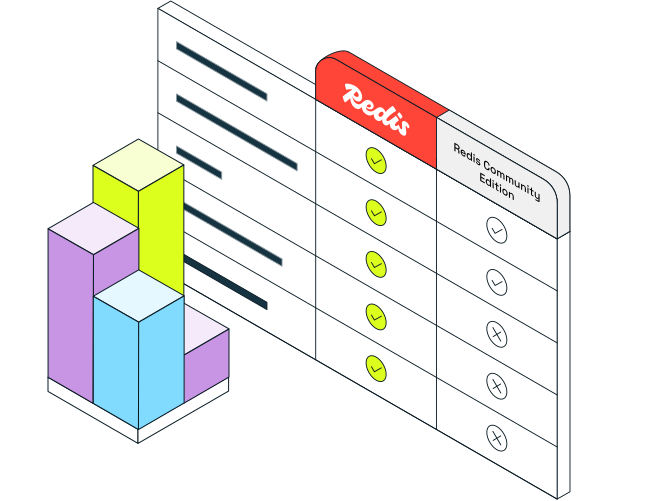
| Enhance Application Performance as Cache |
√ |
× |
| Complete persistence and durability |
√ |
× |
| Advanced Session Management with Hash Field Expiration (HFE) |
√ |
× |
| Auto Retrieve and Change Data Retrieval (CDC) source databases (including Oracle, PostgreSQL, MySQL, etc.) |
√ |
- |
| Build real-time applications to support scalable advanced queries and searches |
√ |
× |
| Built-in JSON support, no need for serialization or external processing |
√ |
× |
| Built-in time series support for efficient storage and querying of timestamped data |
√ |
× |
| Probabilistic data structures (e.g., Bloom, top-k, t-digest) for memory-efficient approximation algorithms |
√ |
× |
| Rapid development with off-the-shelf object mapping libraries supporting frameworks such as Spring, ASP.NET Core, FastAPI, and Express. |
√ |
- |
| End-to-end client support, including language-specific Redis client libraries such as Jedis, Lettuce, redis-py, redisVL, NRedisStack, node-redis, and go-redis. |
√ |
× |
| Redis Insight user interface with tutorials, collaboration tools and query builder |
√ |
× |
| deployments |
| Full support for local deployment, cloud or hybrid environments |
√ |
- |
| Automated deployment in any cloud or multi-cloud environment |
√ |
- |
| Expanding Memory Capacity with SSD Storage via Redis Flex |
√ |
- |
| Execution |
| Convert slow data to real-time data by retrieving data from external databases in real-time using Redis data integration |
√ |
- |
| Provide a consistent global real-time customer experience through geographically distributed data storage |
√ |
- |
| Automated database and cluster management (expansion, resharding, rebalancing) |
√ |
- |
| Built-in High Availability and Disaster Recovery Management |
√ |
- |
| Enterprise Customer Support from Redis Experts |
√ |
- |
| security |
| Access Control Lists (ACLs) and Role-Based Access Control (RBAC) for Data Access |
√ |
× |
| Role-Based Access Control (RBAC) for control plane |
√ |
- |
| Centrally managed RBAC |
√ |
- |
| Connectivity and Validation Audit |
√ |
- |
| LDAP integration for identity management and role assignment |
√ |
- |
| Support HashiCorp Vault |
√ |
- |

 EN
EN