
Search

Hongke's latest articles

HongKe

Lorem ipsum dolor sit amet, consectetur adipiscing elit. Ut elit tellus, luctus nec ullamcorper mattis, pulvinar dapibus leo.

Lorem ipsum dolor sit amet, consectetur adipiscing elit. Ut elit tellus, luctus nec ullamcorper mattis, pulvinar dapibus leo.

[Hongke Case Details] 2015 Mercedes-Benz E260L: Engine Won't Start

A 2015 Mercedes-Benz E260L is experiencing an issue where the engine won't start. Communication error codes are stored in multiple control modules. How can the cause of the CAN bus fault be accurately pinpointed?

01 | Symptoms of the Malfunction

A 2015 Mercedes-Benz E260L won’t start. Communication fault codes are stored in multiple control modules. How can we pinpoint the cause of the bus fault?

02 | Troubleshooting

After picking up the vehicle, a test drive was conducted. When the ignition switch was turned on, several warning lights on the instrument cluster remained illuminated; upon attempting to start the engine, the starter motor did not engage. Using an automotive diagnostic scanner, it was discovered that multiple control modules contained fault codes indicating communication failures (missing data) with the engine control module, transmission control module, and steering column control module, Additionally, the central gateway module contained multiple fault codes indicating communication failures on the Chassis Controller Area Network (CAN E) bus—including bus shutdown, short to ground, and short to positive—leading to the conclusion that the vehicle’s CAN E bus communication had failed.

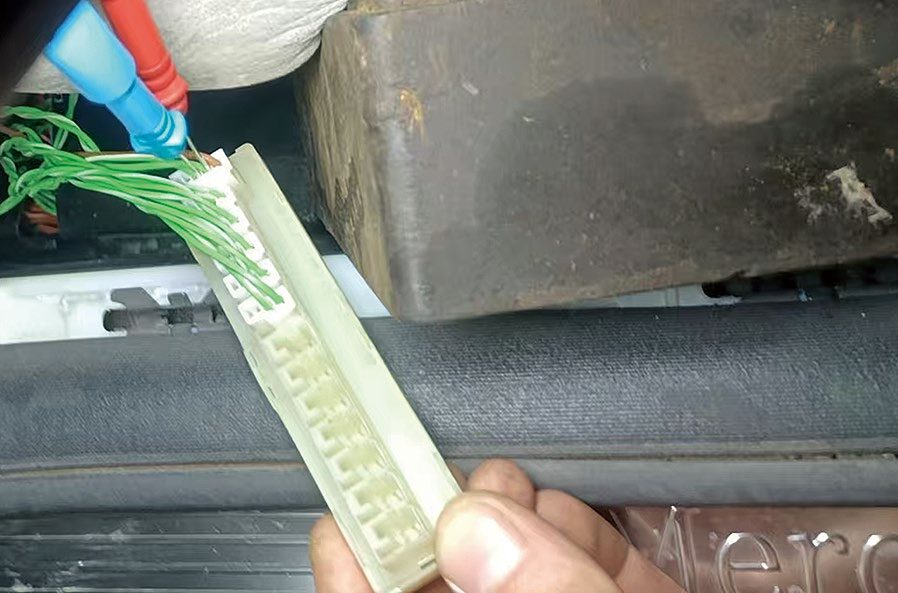
Locate the CAN E bus voltage distributor X30/30 at the left front door sill (Fig. 1). It has a total of 7 wire connectors, numbered sequentially from 1 to 7; the connector with 3 wires is connector No. 1.

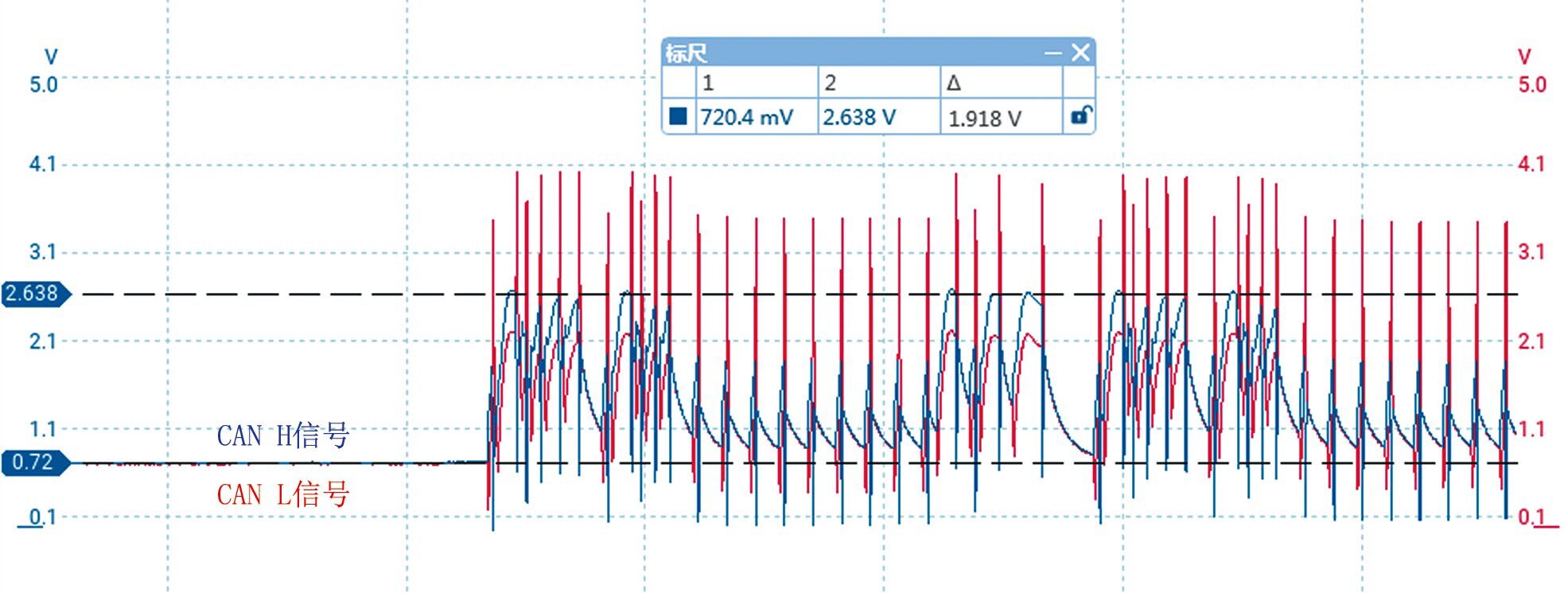
Using the Hongke Pico automotive oscilloscope to measure the CAN E bus signal waveform at connector No. 1 (Figure 2), we found that the signal waveform was noisy, with the CAN H and CAN L signals essentially overlapping. The latent voltage was approximately 0.7 V, which is too low (the normal value is approximately 2.5 V). This led to the suspicion that the CAN L and CAN H circuits were shorted to ground (with resistance).

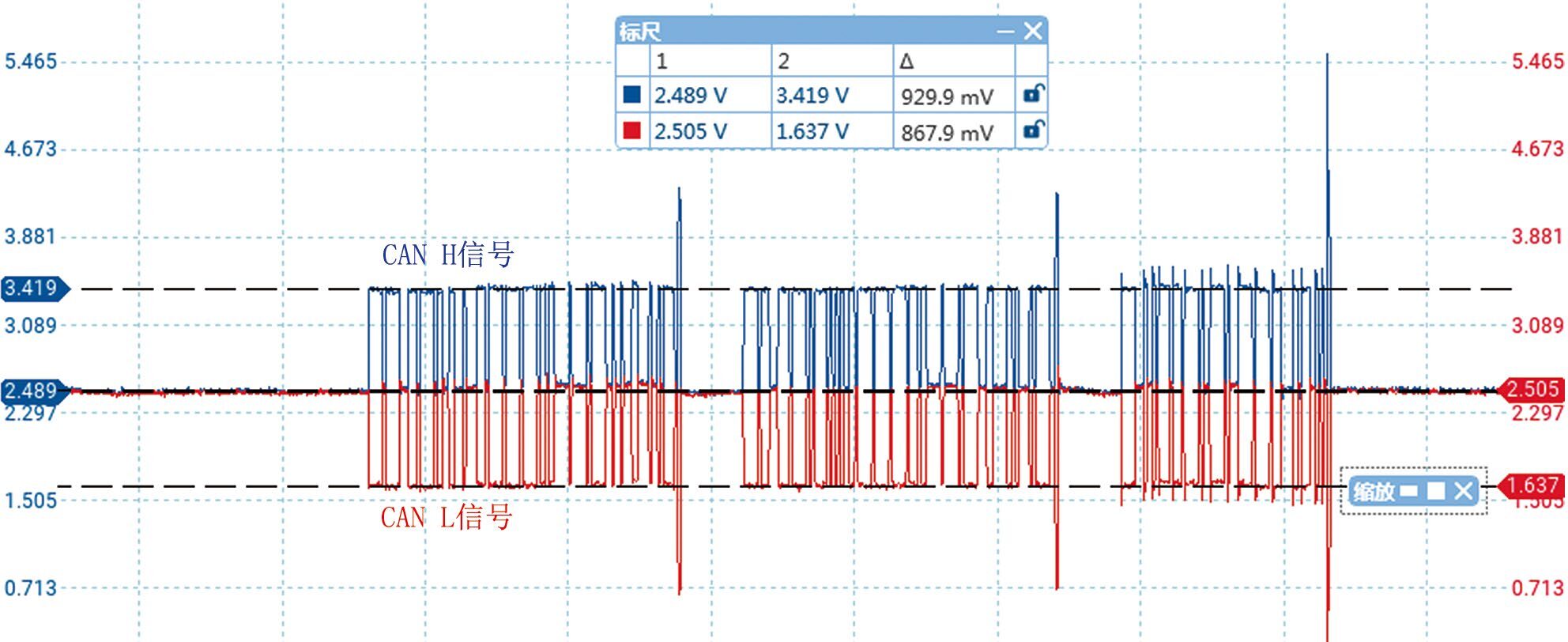
Disconnect the wire connectors numbered 2 through 7 in sequence; when the connector numbered 7 is disconnected, the CAN E bus signal waveform returns to normal (Figure 3), The CAN H signal and the CAN L signal are mirror images of each other. The low-level voltage of both the CAN H and CAN L signals is approximately 2.5 V, while the high-level voltage of the CAN H signal is approximately 3.4 V and that of the CAN L signal is approximately 1.6 V.

A review of the circuit diagram revealed that connector No. 7 is connected to the collision avoidance assist control module (A90). The A90 was located in the front bumper, and an inspection revealed that a large amount of water had drained out of it, indicating that water had entered the A90.

03 | Troubleshooting

After replacing the A90, we conducted repeated test runs, and the engine started and ran normally again, resolving the issue.

Other Articles

Hongke Case

[Hongke Solutions] Safety Solution for Long-Distance Ocean Transport of Lithium Batteries – Shengweino International Case Study

How Can Thermal Runaway and Impact Damage Be Prevented During Long-Distance Ocean Transport of Lithium-Ion Batteries? Shengweino International uses Hongke’s ASPION G-Log 2 shock recorder to precisely monitor container impacts (G-forces) and changes in temperature and humidity throughout the entire journey, creating a comprehensive transport environment history and improving the efficiency of logistics claims processing and quality tracking. Learn more about our B2B lithium-ion battery ocean freight safety monitoring solutions now!

Read more
Hongke Dry Goods

[Hongke Solutions] Cybersecurity Training for Hong Kong’s Financial Industry: From Compliance Records to Human-Factor Risk Management

Cybersecurity Training Solutions for Hong Kong Financial Institutions (Banks, Securities Firms, and Insurance Companies). Designed to meet the compliance requirements of the Hong Kong Monetary Authority (HKMA) and the Securities and Futures Commission (SFC), these solutions help prevent Business Email Compromise (BEC), OTP phishing, and deepfake attacks. Utilizing KnowBe4’s automated simulation exercises, this solution establishes a human-factor risk management mechanism with a complete audit trail.

Read more
Hongke Case

[Hongke Applications] Hongke IDS Multi-Camera Imaging Solution – Overcoming the Challenge of Precise 3D Observation of High-Speed Dynamic Plasma

Hongke, in collaboration with IDS, offers a multi-camera synchronized imaging solution featuring microsecond-level ultra-short exposure and back-illuminated global shutter CMOS sensors, successfully overcoming bottlenecks in high-speed, microscale plasma 3D point cloud reconstruction and dynamic observation. Learn more about Hongke’s industrial machine vision solutions today!

Read more

Contact Hongke to help you solve your problems.

Let's have a chat