
Search

Hongke's latest articles

HongKe

Add your title text here

I. Introduction: Strategic Changes at the Data Layer under the Critical Infrastructure Legislation

Add your title text here

[Hongke Solutions] Say Goodbye to Expensive Manual Annotation! aiData 4D Automatic Annotation Technology Enables a Closed-Loop ADAS Data System

What Is the “Automation Transformation” in High-Precision ADAS Annotation, and What Are the Bottlenecks of Traditional Manual Methods?

In Advanced Driver Assistance Systems (ADAS) and in the field of autonomous driving (AD), high-quality annotated data is the cornerstone of iterative development of perception and localization algorithms.. However, the traditional model, which relies on manual annotation, faces a serious bottleneck: companies spend as much as several million dollars annually on manual annotation, and the data processing cycle typically lasts several weeks or even months...which has significantly slowed down the validation and release process for the new algorithmThe

To break free from this cycle of production capacity and costs, led by aiMotive Research and Development,HOSCO Imported aiData Auto Annotator Automated Annotation Solutions Have Emerged. This powerful automated toolchain can quickly and reliably deliver high-precision 3D annotated datasets once road test data collection is complete....enabling researchers and algorithm engineers to continuously optimize models with zero latency. Over the past few years, Auto Annotator has successfully saved its clients tens of millions of dollars in annotation costs...and aiMotive's own ADAS algorithm stack is already trained entirely on automatically annotated data, with annotation accuracy consistently surpassing the human benchmark across multiple metricsThe

The Three Key Challenges Facing Modern ADAS Data Annotation

1. 2D annotations lack the ability to account for depth and spatial occlusion

Most automatic annotation tools on the market only support 2D output, making it difficult to meet the requirements of 3D spatial perception tasks.. 2D annotations cannot accurately estimate a vehicle's distance, orientation, or exact dimensions, and it is unable to handle target occlusion issues in complex road conditions...cannot provide sufficient depth information for a robust 3D perception systemThe

2. Manual annotation is costly, and its accuracy and quality are inconsistent.

Manual annotation typically yields an accuracy of only about 95%....To further improve accuracy, significant costs must be incurred to conduct multiple rounds of manual spot checks and verification.. When processing large-scale datasets, manual annotation not only leads to labeling errors due to fatigue, but also results in significant overruns in R&D budgets and delivery delays.The

3. Spatio-temporal Synchronization of Multiple Sensors and Distortions Under Extreme Operating Conditions

Under conditions of high-speed driving (e.g., 130 km/h) or when the relative speed of oncoming traffic reaches 260 km/h...the segmented scanning of rotating LiDAR and the rolling shutter effect in cameras can cause severe data distortion. In addition, “ghost reflections” caused by storefront glass and puddles result in point cloud artifacts...which often leads to traditional annotation tools generating a large number of false positivesThe

The Cost to Businesses of Inefficient Annotation

In the fast-paced race toward autonomous driving, delays in the data annotation pipeline will result in significant commercial costs.

The most immediate cost is the massive waste of R&D budgets. Companies spend millions of dollars each year on inefficient, repetitive outsourced human annotation., but cost overruns and delays in data delivery are still unavoidable. When the R&D team has to wait weeks or even months to receive the data,, the decision-making process has been lengthened, the algorithm's iteration has stalledThe

A more profound cost lies in the bottlenecks affecting the performance of perception model algorithms. If the labeled data lacks high-quality 3D spatial boundaries and occlusion handling capabilities,...The trained perception models are highly prone to false negatives or false positives under real-world extreme driving conditions (corner cases), which directly impacts the safety margins of ADAS systems and the progress of automotive-grade mass production.The

Hongke aiData Auto Annotator Solution: Redefining the Closed-Loop Data Annotation Process

To thoroughly address the challenges of manual annotation, Hongke aiData Auto Annotator Provides a fully automated, high-precision 3D multi-sensor annotation production line::

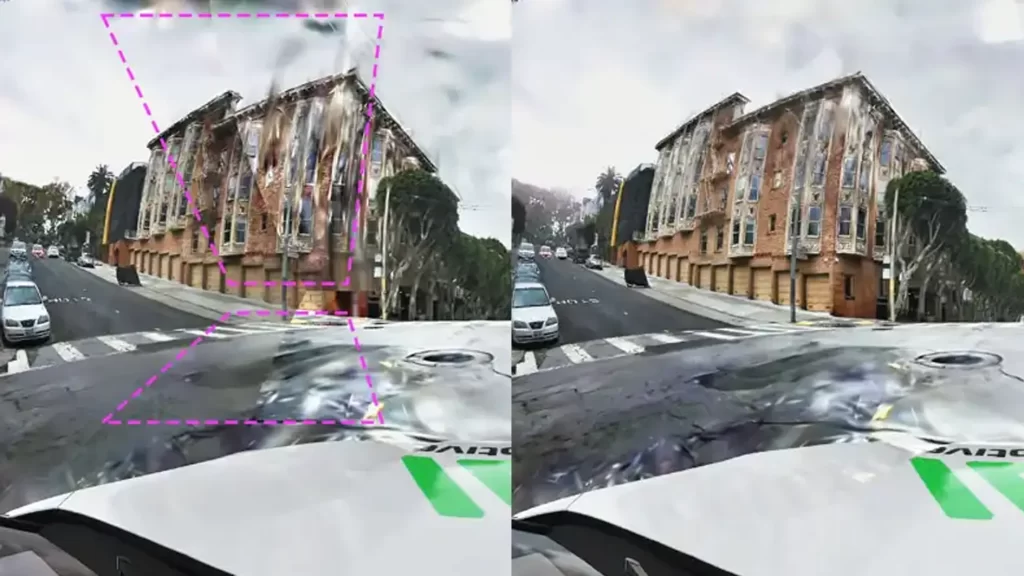
3D高斯潑濺(3DGS)三維場景重建對比圖,展示自動駕駛車輛視角下的街區與建築物重構效果,左圖以虛線框標註細節區域,右圖為高保真重建結果。

1. Fully Automated 3D Annotation of Dynamic and Static Objects

Precise 3D bounding boxes that can automatically generate dynamic objects (vehicles, pedestrians, cyclists, traffic signs, and traffic lights), and automatically annotate static elements such as lane markings and road signs, fully capturing spatial dimensions, orientation, location, and occlusion relationshipsThe

2. 4D Environmental Models and Hybrid Architecture Technologies

Integration of camera, LiDAR, GNSS/INS, and millimeter-wave radar data, annotate within a unified 4D (space + time) model. Using multimodal neural networks, non-causal trackers, and aggregated point cloud technology, Constructing a World Model with Temporal ContinuityThe

3. Key Technical Breakthroughs (Distortion Compensation and Ghosting Filtering)

Compensation for Vehicle Motion (Egomotion) and Calibration of Camera Exposure Time, to eliminate data distortion caused by high-speed operation; at the same time, a specialized algorithm is used to precisely filter out point cloud artifacts (ghosting) caused by glass and puddles, to ensure that the annotated data is clean and reliableThe

Key Advantages of aiData Auto Annotator

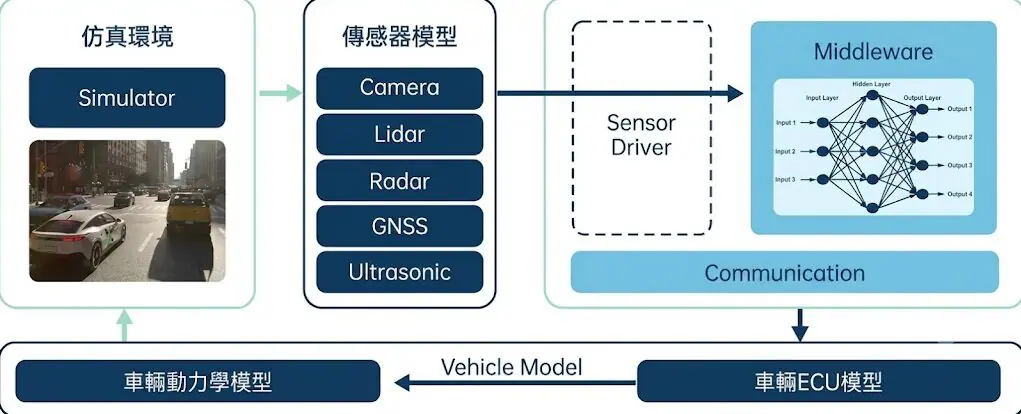
自動駕駛模擬系統架構流程圖,包含仿真環境、傳感器模型(相機、光達、雷達、GNSS、超聲波)、中間件(Middleware)、車輛 ECU 模型與車輛動力學模型之閉環交互。

1. Annotation Accuracy That Exceeds Human Standards (Superhuman Accuracy)

Within the Overall Design Domain (ODD), when considering occlusion handling and the relevant ROI regions, with annotation accuracy and recall rates that comprehensively exceed the human annotation benchmark, providing high-quality training data with extremely high consistencyThe

2. Maximum Cost Optimization and High ROI (Cost & ROI Optimization)

Processing just 30 hours of data is enough to achieve a return on investment (ROI); After processing 500 hours of data,, with a total cost savings rate of 90% or more...which can save companies up to eight figures in labeling budgets each yearThe

3. Highly Efficient and Scalable Parallel Delivery (Horizontal Scalability)

Uses a horizontally scalable pipeline architecture, supports parallel data processing on cluster nodes. A single 8-GPU server can deliver near-real-time annotation performance, delivering usable datasets within hours of completing data collectionThe

4. Generalization Across Multiple Scenarios and with Few Examples (Few-Shot Generalization)

Combining Foundation Models, Few-Shot Learning (FSL), and Similarity Search Techniques...requires only a small amount of image data to quickly complete fine-tuning and adaptation across regions (such as Japan, the United Kingdom, and the United States), vehicle types (such as trucks and passenger cars), and new categories.The

Frequently Asked Questions

Q1: What is aiData Auto Annotator? How does it differ from traditional 2D annotation tools?

A1: aiData Auto Annotator is a fully automated ADAS/AD data annotation tool developed by aiMotive and introduced by Hongke.. Unlike 2D annotations, which provide only planar information...It can output 3D bounding boxes and static lane line annotations that include depth, spatial dimensions, orientation, and occlusion analysis., to better support the training of 3D perception modelsThe

Q2: How does Auto Annotator address data distortion and point cloud ghosting issues during high-speed driving?

A2:Auto Annotator eliminates LiDAR segmented scanning and rolling shutter distortion during high-speed driving (including relative speeds of 260 km/h) through precise egomotion compensation technology and camera exposure calibration; It also features a built-in ghosting filter algorithm that accurately removes false point clouds generated by reflective surfaces such as glass and puddles.

To learn more about how to aiData Auto Annotator Automated annotation technology reduces data processing costs for 90% and above and accelerates the iteration of your ADAS algorithms?Go NowaiMotiveHome PageLearn more.

Other Articles

Hongke Case

[Hongke Case Study Details] 2015 Mercedes-Benz E260L Won’t Start? CAN Bus Troubleshooting and Pico Oscilloscope Diagnosis Case Study

An In-Depth Analysis of the 2015 Mercedes-Benz E260L Engine Failure to Start and Starter Motor Malfunction. Demonstrates how to use a Pico automotive oscilloscope to analyze CAN E-bus waveforms, accurately pinpointing a CAN L/H short to ground and water ingress in the A90 collision prevention control module, and provides professional B2B automotive circuit and CAN bus diagnostic solutions.

Read more
Hongke Case

[Hongke Solutions] Safety Solution for Long-Distance Ocean Transport of Lithium Batteries – Shengweino International Case Study

How Can Thermal Runaway and Impact Damage Be Prevented During Long-Distance Ocean Transport of Lithium-Ion Batteries? Shengweino International uses Hongke’s ASPION G-Log 2 shock recorder to precisely monitor container impacts (G-forces) and changes in temperature and humidity throughout the entire journey, creating a comprehensive transport environment history and improving the efficiency of logistics claims processing and quality tracking. Learn more about our B2B lithium-ion battery ocean freight safety monitoring solutions now!

Read more
Hongke Dry Goods

[Hongke Solutions] Cybersecurity Training for Hong Kong’s Financial Industry: From Compliance Records to Human-Factor Risk Management

Cybersecurity Training Solutions for Hong Kong Financial Institutions (Banks, Securities Firms, and Insurance Companies). Designed to meet the compliance requirements of the Hong Kong Monetary Authority (HKMA) and the Securities and Futures Commission (SFC), these solutions help prevent Business Email Compromise (BEC), OTP phishing, and deepfake attacks. Utilizing KnowBe4’s automated simulation exercises, this solution establishes a human-factor risk management mechanism with a complete audit trail.

Read more

Contact Hongke to help you solve your problems.

Let's have a chat