In September 2026, the Cyberspace Administration of China and the Ministry of Public Security successively released a series of typical enforcement cases in the fields of cybersecurity, data security, and personal data protection. From sensitive information being uploaded to public code repositories, to employees downloading evaluation data without authorization, to former employees injecting malicious code into applications, these real-life incidents serve as a wake-up call for enterprises regarding human risk management.
Cybersecurity risks do not stem solely from external hacker attacks; they can also arise from internal employees’ misjudgments regarding security boundaries, the misuse of internal access privileges, and vulnerabilities in the employee exit management process.
Technical vulnerabilities can be addressed through scanning and remediation, and malicious traffic can be monitored and blocked; however, technical defenses can never fully replace organizational management, access controls, and employee security awareness training. If there is a disconnect between employee behavior and company policies or technical controls, even organizations that have deployed multiple security measures may face severe consequences, including data breaches, business disruption, and even administrative penalties.
Based on three publicly reported cases from Ningxia, Jiangsu, and Beijing, this article provides an in-depth analysis of the typical human-factor risks currently faced by enterprises and explores the core role and scope of application of the security awareness training platform KnowBe4.
I. Let’s Start with the Law: Safety Education and Training Is Not an Optional Corporate Activity
Many companies still view cybersecurity training as a mere formality in the new employee onboarding process or as an annual compliance “check-off” task. However, according to current laws and regulations, security education and training is a statutory safety management obligation that certain entities are required by law to fulfill.
The primary legal basis includes:
- Article 50, Paragraph 4 of the “Personal Information Protection Act”: Processors of personal information shall reasonably define access permissions for personal information and regularly provide security education and training to their employees.
- Article 27 of the Data Security Law: When conducting data processing activities, entities shall establish and improve comprehensive data security management systems covering the entire process, organize data security education and training, and implement appropriate technical measures and other necessary measures to ensure data security.
- Article 23 of the Cybersecurity Law: This stipulates the security obligations that network operators must fulfill under the Cybersecurity Graded Protection System, including establishing internal security management systems, implementing technical measures, retaining network logs, and enforcing data classification and encryption requirements.
- Article 36 of the Cybersecurity Law: Operators of critical information infrastructure are explicitly required to regularly provide cybersecurity education, technical training, and skills assessments to their employees.
It should be noted that the entities to which the above provisions apply and the specific obligations they entail are not entirely the same. Specifically, the explicit provisions in Article 36 of the Cybersecurity Law regarding periodic training and skills assessments are primarily directed at operators of critical information infrastructure; one must not simply interpret all provisions as imposing exactly the same training requirements on all enterprises.
However, for personal information controllers and entities engaged in data processing activities, conducting security education and training already has a clear legal basis in and of itself.
This means that companies cannot simply demonstrate to regulatory authorities which safety equipment they have purchased; they must also establish corresponding internal systems, technical controls, training programs, and record-keeping mechanisms in accordance with applicable laws and regulations and their actual risk profile.
The true value of safety training lies not merely in ensuring that employees “know the rules,” but rather in guiding them to “understand how to properly follow the rules” in specific work situations.
II. Three Real-Life Cases: How Do Human-Related Risks Come to Light?
Case 1: To facilitate collaboration, an employee uploaded sensitive system information to a public code repository
[Case Summary]
According to the “Cyber Shield—2026” typical cases of administrative law enforcement in cybersecurity published by the Ministry of Public Security, in April 2025, Zhang, an employee of a technology company in Ningxia, while responsible for the maintenance and operation of a certain system, privately uploaded sensitive system information to a public personal repository on a global open-source code hosting platform to facilitate internal collaboration and work coordination within the project team.
The information in question included the system's network architecture, security defense systems, and internal personnel data, resulting in this sensitive information being directly exposed to the public network environment.
After discovering the relevant circumstances, the public security authorities imposed administrative penalties on the company and its employee, Mr. Zhang, in accordance with the law.
It should be noted that the official public announcement did not disclose the specific amount of the fine; therefore, this article does not cite any unverified figures regarding the penalty.
[Analysis of the Root Causes of Risk]
What should be of greatest concern to companies regarding this incident is that the employee’s misconduct occurred in the context of daily work. From the perspective of project collaboration, using code repositories to store and share files is not uncommon. However, from a security management standpoint, internal system data, evaluation materials, and personnel information must never be uploaded to personal accounts or public repositories without authorization. The public announcement clearly confirms that an employee uploaded sensitive information without authorization. As for whether the company completely lacked relevant policies or whether employees had received security training beforehand, the current report does not provide sufficient details to support these conclusions; therefore, it cannot be directly asserted that this incident occurred solely due to a “lack of training.”
However, this case does highlight the need for companies to clearly address the following key questions:
- What information can be shared externally? Which files can only be stored within a designated, controlled environment?
- What guidelines should employees follow when accessing their personal code repositories, Google Drive, or other collaboration tools?
If these management boundaries are not clearly defined, communicated, and implemented, operational convenience can very easily come into serious conflict with security and compliance requirements.
[Corporate Defense Strategies]
First, a mechanism for classifying and categorizing data and for approving data transfers should be established to clearly define the boundaries for the storage, sharing, and transmission of sensitive data.
Second, the risk of unauthorized data exfiltration can be mitigated through code repository access controls, restrictions on the creation of public repositories, dynamic scanning for sensitive information, and appropriate data loss prevention (DLP) technologies.
Finally, these guidelines need to be translated into specific operational instructions that employees can easily understand and implement. Through scenario-based training, employees should clearly understand which actions could lead to the leakage of sensitive information and how to properly handle uncertain situations.
While security awareness training cannot replace technical safeguards, it can effectively reduce risky behavior caused by a lack of understanding of compliance requirements.
Source: Ministry of Public Security Releases 10 Typical Cases of Administrative Law Enforcement in Cybersecurity, September 17, 2026.
Case 2: Employee Downloads Assessment Data Without Authorization; Data Usage Boundaries Emerge as a Management Weakness
[Case Summary]
Among the typical cases released by the Ministry of Public Security in the same batch, the data security incident involving a company in Jiangsu is also highly instructive.
In November 2025, public security authorities in Suqian, Jiangsu, received a tip from relevant departments indicating that a service platform within their jurisdiction had a vulnerability in its data API interface.
The investigation revealed that a Jiangsu-based company responsible for the platform’s construction, operation, and maintenance failed to implement necessary data transmission and storage security measures during the development and maintenance processes, and did not thoroughly address the security vulnerabilities that had been identified. At the same time, company employees accessed and downloaded assessment data from the platform without authorization for analytical purposes.
The local public security authorities imposed administrative penalties on the company in accordance with the law and supervised the entire process of destroying the personal data it had retained without authorization.
The official public announcement did not specify whether the data in question had been sold, nor did it disclose the total volume of data involved; therefore, the incident should not be overstated as the “sale of 12,000 pieces of personal information,” nor should it be assumed that the employees involved have committed a specific crime.
[Analysis of the Root Causes of Risk]
Unlike a simple external hacking attack, this case also reveals two major categories of underlying risks:
The first category isInadequate Technical and Management Controls. The platform itself contained vulnerabilities in its data API, and the company failed to implement adequate measures to protect data during transmission and storage, nor did it fully address the vulnerabilities.
The second category isUnclear Boundaries in the Use of Internal Data. Assessment data is not ordinary information that employees can access, download, and retain without restriction. Even if employees are performing these actions for the purposes of analysis or to facilitate their work, they must still comply with the scope of authorization and data processing rules.
Therefore, companies cannot focus solely on whether external attackers have gained access; they must also monitor what data internal personnel can access, what actions they can perform, and whether such activities align with authorized uses.
[Corporate Defense Strategies]
Technical Aspects: The principle of least privilege should be implemented; data interfaces should be strictly managed; access controls, log auditing, and monitoring for abnormal downloads should be enhanced; and any identified vulnerabilities should be promptly patched.
Management Level: The boundaries for the use of assessment data, business data, and personal information should be clearly defined, and the processes for data export, analysis, sharing, and retention should be standardized.
Training Level: It is important to help employees understand that having system access does not equate to unrestricted rights to use data; nor does having access to data for work purposes mean they can copy, retain, or use it for other purposes without authorization.
It is important to emphasize that security education cannot replace access controls and behavioral monitoring. To effectively defend against the risk of internal data misuse, a truly effective defense requires the combined efforts of policies, technology, and personnel management.
Source: Ministry of Public Security Releases 10 Typical Cases of Administrative Law Enforcement in Cybersecurity, September 17, 2026.
Case 3: Malware Installed Before Resignation Threatens the Security of an App with Approximately 350,000 Users
[Case Summary]
On September 15, 2026, the Cyberspace Administration of China announced a case involving a Beijing-based internet technology company that had installed malicious software.
According to an official report, a certain “assistant” app operated by the company had approximately 350,000 users. An employee surnamed Liu had participated in the development of the app while employed there. Later, due to dissatisfaction over the renewal of his employment contract, he implanted malicious code into the app before leaving the company in order to obtain promotional fees.
After users install this app, when they use features such as the browser's home page, search engine, and bookmarks, the page will redirect to promotional links.
The investigation found that the company failed to fulfill its cybersecurity obligations in accordance with the law, neglected to properly manage the applications it operated and its employees, and failed to promptly identify relevant issues and take corrective measures. The local Cyberspace Administration ordered the company to rectify the violations in accordance with the law, imposed a fine, and referred Liu’s suspected illegal and criminal activities to the public security authorities.
The official report confirms that the app has approximately 350,000 users, but this does not mean that all users have been confirmed to have actually been compromised.
[Analysis of the Root Causes of Risk]
This incident highlights the risks associated with malicious acts by insiders combined with software development and release processes.
Developers may have control over the code, build, and release processes, as well as an understanding of system architecture and common review mechanisms. If there is no effective separation of development and release privileges, if code changes lack independent review, and if access privileges are not properly managed before and after an employee leaves the company, malicious actions may evade routine checks.
Therefore, these types of risks cannot be simply attributed to a lack of safety awareness among employees, nor can they be resolved solely through training.
[Corporate Defense Strategies]
For software development companies, they should start bySecure Software Development Lifecycle (SSDLC)Implement measures such as code reviews, change approval processes, the separation of build and release permissions, code signing, and release integrity verification.
existHuman Resources ManagementIn this regard, an access control mechanism should be established to cover the entire process—from onboarding to active employment, job changes, and separation—to promptly adjust or revoke access privileges that are no longer needed, and to strengthen auditing of access changes and sensitive operations performed by key personnel.
The purpose of security awareness training is to help employees understand code security, professional ethics, confidentiality obligations, and the legal consequences of violations; however, effectively preventing malicious code from entering the production environment still requires independent audits and technical controls.
Source: The Cyberspace Administration of China released recent typical enforcement cases in the areas of cybersecurity, data security, and personal information protection on September 15, 2026.
III. Putting the Three Case Studies Together: Companies Need to Manage More Than Just Technical Vulnerabilities
These three cases illustrate different types of human-related risks: the unauthorized disclosure of sensitive information, employees accessing and downloading data without authorization, and the implantation of malicious code prior to leaving the company.
| Risk Types |
Representative Cases |
Areas Where Companies Need to Strengthen Their Defenses |
| Unauthorized Disclosure of Sensitive Information |
The Ningxia Open-Source Code Repository Case |
Data Classification, Outsourcing Restrictions, Scenario-Based Training |
| Unauthorized Use of Internal Data |
The Jiangsu Test Score Data Case |
Least Privilege, Interface Security, Log Auditing, Data Usage Policies |
| Internal Malicious Acts and the Risk of Employee Turnover |
The Beijing Malware Case |
Secure Development Processes, Separation of Duties, Exit Management, Code Reviews |
These three cases do not prove that all cybersecurity penalties are caused by employee behavior, nor do they suggest that technical measures are unimportant.
On the contrary, together they demonstrate that:Security incidents often occur at the intersection of technical controls, management processes, and human behavior.
Firewalls, data loss prevention (DLP), log auditing, and secure development tools each have their own specific applications; employee security awareness training, on the other hand, helps employees understand and follow security policies. Together, they complement each other to form a more comprehensive risk management system.
For companies, the goal of safety training should not be merely to have employees complete the courses, but rather to gradually establish a sustainable system:Identify risks ➔ Foster appropriate behaviors ➔ Verify the effectiveness of training ➔ and adjust follow-up measures based on actual risks.
IV. KnowBe4: Transforming Security Awareness Training from a One-Time Task into Continuous Risk Management
In the field of security awareness training and simulated phishing tests, KnowBe4 is a vendor with a long track record of product development. Founded in 2010, the company currently serves more than 70,000 organizations worldwide.
KnowBe4's core approach is to useSecurity Awareness Training, Simulated Attacks, Behavioral Feedback, and Effectiveness Analysis...to help companies continuously improve their employees' safety behaviors, rather than reducing training to a once-a-year online course.
Based on the aforementioned case study, its practical value can be understood from the following perspectives:
1. Combine training, testing, and reinforcement, and continuously monitor safety behaviors
A common problem with traditional training is that just because employees have attended a course doesn’t mean they can actually identify safety risks on the job.
KnowBe4 combines security awareness training with simulated phishing tests and follow-up reinforcement. By conducting ongoing tests, the company assesses how employees respond to simulated attacks and then schedules appropriate training based on the risk profile.
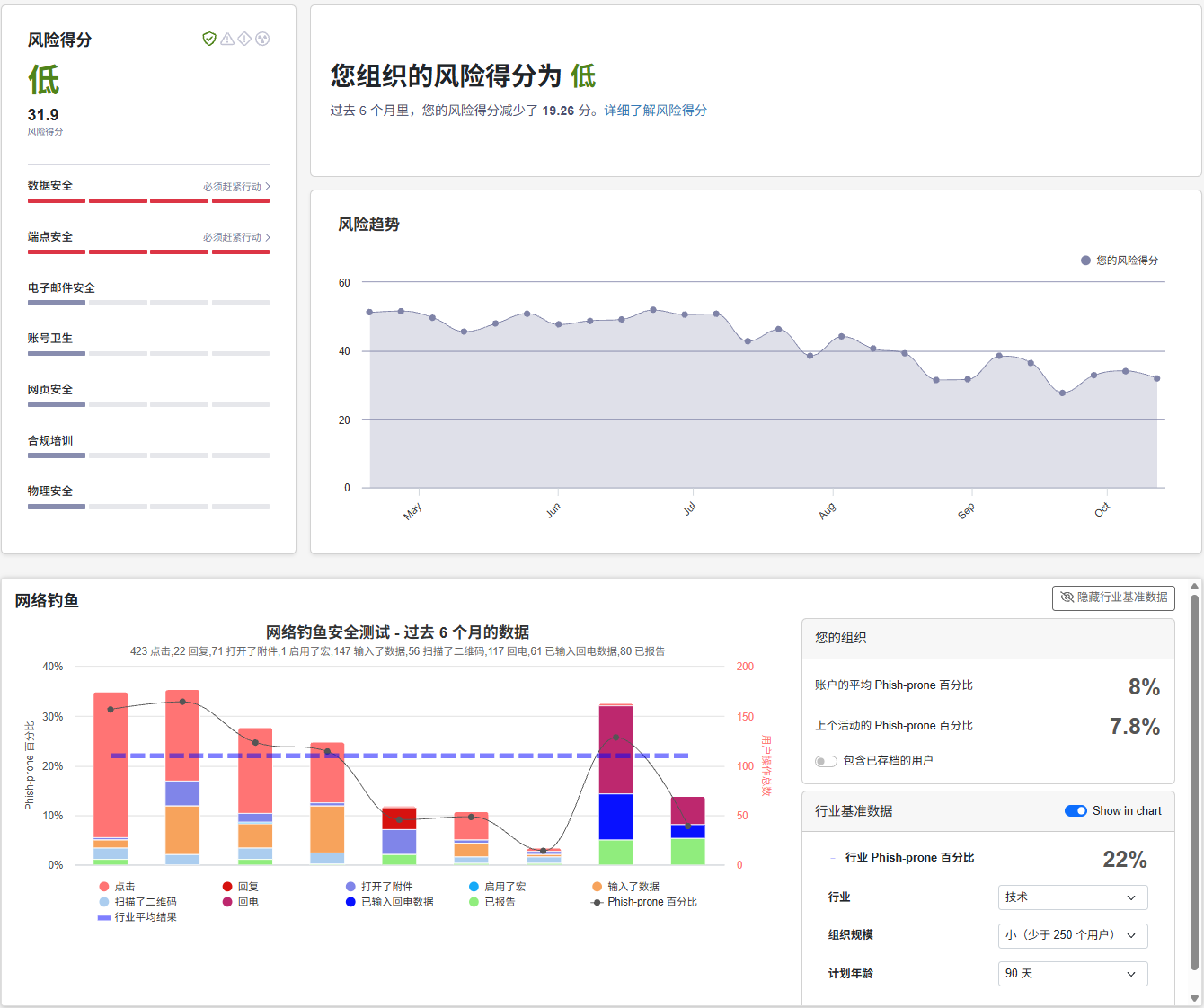
One commonly used metric is Phishing-Prone Percentage (PPP), used to measure the vulnerability of employees as demonstrated in simulated phishing tests.
According to benchmark data currently cited on the KnowBe4 website, the average PPP for relevant organizations can decrease from 33.1% decreased to 4.1%. This data reflects the benchmark results published by vendors; it does not mean that every company can achieve the same results, nor should it be directly equated with the percentage reduction in a company’s overall cybersecurity risk.
As illustrated by the Ningxia case, this model can help companies raise employee awareness of risks such as the handling of sensitive information, suspicious links, and social engineering attacks through training. However, when it comes to uploads to public repositories, companies should still address this issue by combining specific data management policies, technical restrictions, and scenario-based training.
2. Use AIDA and real-time coaching to make training more relevant to actual risks
KnowBe4's AI Defense Agents (AIDA) A set of AI agents designed to automate the management of security awareness training programs and personalize content.
Its related capabilities can automatically schedule phishing simulation tests and training content based on the user's risk profile; after enabling the corresponding features,Real-Time Coaching It can also combine the results of simulation tests or risk signals generated by connected security tools to provide targeted security alerts or remediation training.
The value of this model lies in gradually shifting training from a one-size-fits-all approach—with standardized content and a fixed schedule—to continuous reinforcement tailored to employee behavior and risk profiles.
For example, for employees who repeatedly engage in unsafe practices during simulated phishing tests, companies can arrange more targeted training to help them identify suspicious links, unusual requests, and the hallmarks of social engineering attacks.
It is important to note that the trigger conditions, data sources, and specific handling methods for real-time guidance depend on the enabled features and related configurations. This should not be interpreted to mean that the system can automatically correct all risky behaviors in real-world work scenarios. For risks such as the unauthorized use of internal data and the injection of malicious code, enterprises must still rely on measures such as access control, code reviews, behavioral monitoring, and exit management.
3. Use PAB and PhishER to encourage employees to identify and report suspicious emails
KnowBe4's Phish Alert Button (PAB) Allow employees to report suspicious messages via email or supported collaboration platforms.
In conjunction with PhishER, organizations can analyze emails or messages reported by employees based on configured rules, categorize and assess them, and take follow-up actions; they can also implement further measures to block or remove emails after enabling the relevant capabilities.
This helps establish a collaborative process that spans from employees identifying suspicious messages and submitting reports to the security team analyzing and responding to them.
For companies, this not only helps employees become more proactive in identifying and reporting phishing attacks, but also enables security teams to identify common threat types and continuously optimize training content.
However, PAB and PhishER are primarily designed to address suspicious emails and related messages reported by employees; they should not be viewed directly as tools for monitoring internal data exports, database auditing, or source code security testing. If an organization needs to detect unauthorized data downloads or malicious code modifications, it should implement appropriate database auditing, endpoint monitoring, data loss prevention, and software supply chain security measures.
4. Comprehensive training content and reporting capabilities that provide a record for risk governance
The KnowBe4 training library offers more than 1,000 training modules, with content available in over 35 languages, covering security awareness, social engineering, phishing attacks, and other cybersecurity-related topics.
In addition, the platform offers more than 60 built-in reports and management-level reporting capabilities, helping organizations track training completion rates, phishing test performance, and changes in relevant metrics over time.
For businesses, these features provide documentation for training program management, internal audits, and tracking of corrective actions, ensuring that safety awareness initiatives go beyond simply being described as “training sessions conducted” and instead allow for further observation of participation and behavioral performance.
KnowBe4 also offers Email Exposure Check Pro (EEC Pro) Email Exposure Detection capabilities can help companies identify corporate email information that may have been compromised by leveraging sources such as the deep web and data breach databases.
These results can serve as a reference for risk identification and follow-up actions; however, email exposure checks do not constitute real-time attack detection, nor do they automatically trigger personalized training by default. It is particularly important to emphasize that while platform reports can assist companies in maintaining training and testing records, they cannot, on their own, prove that a company has met all of China’s regulatory requirements. Organizations should still establish a comprehensive chain of compliance evidence by considering applicable laws, internal policies, training content, assessment records, technical measures, and the remediation process.
5. Position KnowBe4 as a key component of human-factor risk management
By examining KnowBe4 in the context of the three cases mentioned above, we can gain a clearer understanding of its scope of application:
- Unauthorized Disclosure of Sensitive Information: Security awareness training helps strengthen data classification and external data sharing policies, but it still requires technical controls and approval processes to be in place.
- Regarding the Improper Use of Internal Data: Training helps clarify the boundaries of authorization and data processing, but it cannot replace the principle of least privilege, audit logging, and monitoring for anomalous behavior.
- Regarding the insertion of malicious code prior to leaving the company: Training helps reinforce code security and accountability, but it must be complemented by measures such as independent code reviews, separation of release permissions, and revocation of permissions upon termination.
Therefore, KnowBe4’s value lies not in replacing an organization’s existing security technology infrastructure, but in helping organizations integrate employee security awareness into a continuous, measurable human-factor risk management process.
If a company plans to use this platform for cybersecurity awareness training and compliance programs within China, it should also conduct a separate assessment of the compliance requirements for data processing and service usage based on the specific deployment, data flow, and applicable laws. It cannot assume that the platform meets all domestic compliance requirements simply because it has reporting capabilities.
V. In Closing: A Truly Effective Line of Defense Is the Combined Effect of Technology, Systems, and People
From the uploading of sensitive information to public code repositories, to employees downloading evaluation data in violation of policies, to former employees implanting malicious programs—these cases all serve as a reminder to companies that cybersecurity is not just a matter of devices and systems, but also a matter of access permissions, processes, employee behavior, and accountability.
Companies need not only to deploy the necessary technical safeguards but also to establish clear security management policies, improve access control and exit management, and continuously assess whether employees can make the right security decisions in real-world business scenarios.
The security awareness training, simulated attacks, and real-time coaching capabilities provided by KnowBe4 can serve as a key component of this system, helping organizations conduct training on a more consistent basis, monitor employee performance, and adjust their educational and risk management measures accordingly.
Technology provides the means for control and monitoring; policies define boundaries and responsibilities; and safety awareness training helps employees understand and implement these requirements. Only when these three elements form a closed-loop system can a company more effectively reduce human-related risks.
Only when safety awareness is no longer just a one-time training exercise but becomes a code of conduct in daily work and a mechanism for continuous improvement will companies have the opportunity to manage risks before incidents occur, rather than waiting until problems surface to take corrective action.