Search

Hongke's latest articles

HongKe

Lorem ipsum dolor sit amet, consectetur adipiscing elit. Ut elit tellus, luctus nec ullamcorper mattis, pulvinar dapibus leo.

Lorem ipsum dolor sit amet, consectetur adipiscing elit. Ut elit tellus, luctus nec ullamcorper mattis, pulvinar dapibus leo.

HTC Solution] HIL Closed Loop Test Solution Based on CANoe and HTC GNSS Simulator

Basic introduction of CANoe software

CANoe It's from Germany. Vector Informatik It is a powerful development and test platform for automotive electronic systems. It is widely used in in-vehicle networks such as CAN, LIN, FlexRay, Ethernet, MOST etc.) and ECU (Electronic Control Unit) CANoe is a tool for simulation, diagnosis, analysis and automated testing of automotive electronics. As a core tool in today's automotive electronics development process, CANoe covers the entire process from the early design stage to final validation.

CAPL (Communication Access Programming Language) CAPL is a programming script language for Vector CANoe / CANalyzer, which is mainly used for simulating bus nodes, executing test logic, and handling specific events.CAPL is defined by Vector, and the syntax is highly similar to that of the C language, but it is specific to automotive communication systems.Event Driven MechanismsOptimized to be a key tool for CANoe communication with the vehicle bus and external devices.

HONGKE GNSS Simulator: HIL Solution with CANoe Integration

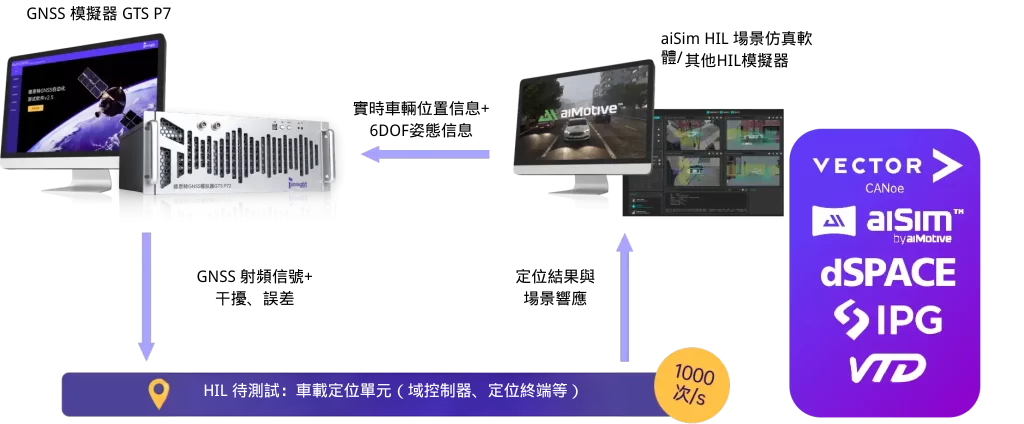
Hongke GNSS Simulator GTS P7 It is equipped with high-performance Hardware-in-the-Loop (HiL) simulation capability, providing a simulation iteration rate of up to 1000Hz and ultra-low latency of as low as 5ms. Through standardized interfaces, the device can achieve high-performance and low-latency data interaction with the industry's mainstream HiL systems and scenario simulation software, such as Vector CANoe, aiSim, and dSPACE.Autopilot, Low Altitude EconomyIt provides reliable technical support for high-dynamic, closed-loop testing in cutting-edge fields.

The HONGKE GNSS Simulator combined with CANoe development solution is designed to provide the highest standard of Global Navigation Satellite System (GNSS) signal test and sensor simulation performance in an easy-to-operate, scalable and expandable platform. The solution utilizes C++ Shared Libraries Create a real-time feed Skydel trajectory (HIL simulation) CANoe scenarios, thus realizing comprehensive simulation and testing for complex scenarios and automotive applications.

Tech Tip: Before using CANoe to communicate with Skydel, you need to configure the C++ compiler environment. On Windows system, please download and install the Visual Studio 2019 up to CMake Tools. For instructions on downloading and installing these tools, please contactHOSCOGet professional support.

Demonstration of HIL Closed Loop Test Procedure

This program provides a complete demonstration of the standard procedure for hardware-in-the-loop (HiL) closed-loop testing:

  1. Component Activation: Activate the hardware and software components of the system.
  2. Scene sending::CANoe Sends the preset GNSS scene commands to the HONGKE GNSS SimulatorThe simulator generates simulated scenes based on time, location, constellation frequency, and atmospheric conditions. The simulator generates simulated scenes according to the requirements of time, location, constellation frequency points, and atmospheric conditions to ensure that each satellite simulates the real-world distribution and transmits GNSS signals.
  3. Track Generation and Transfer: The user has the option to preset the track within CANoe, or in the IPG Carmaker A virtual driving scene is set up in the simulation. Once the simulation starts, Carmaker outputs the vehicle's trajectory in real time, which is then transferred to a virtual driving scenario via the Carmaker Interface Send to Vector CANoeCANoe is responsible for reading and formatting the real-time transmission of longitude, latitude, altitude, and velocity information to the GNSS simulator at each moment in time.
  4. Signal Emulation and Transmission::GNSS Simulator Simulated GNSS satellite RF signals are generated in real time from the received track data. These signals are identical to the real satellite signals that the virtual vehicle should receive at its location in the Carmaker scene. The simulator sends the signals via antenna or cable to the GNSS RF Signal Launched to theParts to be tested (DUT, e.g. T-Box/OBU)The
  5. Positioning Data Processing: The device to be tested receives and processes the simulated signals, calculates its position and outputs the positioning result data (e.g. NMEA Report (or a specific CAN message).
  6. Closure Assessment and FeedbackThe positioning result data is fed back to CANoe or other analysis systems and compared with the "real" position in IPG Carmaker. This enables a precise evaluation of thePositioning accuracy, latency, time to first fix (TTFF), and recapture capabilityand other core performance indicators.

Why choose HTC's HIL testing solution?

  • High-precision simulation: Supports real-time signal generation in high-dynamic scenes.
  • Seamless IntegrationPerfectly adapts to major toolchains such as Vector CANoe and IPG Carmaker.
  • Localization support: Avision provides professional technical consulting and after-sales services in Hong Kong and Southeast Asia.

Other Articles

Hongke Dry Goods

Rainbow Solutions] 2026 Procurement Committee Must-Have: Hong Kong Bank Redis Procurement Checklist (Open Source vs Enterprise Decision Framework)

The HKMA has repeatedly emphasized risk-based and principle-driven requirements in recent years, and has brought the risk of third-party IT solutions to the forefront, meaning that it's fine to turn on Maintenance or Redis Enterprise, but you have to prove that the "controls work" rather than that the "tool is famous".

Read more
Hongke Case

How to map analog signals to CAN/CAN FD telegrams? One Step Guide

Get an in-depth look at how to accurately convert analog signals such as temperature and pressure into CAN/CAN FD telegrams using a data acquisition module (DAQ). This guide covers quantization, packaging principles, and hands-on procedures for automotive electronics and industrial automation engineering development.

Read more

Contact Hongke to help you solve your problems.

Let's have a chat