

Search

Hongke's latest articles

HongKe

I. Introduction: Strategic Changes at the Data Layer under the Critical Infrastructure Legislation

[Hongke Solutions] How Can AI-Powered Industrial Vision Inspection Overcome Quality Bottlenecks? A Comprehensive Analysis of Multi-Camera PTP Synchronization and Defect Detection

With the advancement of smart manufacturing, traditional AOI optical inspection has reached its limits when dealing with microscopic defects and complex curved surfaces.. Combining high-resolution industrial cameras, AI deep learning algorithms, and IEEE 1588 PTP microsecond-level multi-camera time synchronization technology, providing high-precision, ghosting-free, fully automated visual inspection solutions for high-speed production linesThe

How Does AI-Powered Industrial Vision Inspection Improve the Efficiency and Accuracy of Quality Control in Manufacturing?

Traditional AOI (Automated Optical Inspection) systems rely heavily on manually written rule-based algorithms and fixed grayscale contrast thresholds.. When a product has a reflective surface, complex geometric shapes, or tiny irregular scratches,, Traditional AOI systems are prone to extremely high false positive or false negative rates. After implementing AI-powered industrial vision inspection,, the system can use a convolutional neural network (CNN) to learn from a large number of good and defective samples and automatically extract minute features. Whether it’s measuring complex microcomponents or detecting microscopic cracks on metal or plastic surfaces, AI vision systems can accurately identify them in milliseconds.The

Key Challenges in Multi-Camera Systems: Why Is IEEE 1588 PTP Time Synchronization Necessary?

When inspecting large objects or performing multi-angle 3D visual reconstruction (such as vehicle body inspection, large PCB board inspection, or battery module inspection), a single camera cannot cover the entire field of view.. However, when multiple industrial cameras are capturing images at high speed simultaneously, even a slight deviation in exposure time between the cameras (even if it’s only a few milliseconds) can cause image ghosting, motion blur, or distortion in the alignment of the 3D point cloud.The

How the PTP (IEEE 1588) Master-Slave Architecture Works

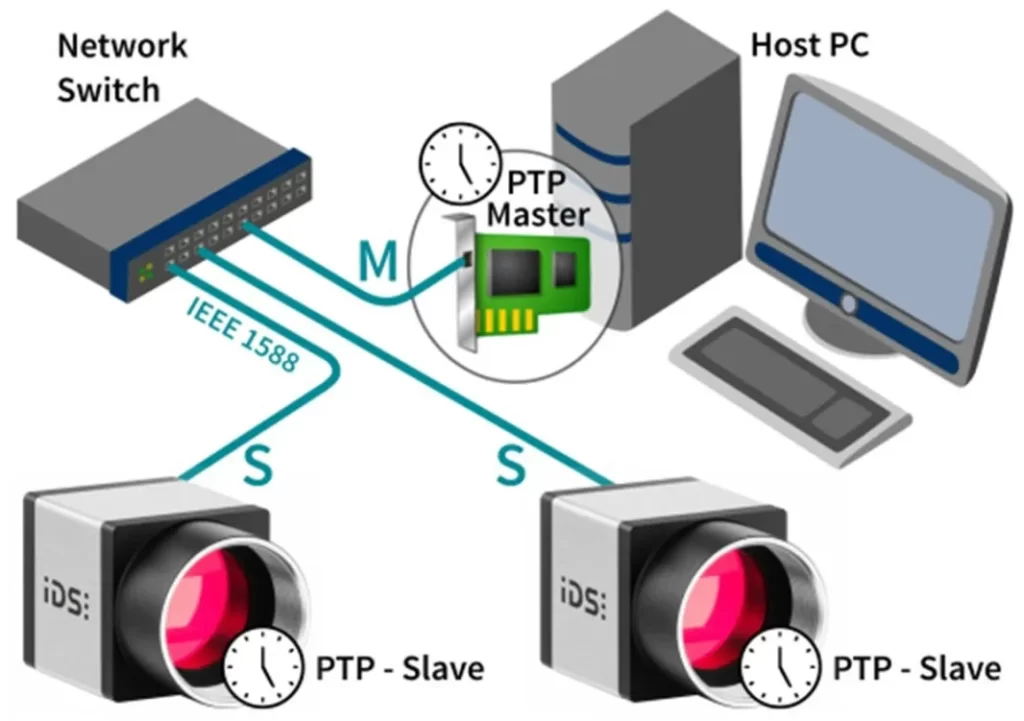
多相機 PTP 時間同步採集系統示意圖:顯示 Host PC 主機(PTP Master,標註 M)與兩台 IDS 工業相機(PTP Slave,標註 S)透過 IEEE 1588 網路交換器(Network Switch)連接,實現精準時鐘同步與影像採集。

PTP (Precision Time Protocol) is defined in the IEEE 1588 standard. In the system, a designated “master clock” (PTP Master, such as a dedicated network card or host) sends precise timestamp packets to all “slave clocks” (PTP Slaves, i.e., each industrial camera) on the network. By comparing packet transmission delays, the hardware clocks of each camera can automatically synchronize, reducing the time deviation to within 1 microsecond (μs).The

Comparison of Software-Triggered vs. Hardware PTP Synchronization Accuracy

Traditional software is triggered by API commands sent by the operating system (Windows/Linux). Due to the system’s multitasking capabilities and network latency, synchronization errors typically range from 10 to 50 milliseconds, which fails to meet the demands of high-speed production lines.; PTP, on the other hand, achieves microsecond-level synchronization through the Ethernet hardware clock mechanism, while eliminating the need for complex external hardware trigger wiringThe

Typical Applications of AI Deep Learning in Industrial Defect Detection

The combination of AI vision technology and high-resolution industrial cameras has demonstrated breakthrough inspection capabilities in multiple high-precision manufacturing fields.::

1. PCB Assembly and Visual Inspection of Components

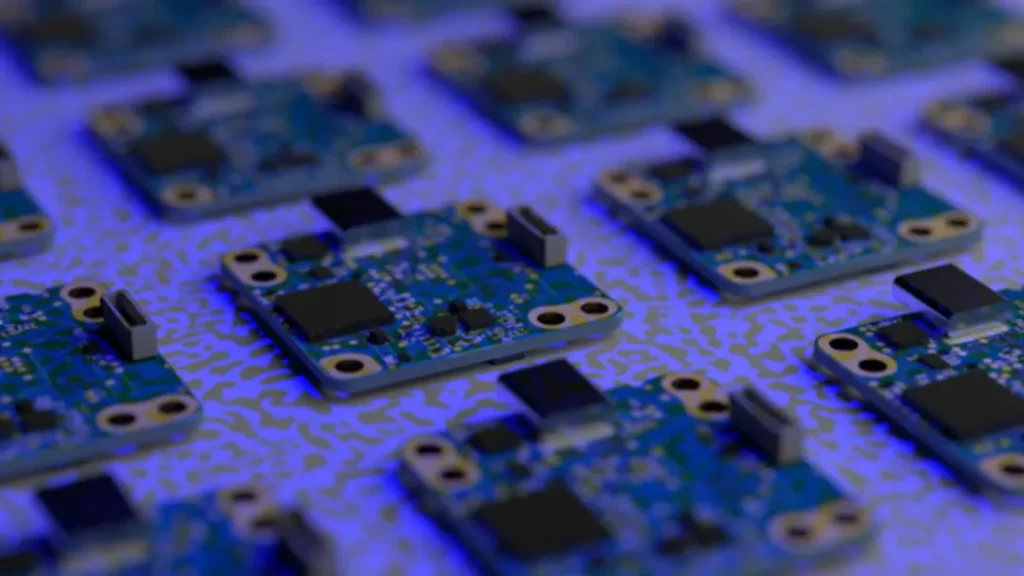
On SMT (Surface Mount Technology) production lines, microchips, capacitors, and solder joints are arranged with extremely high density.. By capturing details with a high-resolution camera, AI algorithms can automatically detect component misalignment, reverse polarity, cold solder joints, and measure pin spacing, significantly reducing the false-negative rate.The

PCB 電路板組裝視覺檢測與測量示意圖:陣列排列的印刷電路板(PCBA)在藍光光源下展示晶片、元件與金屬焊盤細節,適用於 SMT 表面貼裝自動光學檢測(AOI)與品質管控。

2. Surface defect inspection of lithium-ion batteries and cylindrical batteries (dents, scratches, water stains)

New energy battery production lines operate at high speeds, and defects in battery casings and caps are often difficult to detect due to light reflection.. AI deep learning models can perform heatmap analysis on dents in cylindrical battery caps, scratches on the sides, water stains on the surface of pouch batteries, and electrode alignment, achieving an extremely high recognition rate even when dealing with irregular defects.The

鋰電池生產缺陷 AI 視覺檢測對比圖:展示圓柱電池蓋帽凹痕與污染檢測、圓柱電池側面劃痕與孔洞檢測、軟包電池表面水漬與劃痕檢測,以及基於 X 射線的陽極/陰極對準檢測,下方配有 AI 熱力圖與缺陷標註結果。

Comparison of Multi-Camera PTP Time Synchronization and Traditional Triggering Solutions

When designing a multi-camera automated inspection system, selecting the appropriate synchronization method directly affects system cost, wiring complexity, and inspection accuracy.. Below is a detailed comparison of common synchronization solutions::

1. IEEE 1588 PTP Time Synchronization

  • Synchronization accuracy:< 1 microsecond (μs)

  • Complexity of Cable Routing:Low (requires only a standard GigE Ethernet cable)

  • System Scalability:Very high (cameras can be expanded via a switch)

  • Hardware Costs: Medium (requires a PTP-compatible camera and switch)

  • Applicable Scenarios: High-speed dynamic detection, multi-camera 3D reconstruction

2. Hardware GPIO External Trigger

  • Synchronization accuracy:< 1 microsecond (μs)

  • Complexity of Cable Routing: High (requires an additional GPIO to trigger a physical line)

  • System Scalability:Medium (limited by the number of I/O ports on the trigger controller)

  • Hardware Costs:Mid-to-High (Requires purchase of a dedicated I/O card/controller)

  • Applicable Scenarios:Fixed-Point Conveyor Belt Single/Dual-Camera Inspection

3. Triggered by Software API Commands

  • Synchronization accuracy:10–50 microseconds (μs)

  • Complexity of Cable Routing: Low (requires only a standard Ethernet cable)

  • System Scalability:高

  • Hardware Costs:Lowest

  • Applicable Scenarios:Detection of Low-Speed Stationary Objects

How to Design a High-Performance Industrial AI Visual Inspection System?

To build a robust and scalable AI-powered industrial vision inspection system, we recommend following these four key steps::

1. Evaluate the test object and optical imaging conditions

Determine the dimensions of the object under test, inspection tolerances, and production line speed, and select the appropriate lens focal length, light source angle (e.g., ring light, coaxial light), and camera resolution.The

2. Selecting the Camera Architecture and PTP Synchronization Mechanism

For multi-camera omnidirectional inspection, select GigE industrial cameras and industrial-grade PTP switches that support the IEEE 1588 PTP protocol to ensure seamless synchronization across multiple fields of view.The

3. Collect defect data and train AI models

Collect real-world production line images showing both "OK" and "NG" products, annotate key defect areas, train and validate the model using a convolutional neural network (CNN), and optimize the recognition rate.The

4. Integration of PLC Control and On-Site Production Line Validation

Transmit AI vision results (such as OK/NG signals or coordinates) to the production line PLC via industrial communication protocols such as Modbus and Profinet to enable automatic rejection or robotic arm guidance.The

Frequently Asked Questions

Q1: What is IEEE 1588 PTP time synchronization technology? What role does it play in industrial cameras?

A1:IEEE 1588 PTP (Precision Time Protocol) is a protocol that achieves microsecond-level(μs)A standard protocol for time synchronization ensures that multiple industrial cameras can capture images with synchronized exposures without any time lag, even during high-speed motion.

Q2: How does AI-based deep learning defect detection differ from traditional AOI optical inspection?

A2: Traditional AOI relies on fixed rules and contrast, making it prone to false positives when detecting irregular scratches, reflections, or complex textures.; Through training on a large number of defect feature models, AI deep learning can accurately identify complex defects that are minute and vary in shapeThe

Q3: What hardware is required to set up a multi-camera PTP vision system?

A3:The system requires industrial cameras that support the PTP IEEE 1588 protocol (such as iDS cameras), a host or network card that supports the PTP Master module, and an industrial-grade network switch that supports IEEE 1588.

Want to learn more about how iDS industrial vision cameras and PTP time synchronization can solve high-precision inspection challenges?

Go NowHongke iDS Visual Inspection SeriesVisit the product page for more details and technical specifications.

Other Articles

虹科 ELPRO 醫藥冷鏈實驗室技術人員操作 LIBERO 系列溫濕度記錄儀與監測設備。
Hongke Case

[Hongke Case Study] ELPRO LIBERO Series Temperature Loggers—Ensuring the Safety of High-Value Biopharmaceuticals

High-value novel biopharmaceuticals have extremely stringent cold chain temperature control requirements; even the slightest temperature deviation can result in losses of tens of millions of yuan and pose compliance risks. Using the example of a major domestic pharmaceutical group’s implementation of Hongke’s ELPRO LIBERO series temperature loggers, this article provides an in-depth analysis of how the system achieves zero-incident temperature control throughout the entire process (2°C to 8°C) and dual compliance with GSP and international standards through the automatic generation of tamper-proof PDF reports, SmartStart batch configuration, and standardized SOP services.
Read more
Hongke Dry Goods

[Hongke Solutions] Say Goodbye to Expensive Manual Annotation! aiData 4D Automatic Annotation Technology Enables a Closed-Loop ADAS Data System

In the development of ADAS and autonomous driving, the high cost and lengthy cycle of manual annotation severely hinder algorithm iteration. Hongke’s aiData Auto Annotator solution (developed by aiMotive) utilizes 4D environmental models and neural computing technology to achieve fully automated, high-precision annotation of dynamic 3D bounding boxes and static lane markings. Its annotation accuracy exceeds the human benchmark and can reduce annotation costs by more than 90%, providing an efficient and scalable closed-loop data system for autonomous driving R&D.

Read more

Contact Hongke to help you solve your problems.

Let's have a chat