


Search

Hongke's latest articles

HongKe

Lorem ipsum dolor sit amet, consectetur adipiscing elit. Ut elit tellus, luctus nec ullamcorper mattis, pulvinar dapibus leo.

Lorem ipsum dolor sit amet, consectetur adipiscing elit. Ut elit tellus, luctus nec ullamcorper mattis, pulvinar dapibus leo.

HONGKE Solution] High-efficiency Sensor and ECU R&D Test Solution: HONGKE PSI5 Simulator Accelerates Intelligent Safety System Implementation

With the increasing complexity of automotive electronic systems, thePSI5 ProtocolIt has been widely used in the fields of airbag, chassis control, and powertrain assembly. In the face of severe challenges such as the lack of controllers, incomplete test environments, and diversified simulation requirements, we have been able to develop a new system to meet the needs of the industry.Hongke PSI5 SimulatorWith its powerful simulation, testing and analysis capabilities, it has become an indispensable core tool for engineers in the R&D and testing process.

01 Industry Background: Realistic Challenges in Automotive Sensor Development

In the development of modern automotive electronic systems, the validation and testing of communication protocols for sensors, which are the core components of the sensing layer, are facing multiple challenges:

  • Missing controller: In the early stages of sensor development, the physical ECU controller flag is often not yet ready, and engineers are unable to verify sensor protocol compatibility, forcing development cycles to lengthen.

  • High complexity of test environment: Car sensor communication involves PSI5, SENT, SPI Different protocols have different requirements on timing, electrical characteristics and data format.

  • Redundant configuration information: There is a wide range of general information in the PSI5 configuration including, but not limited to: Programming Mode Enable flag and related information, Bus Communication Mode or Asynchronous Communication Mode related information (e.g., Bus Rate, Synchronization Pulse Voltage, etc.).

  • Bottlenecks in Data Tracing and Analytics: It is difficult to correlate the digital communication data with the underlying voltage/current waveforms for analysis by traditional test methods, and once communication abnormalities occur, fault location and troubleshooting are inefficient.

PSI5 Agreements' Core Strengths and Wider Applications

Avision's PSI5 emulator provides a low-cost, highly reliable authentication solution for automotive sensor communications.

  • Compared to high-speed network protocols such as CAN, FlexRay, etc.: PSI5 achieves the perfect balance of "high performance and cost-effectiveness" at the sensor interface level.

  • Compared to one-way protocols such as SENT: The PSI5 has bi-directional communication capabilities to support more complex diagnostics and parameter configurations.

  • Compared to conventional analog signalsThe digital coding method significantly improves interference immunity and data integrity, and offers significant advantages such as integrated power supply and data transmission, and flexible topology.

02 HongKe PSI5 Simulator Application Cases

Application Scenario 1: Hardware-in-the-Loop (HiL) Simulation of Airbag System

During the airbag ECU development process, a complete HiL test environment must be constructed. The system uses simulation software to calculate the crash model and generate theoretical acceleration and pressure data curves, which are then converted by the PSI5 simulator and injected into the ECU under test.

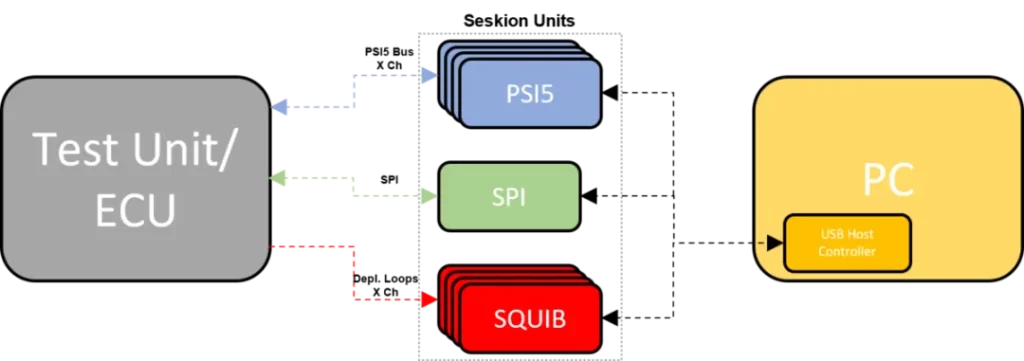
[Rainbow Technology Program] The Avision PSI5 Simulator supports ECU simulation mode to simulate multiple PSI5 sensor signals (e.g., left-front, right-front, and center crash sensors) at the same time and works with the Avision SPI Simulator to simulate internal acceleration sensors. All channels are configured through a unified host computer software, achieving microsecond time synchronization to accurately reproduce the multi-sensor data fusion process in a crash scenario.

[Application Value Sensor protocol compatibility validation and preliminary crash algorithm testing can be completed early, before physical ECU samples are available.Shorten the development cycle above 30%The

Application Scenario 2: CPS Sensor Performance Testing and Production Line EOL Final Verification

In laboratory performance tests (including static accuracy, linearity, and dynamic response) of core components such as chassis position sensors (CPS) and pressure sensors, as well as end of line (EOL) tests, it is necessary to simulate the communication between the ECU and the sensors, as well as to collect and parse the PSI5 data into physical quantities for use by the host computer's test software.

[Rainbow Technology Program]

  • Laboratory Environment: Using the ECU mode of the HONGKE PSI5 simulator in place of the real ECU, communication parameters can be easily configured through GUI software, and sensor data can be collected and parsed in real time.

  • Production Line EOLThe PSI5 can be deployed to test two PSI5 devices in parallel, which greatly enhances the efficiency of the production schedule. The host computer can also be integrated through the LabVIEW API to fully automate the test process.

[Application Value

  • Eliminate Reliance on Real ECUsThis significantly reduces the cost of testing.

  • Supports cascading of up to 5 PSI5 devices.It is the perfect solution to meet the testing needs of high-volume production lines.

Application Scenario 3: EMC Electromagnetic Compatibility and Long-term Stability Testing

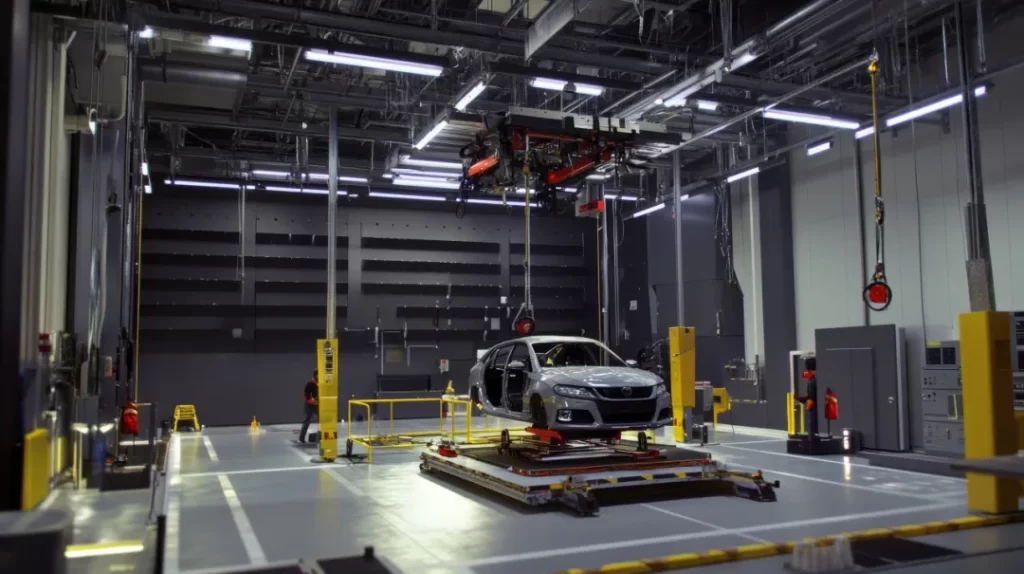
In an EMC darkroom or weatherization chamber, immunity and long-term stability tests are required to verify the reliability of sensors for communication in complex electromagnetic environments or extreme temperature conditions.


[Rainbow Technology Program] HONGKE PSI5 Emulator Support Options EMC Test KitThe device can monitor the data communication quality of the sensor in real time and accurately record the key indicators such as packet loss rate and bit error rate within the electromagnetic interference frequency range. Device Support Wide operating temperature range of -40°C to 125°CIt is fully compliant with the stringent requirements of automotive grade reliability testing.

[Application Value Ensures stable operation of the inductor in the electromagnetic environment of the entire vehicle, and fully meets the requirements of ISO 11452, CISPR 25 EMC international standards; built-in 4GB Ring BufferSupports long-term data logging to ensure that no anomalies are missed.

03 Core Strengths

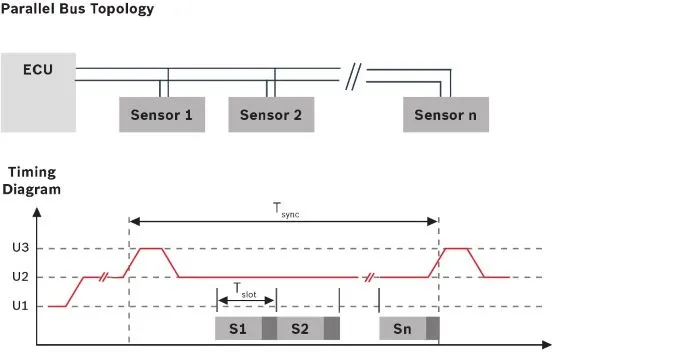
  • Comprehensive protocol coverage and high configuration flexibility Avision's PSI5 emulator fully supports all modes of operation such as point-to-point, parallel bus, and universal bus as defined in the PSI5 specification. The baud rate supports 125/189 kbps standard rate and a single customized rate in the range of 80-250 kbps, making it highly compatible with the products of the world's leading sensor manufacturers.

  • Digital Oscilloscope Level Data Traceability PSI5 voltage waveforms, current waveforms and FPGA decoding data can be synchronously recorded during the measurement process, and the three are precisely correlated on the time axis. Users only need to click any sensor data frame on the software interface, the system can automatically jump to the corresponding physical layer waveforms, realizing "from phenomenon to nature" accurate fault diagnosis.

  • Flexible switching between three modes The single device integrates ECU, Sensor, Passive Three working modes, no need to replace the hardware can be perfectly adapted to different test scenarios: a significant reduction in the types and number of test equipment, and effectively reduce the investment in fixed assets of the laboratory.

  • Powerful gateway and integration features Supports bi-directional conversion of CAN and PSI5 messages (additional enablement required), allowing PSI5 sensor data to be seamlessly integrated into the CAN bus-based test network. Trigger logging, ring buffer and multi-device synchronization are also available.

  • Complete software ecosystem and technical support HONGKEI provides a full stack of software support from the underlying drivers to the upper layers of applications:

    • Base GUIVisual bus communication, parameter editing, data logging, import and export.

    • API Interface: ANSI-C Standards Library, LabVIEW Toolkit (optional).

    • Expansion Module: EMC test kits, sensor programmers, and multi-device co-testing software.

    • Cross-platform support: Windows 10/11 (full-featured GUI + API), Linux systems (API).

  • Compact and reliable hardware design The unit is housed in an aluminum alloy casing with a compact and lightweight design for deployment in confined spaces. Operating temperature is standardized at 0-40°C and can be extended to a wider range with external power supply and proper heat dissipation. Dual PSI5 interfaces (the second one needs to be enabled) allow a single device to build a simple two-node test network.

04 Customer Benefits

  • Shorten the R&D cycleAccelerating the product launch process

  • Reduced testing costsEnhancement of Resource Utilization

  • Increase Test CoverageFunctional safety is fully guaranteed

  • Simplify the testing processThe Government of the Hong Kong Special Administrative Region (HKSAR) has also lowered the technical threshold significantly.

With comprehensive protocol coverage, flexible configuration, powerful data traceability, and a complete software ecosystem, the PSI5 simulator provides a full lifecycle solution for automotive sensor R&D and testing, from the lab to the production line. Whether it's HiL simulation of airbag systems, performance verification of CPS sensors, or wafer-level protocol compliance testing, HONGKE's solutions help engineers break through testing bottlenecks and accelerate the time-to-market of high-quality products.

Other Articles

Hongke Case

HongKe Solutions] Observability Budget Busting: How Redis + Grafana Saved Hong Kong Banks $1.4 Million in 2 Years?

Hong Kong Bank, troubled by the high license cost of Dynatrace, adopted Redis+Grafana to build an open source observable architecture in accordance with the TM-E-1 regulatory standards of the Hong Kong Monetary Authority. By adopting a hierarchical strategy of APM for the core system and metrics monitoring for the rest of the services, the bank maintains 70% of the monitoring performance, saving US$1.4 million in monitoring expenses over two years, and the report data can also satisfy the monitoring requirements.

Read more

Contact Hongke to help you solve your problems.

Let's have a chat