
Search

Hongke's latest articles

HongKe

Add your title text here

I. Introduction: Strategic Changes at the Data Layer under the Critical Infrastructure Legislation

Add your title text here

[Hongke Solutions] Beyond Signals: Decoding Desite’s “Full-Stack” Technical Depth in the GNSS Field

What Are the “Full-Stack” Technical Depth and Shallow Integration Dilemmas in GNSS Testing?

Global Navigation Satellite Systems (GNSS) have become deeply integrated into core fields such as autonomous driving, drone swarms, aerospace, and defense. However, most companies in the current market tend to settle for being “application-layer implementers”—simply integrating off-the-shelf modules into devices to address the basic question of “whether or not” the technology is present. When faced with complex challenges such as drone swarm coordination, high-precision positioning in extreme environments, and anti-jamming encrypted communications, this superficial integration capability falls short.

Deste (a partner of Hongke) pursues a comprehensive technological depth spanning the entire value chain—from “underlying technology” to “testing and validation” to “applications in complex scenarios.” For Desite, the patents and software copyrights—both those already obtained and those currently in the pipeline—are not merely meant to pad a wall of honors with numbers, but rather serve as milestone evidence of building a technological moat in the GNSS field from the “ground up.”

Three Major Challenges in GNSS R&D and Testing

1. Lack of control over low-level signals and black-box limitations

The lack of the ability to independently define the underlying hardware and "algorithm kernel" of GNSS simulators results in testing equipment being constrained by third-party "black-box" mechanisms. When faced with complex signal environments and "meta-testing" requirements, it is impossible to accurately verify end-to-end signal quality, making it even more difficult to achieve secure and trustworthy positioning defense.

2. Testing and verifying the transformation between strata and coordinates is a cumbersome process.

There is a huge gap between theoretical algorithms and their practical implementation in hardware. Without an automated testing platform and flexible data processing tools, engineers often have to spend a great deal of time handling tedious and error-prone coordinate conversions. Furthermore, traditional manual testing is inefficient and fails to precisely meet the automated testing requirements of national standards (such as GB/T 45086).

3. Difficulty in reproducing highly dynamic and multi-body collaborative scenarios

In highly dynamic scenarios—such as drone formation flight, high-g maneuvers, and complex electromagnetic interference—ground testing using a single device cannot simulate the rapidly changing relative positions in the air, making it difficult to authentically verify the signal reception status and safety of flight control systems under extreme conditions.

The Cost to Businesses of Insufficient Test Depth

When a positioning system lacks robust technical support, companies will face a series of hidden and costly consequences when dealing with advanced applications.

The most immediate consequence is a loss of control over product development and validation cycles. Because they cannot independently define signal scenarios and automated test processes, engineers are forced to rely on time-consuming and labor-intensive on-site road testing or manual troubleshooting. This results in insufficient test coverage, delays in obtaining stringent industry certifications, and a loss of first-mover advantage in the market.

A deeper cost lies in the collapse of security mechanisms. In today’s environment, where requirements for countering interference and preventing deception are becoming increasingly stringent, if devices lack underlying encryption algorithms and secure, trusted positioning capabilities, devices are highly susceptible to positioning jumps, signal loss, or flight control failures when faced with intentional interference or highly dynamic and complex environments, which can lead to serious safety incidents and damage to brand reputation.

Deste's Full-Stack GNSS Solution: Building a Technological Moat from the "Ground Up"

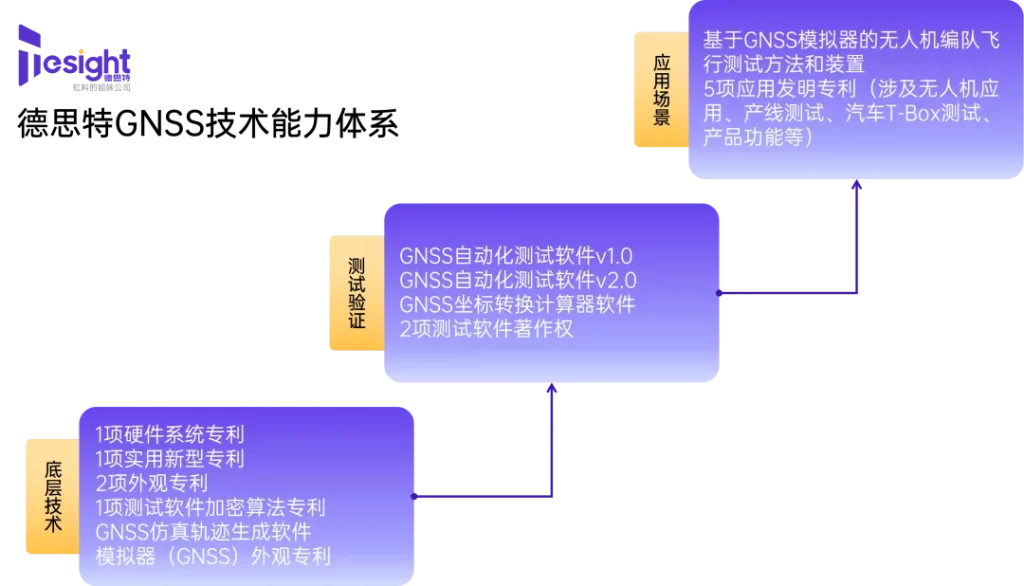
To fundamentally address the pain points of traditional integration, Desite has achieved comprehensive coverage from the signal source to complex applications through a three-tiered technical approach:

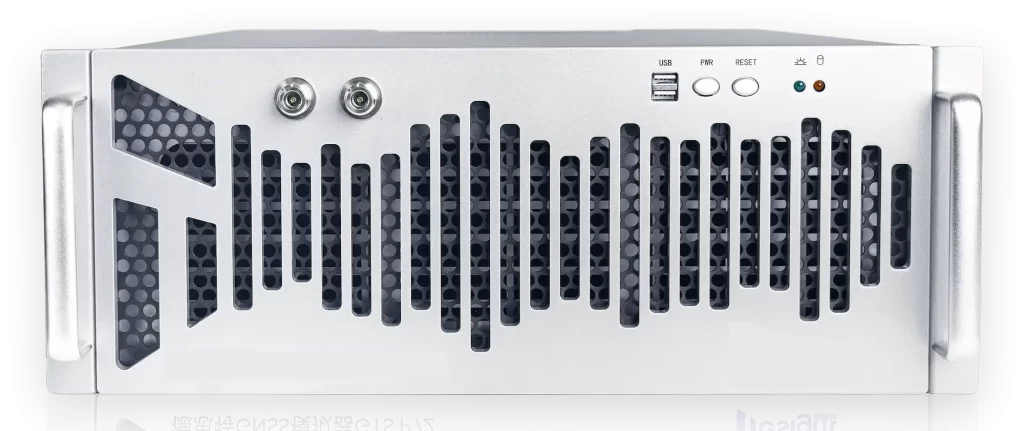
德思特 GTS P7 衛星導航(GNSS)模擬器硬體正面圖,採用白色機架式設計,配備波浪形散熱孔、RF 射頻介面、USB 埠與電源控制開關。

1. Grounded in the Fundamentals: Defining the “Soul” and “Body” of a Signal

Deste starts at the lowest level of hardware and has masteredDeste GTS P7 Design Patentcontrol over industrial design specifications and achieve “meta-testing” capabilities for the full-link quality of GNSS signals, ensuring accurate and reliable signal simulation. At the same time, by securing the copyright for the “GNSS Simulation Trajectory Generation Software” to control the algorithm core, the company has freed itself from third-party constraints; furthermore, by strategically securing invention patents for the “GNSS Simulator Automated Testing Software Encryption Algorithm,” it is advancing into the “deep waters” of “secure and trustworthy positioning.”

2. Integrated Validation: Building a “Bridge” Between Theory and Reality

We developed “GNSS Automated Testing Software v1.0 & v2.0,” marking a leap from “basic testing” to “intelligent testing.” The software can automatically invoke underlying simulator hardware and fully complies with national standards for automated testing, such as GB/T 45086. When paired with the “GNSS Coordinate Conversion Calculator Software,” it bridges the data gaps between surveying, geographic information, and navigation and positioning, creating a robust verification platform.

3. Decisive Applications: Unleashing “Technological Potential” in Complex Scenarios

For high-dynamic and complex scenarios, we obtained an invention patent for “Test Methods and Devices for UAV Formation Flight Based on a GNSS Simulator,” establishing a realistic “multi-body coordination” test environment for aerial formations in the laboratory; At the same time, we have refined the interaction logic between the simulator and the flight control system, launching a high-dynamic testing solution tailored for UAV flight control systems. Looking ahead to 2026, Desite plans to file for four GNSS application patents and two software copyrights, continuing to deliver proprietary solutions.

Key Advantages of the Deste GNSS Solution

德思特 GNSS 技術能力體系圖,展示從底層技術(硬體與加密演算法專利)、測試驗證(自動化測試軟體與座標轉換)到應用場景(無人機編隊飛行與汽車 T-Box 測試)的三層進階架構。

1. Proprietary Signal Algorithm Core (Proprietary Core Algorithm)

Master GNSS Simulation Track Generation SoftwareWith control over the underlying hardware, you can freely customize complex signal scenarios and perform signal "meta-testing," completely free from the constraints of third-party black-box solutions.

2. Low-Level Encryption and Secure, Trusted Positioning (Security & Encryption Algorithms)

Layout Encryption Algorithms for GNSS Simulator Automation Testing SoftwareThis patented invention builds anti-interference and anti-spoofing capabilities from the very foundation of the technology, laying the cornerstone for the first line of defense.

3. Smart Automated Testing Platform

GNSS Automated Testing Software v1.0 & v2.0 Supports automated call verification in accordance with national standards (such as GB/T 45086), combined withCoordinate Conversion Calculator Software, streamlining data and testing processes at lightning speed.

4. Multi-Body Coordination and High-Dynamic Simulation (Swarm & High-Dynamic Testing)

EquipmentPatent for Drone Formation Flight TestingThis technology can accurately reproduce, in a laboratory setting, the in-flight dynamics of “drone swarms” and the signal reception status of their flight control systems during high-maneuvering flight.

5. Ongoing Evolution of Native Application Patents (Native Application Roadmap)

Building on our core capabilities in low-level encryption, precise trajectory tracking, and automated testing, we plan to file four new application patents and two software copyright registrations in 2026, providing robust, native solutions for autonomous driving and production line testing.

Frequently Asked Questions

Q1: What is Deste GNSS’s “full-stack” technical depth?

A1: Deste’s full-stack technical depth means refusing to be merely an “application-layer middleman,” but rather spanning “underlying technologies (proprietary algorithm core, GTS P7 hardware, and encryption algorithms)” - “Testing and Validation (Automated Software v1.0/v2.0, National Standard Integration, and Coordinate Conversion Platform)” - “Complex Scenario Applications (drone swarm formation, high-dynamic flight control testing)”—spanning the entire technology ecosystem.

Q2: How does Desite solve the challenges of testing drone swarm formation and flight control systems?

A2:Using its patented technology, “Test Method and Device for Drone Formation Flight Based on a GNSS Simulator,” Siter builds a realistic multi-body cooperative dynamic environment in the laboratory and combines it with flight control interaction logic to verify signal reception during high-dynamic maneuvers, ensuring air safety for both individual drones and formations.

Want to learn more about how you can optimize your high-precision positioning or drone/autonomous driving products using Deste's full-stack GNSS technology and automated testing solutions? Visit us nowGNSS Main PageLearn more.

Other Articles

Hongke Dry Goods

[Hongke Insights] Cybersecurity in Healthcare and Defense Strategies Against AI Agents – Digital Healthcare Security White Paper

Hackers Are Targeting Healthcare Organizations! An IBM report indicates that the cost of a healthcare data breach can reach as high as $7.42 million. This white paper analyzes the risks associated with telemedicine, AI agent prompt injection, and KnowBe4 cybersecurity training to help Hong Kong healthcare organizations strengthen their security defenses.

Read more
Hongke Case

[Hongke Case Study Details] 2015 Mercedes-Benz E260L Won’t Start? CAN Bus Troubleshooting and Pico Oscilloscope Diagnosis Case Study

An In-Depth Analysis of the 2015 Mercedes-Benz E260L Engine Failure to Start and Starter Motor Malfunction. Demonstrates how to use a Pico automotive oscilloscope to analyze CAN E-bus waveforms, accurately pinpointing a CAN L/H short to ground and water ingress in the A90 collision prevention control module, and provides professional B2B automotive circuit and CAN bus diagnostic solutions.

Read more
Hongke Case

[Hongke Solutions] Safety Solution for Long-Distance Ocean Transport of Lithium Batteries – Shengweino International Case Study

How Can Thermal Runaway and Impact Damage Be Prevented During Long-Distance Ocean Transport of Lithium-Ion Batteries? Shengweino International uses Hongke’s ASPION G-Log 2 shock recorder to precisely monitor container impacts (G-forces) and changes in temperature and humidity throughout the entire journey, creating a comprehensive transport environment history and improving the efficiency of logistics claims processing and quality tracking. Learn more about our B2B lithium-ion battery ocean freight safety monitoring solutions now!

Read more

Contact Hongke to help you solve your problems.

Let's have a chat