

Search

Hongke's latest articles

HongKe

Lorem ipsum dolor sit amet, consectetur adipiscing elit. Ut elit tellus, luctus nec ullamcorper mattis, pulvinar dapibus leo.

Lorem ipsum dolor sit amet, consectetur adipiscing elit. Ut elit tellus, luctus nec ullamcorper mattis, pulvinar dapibus leo.

HONGKE Solution] HONGKE Dual Mode Simulation Test Solution: Leading the Physical Digital Revolution for End-to-End Autonomous Driving

along withEnd-to-End Automated Driving ArchitectureWith the emergence of the "real world", the traditional rule-based simulation test is encountering the double bottleneck of "lack of realism" and "difficult to generalize the scene".

In this article, we're going to take a deeper look atHongke Launches Dual Mode Emulation Test Solution: On the one hand, it relies on aiSim Providing certaintyPhysical Sensor Modeling; and on the other hand, through World Extractor Realize the benefits based on 3DGS/NeRF We will focus on how these two techniques can be generalized to realize dynamic traffic flows while preserving the visual fidelity of the real world through Hybrid Rendering. We will focus on how these two techniques can be used to generalize the dynamic traffic flow through Hybrid Rendering to create a Digital Twin environment for Closed-loop Verification while preserving the visual fidelity of the real world.

01. Key Challenges in End-to-End Testing

The core contradiction in automated driving simulation testing has long existed in thePhysical Reality (Realism)"The "M" is the same as the "M" in the "M".Simulation ControllabilityThe "between" approach is the same as that of the "between" approach. Based on this, HONGKEI has constructed two independent and complementary technology routes, forming a complete tool chain ecosystem:

  • Physically driven routes (Model-based): in order to aiSim simulation platformBased on a high-precision 3D mesh and physical material system, the core provides ISO 26262 ASIL D certification levelThe qualitative simulation focuses on closed-loop verification, sensor modeling, and the construction of corner cases.
  • Data-driven routes: in order to World Extractor ToolchainThe core of the program is the use of 3DGS cap (a poem) NeRF technology to automatically reconstruct the real collected data into a high-fidelity digital world, focusing on solving the perceptual model of the Sim-to-Real GapThe

These two routes are not isolated, but converge at the endpoint through a hybrid rendering architecture to provide a "smart driving" solution for high-end smart drivers.Realistic static environments and controllable dynamic targets"Closed-loop testing capability.

02. aiSim: a qualitative high-fidelity physics engine

aiSim Not just a player for neural rendering, but a standalone, physically based, high performanceFull Stack Simulation PlatformIt integrates key functions of autonomous driving test such as dynamics simulation, weather environment system, physical sensor model and scene editing. It integrates the key functions of automated driving test such as dynamics simulation, weather environment system, physical sensor modeling and scene editing.The world's first ISO 26262 ASIL D certified.The core value is to provide high-fidelity outputs for end-to-end smart driving systems and to perform effective closed-loop testing. Its core value lies in providing high-fidelity, deterministic outputs for end-to-end smart driving systems with effective closed-loop testing.

In-house rendering engine and certainty

Unlike game engine-based solutions (e.g. UE/Unity), aiSim utilizes its own in-house developed, in-house game engine-based solution. Vulkan API The rendering pipeline:

  • Determinism: Ensure that the rendering of the same scene is consistent across different hardware architectures (from workstations to large-scale clusters in the cloud) in terms of pixels, point clouds, and kinetic information. This is critical for **Regression Testing**.
  • Ray-tracing: Supports multipath reflection simulation and Gaussian beam calculation for LiDAR and Radar, and accurately calculates reflectance based on physical material properties (PBR) rather than simple geometric projections.

Physical Sensor Modeling

aiSim provides the ultimate in modeling by going deeper into the physical properties:

  • Camera: Supports full link emulation from aperture, aberration (F-theta/Mei/Ocam), CFA (Color Filter Array) to ISP post-processing.
  • LiDAR (Laser Radar): Based on radiometric measurements, it takes into account the reflectivity of the material at 905nm, atmospheric attenuation (e.g. Mie scattering in rain and fog) and the Rolling Shutter effect.
  • Radar: The simulation of multipath effects using ray tracing supports the output of RCS, Doppler velocity, and point cloud level simulation data.

03. World Extractor: automated scene reconstruction

Addressing the pain points of long cycle and high cost of traditional manual modeling, theWorld Extractor Provides a proven end-to-end automation toolchain to efficiently transform the real world into digital assets.

Rigorous hardware sourcing standards

High-quality rebuilds come from high-quality data. HONGKE defines strict deployment specifications for sensors:

  • Covering Requirements: The camera needs to achieve full 360° coverage with >10° overlap of neighboring fields of view to ensure precise matching of features.
  • Synchronization accuracy: Multi-sensor (Camera/LiDAR) and GNSS/INS time synchronization accuracy needs to be <1ms and position error needs to be controlled to centimeter level (RTK/PPK).
  • Recommended Configuration: Features Sony IMX490/728 sensor and 128-line laser radar.

Automation and 3DGS Training

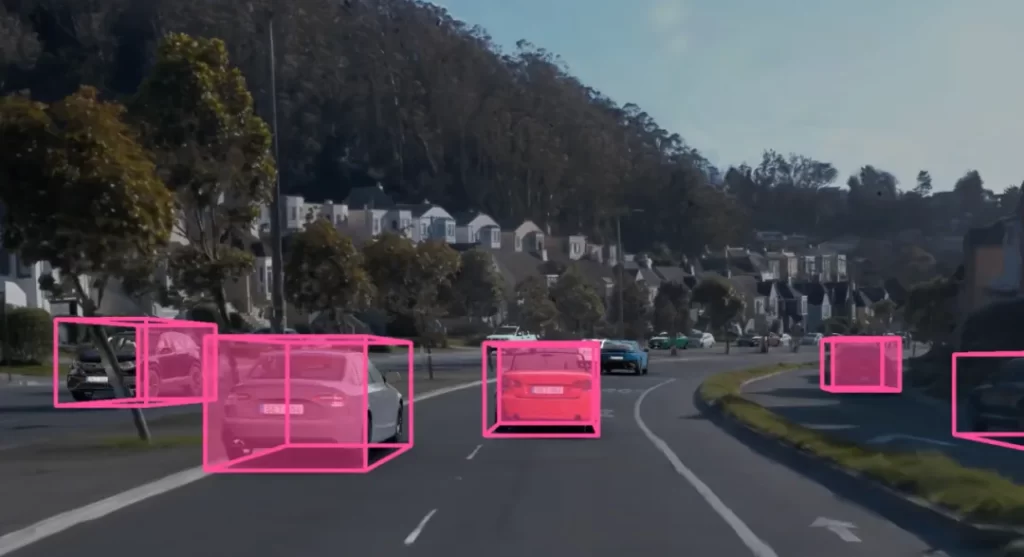
  • Dynamic object removal: Automated annotation algorithms (2D segmentation combined with 3D fringing boxes) are used to recognize and exclude moving vehicles and pedestrians, preserving purely static scenes (buildings, roads, vegetation, etc.).
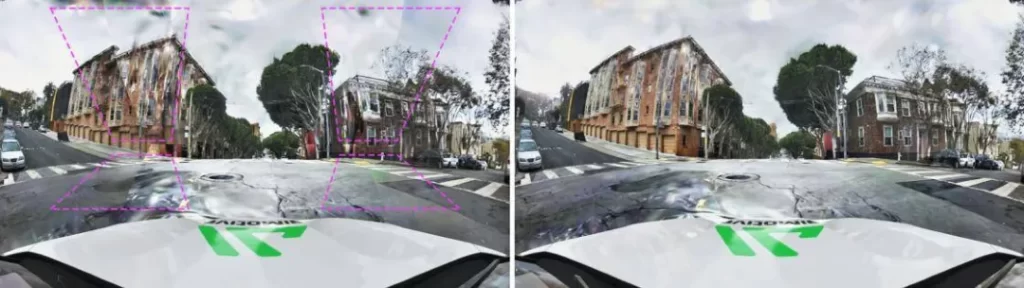
  • NeRF2GS training new paradigm: In order to solve the problem of geometric collapse of traditional 3DGS in weak texture areas (e.g., road, sky), HONGKEI proposes to train the NeRF model to perform Depth Regularization first, and then initialize the 3DGS model by using its high-quality depth maps as the supervisory signals.
  • Large-scale block training: For city-scale scenes (>100,000 m²), the BEV spatial dynamic block-based strategy supports parallel training of multiple GPUs to eliminate rendering seams.

04. Hybrid rendering for closed-loop testing

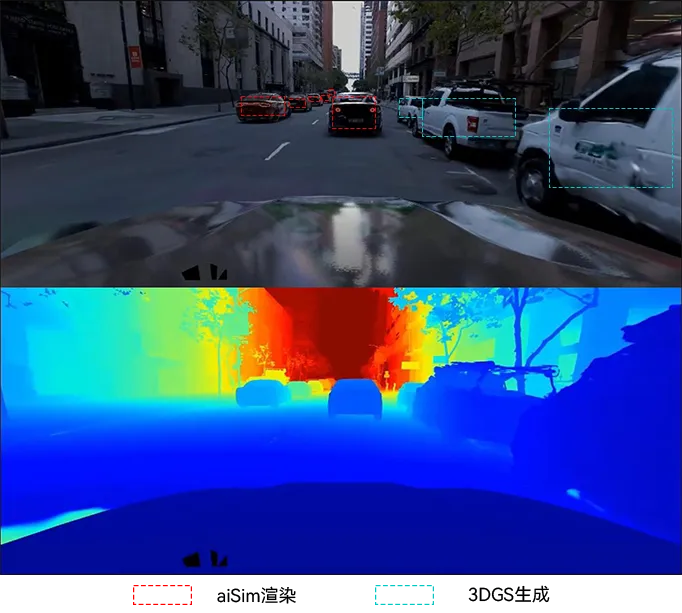
This isRainbow SolutionsThe core technology of 3DGS/NeRF is the core technology barrier. Although pure 3DGS/NeRF is visually realistic, it is a "three-dimensional video" that is difficult to interact with. In order to realize the closed-loop testing, we have adopted theDecoupling Techniques::

  1. Background: Generated using World ExtractorStatic 3DGS ModelsThis ensures that the environmental textures and lighting are absolutely true to life.
  2. Foreground: generated using the aiSim physics engineDynamic Mesh ObjectsThe behavior of these objects is determined by the The behavior of these objects is determined by the OpenSCENARIO Standard driver with support for generalization and interaction.

Deep Synthesis and Multimodal Consistency

  • Depth Compositing (DCC): The system calculates the 3DGS background depth map and the Z-buffer of the aiSim foreground objects in real time, accurately handles occlusion relationships (e.g., a virtual vehicle traveling behind a real tree), and provides the necessary information to the system via the Information on ambient light (IBL) Blend shadows and reflections.
  • LiDAR simulation consistency: Realize light tracing for 3D Gaussian sphere as a proxy geometry. BVH Accelerated StructureThis ensures strong synchronization between the Camera and LiDAR at the spatial and temporal levels.

05. Scenario Generalization and Engineering

Based on the above framework, HONGKE has realized the technological leap from "reproduction" to "generalization":

Dynamic Traffic Flow Generalization

In the reconstructed high fidelity maps, the tester can OpenSCENARIO Freely configure the traffic flow to generate congestion, cut-in or accident scenarios. This greatly expands the ODD (Operational Design Domain) The coverage of the road test algorithms in the road test is a very important factor to precisely overcome the difficulties encountered by the perception algorithms in the road test. Corner Case Pain Points.

Extensive HiL integration support

The toolchain has been validated with multiple OEMs and Tier 1 suppliers and supports hardware-in-the-loop (HiL) integration of the main basin control platform:

  • Video Injection: Supports injection of hybrid rendered video streams via HDMI/DP or GMSL injection cards. NVIDIA Orin, NVIDIA Thorn, Horizon J6 etc. domain controllers.
  • Real-time: In a single node (e.g., a 4-card simulation workstation), you can realize high frame rate real-time simulation with 12 cameras + laser radar.

Conclusion

Hi-Tech's dual-mode simulation test solution through the NeRF2GS technology to "move" the real world into the simulator and utilize the aiSim Physics Engine The world comes alive. This kind ofHigh fidelity for static environments and full generalization for dynamic scenes.The "hybrid rendering model" provides an industry-leading data base for end-to-end closed-loop validation from sensing to regulation, significantly reducing reliance on high-cost real-world road tests!

Other Articles

Hongke Case

Hongke Solutions] Decision Automation vs Process Automation: Breaking the Bottleneck of B2B Digital Transformation

Just because a process is fast doesn't mean a decision is fast! HongKe explains how to systematize "decision logic" through the Decisions platform. From discount authorization to risk management, decision automation can dramatically improve consistency and compliance, helping Hong Kong and Southeast Asian companies achieve high-quality growth. Learn more about our automation upgrades today!

Read more
Hongke Dynamic

HONGKE News] HONGKE AR Power Solution Won the Most Valuable Solution of the Year Award of Automation 2025 China

Hongke's AR power industry solution was honored as the "2025 China Automation Annual Most Valuable Solution". The solution integrates AR glasses, ARSOP and AI recognition, effectively improves the efficiency of power operation and maintenance, realizes 80% return on investment (ROI), and helps enterprises in digital transformation.

Read more
Hongke Case

Hongke Solutions] Process ≠ Decision: The Most Often Ignored Technical Divide in Enterprise Digital Transformation Architecture

Process management is the foundation of enterprise digital transformation, but the technical positioning of process systems determines that they are incapable of undertaking complex decision-making functions. Embedding decision logic into processes not only leads to system bloat and maintenance difficulties, but also limits the extensibility of an enterprise's digital architecture.Decisions provides a practical solution to decouple processes and decisions through a standardized technical architecture, flexible rules management capabilities and seamless integration, helping enterprises create a simple, efficient and scalable digital architecture.

Read more

Contact Hongke to help you solve your problems.

Let's have a chat