

Search

Hongke's latest articles

HongKe

Lorem ipsum dolor sit amet, consectetur adipiscing elit. Ut elit tellus, luctus nec ullamcorper mattis, pulvinar dapibus leo.

Lorem ipsum dolor sit amet, consectetur adipiscing elit. Ut elit tellus, luctus nec ullamcorper mattis, pulvinar dapibus leo.

Hongke Solutions] Energy SCADA: How to gain insight into hidden energy waste problems in buildings?

With rising energy costs and increasingly stringent energy-saving and emission-reduction policies, building energy optimization has become a key aspect of digital transformation for enterprises. In the face of energy wastage and equipment inefficiency that are invisible to the naked eye, how can business managers accurately identify and tap into the "invisible energy-saving potential"? The answer is exactly:Energy SCADA System (Energy SCADA)The

01 What is Energy SCADA?

The core role of SCADA in energy management is to digitize the energy consumption of buildings. Real-time monitoring, analysis and optimizationIt can help enterprises to continuously improve energy efficiency and form a closed-loop energy efficiency improvement mechanism. It can help enterprises to continuously improve energy efficiency, form a closed-loop energy efficiency improvement mechanism, and truly implement smart energy saving.

Through the SCADA platform, the building's Electrical, HVAC, lighting, etc. systems The system can monitor and control all aspects of energy consumption, and provide automatic alerts and intelligent adjustments in the event of abnormal fluctuations or energy wastage. This data-driven energy management model not only effectively reduces costs, but also helps companies meet various energy-saving regulations (e.g., France's Tertiary Energy Efficiency Decree, China's "Double Carbon" standard, etc.).

02 Core Value of SCADA System

  • Quantifiable energy savings: Real-time data analysis can quickly locate energy consumption anomalies, reducing redundant operation and energy waste.
  • Compliance Enhancement::Helps enterprises to meet the requirements of energy saving or carbon emission related policies.
  • Efficiency and comfort at the same time: Ensure indoor comfort while realizing intelligent equipment operation.
  • Sustainable Optimization: Based on long-term data tracking and analysis, it provides a scientific basis for subsequent energy efficiency decisions.

03 Key Technologies for Realizing Energy Efficient SCADA

Building Management System (BMS)

BMS is the core infrastructure of energy SCADA, which collects building operation data through a network of distributed sensors and actuators, and regulates HVAC, lighting and other equipment in an automated manner.

A well-established BMS typically includes:

  • Environmental SensorsTemperature, CO₂, brightness, etc.

  • Enforcer: Valves, Thermostats, Lighting Control Modules

  • controllers: parsing data, triggering control logic

  • Communication Agreement: BACnet, Modbus, etc.

  • HMI Human Machine Interface: Visual monitoring and parameter setting

According to Energies Dev, intelligent BMS control can reduce energy consumption by as much as 30%This is especially true for high energy consumption scenarios such as HVAC.

Intelligent Sensing and Energy Monitoring

In the SCADA architecture, sensors and smart metering devices are the core of the "sensing layer" of energy monitoring.
High-frequency energy-consuming data collection and remote transmission can be realized through multiple types of sensors (power, heat, motion, etc.) and IoT communication technologies (LoRaWAN, Sigfox).

Focused control is required during deployment:

  • Accurate mapping of key energy consumption points

  • Sensors near major energy-consuming equipment to improve representativeness

  • Real-time data upload to SCADA to support predictive maintenance

This approach significantly reduces the risk of downtime and equipment failures, and enhances the reliability of energy management.

SCADA Energy Management Platform

Modern Energy SCADA platform integration:

  • Real-time monitoring

  • Trend Analysis

  • Data Modeling

  • Visualization

Helps managers to quickly pinpoint building energy consumption problems and develop improvement strategies.

An ideal SCADA system should have:

  • Real-time Alarms: Instant alerts for energy abnormalities

  • Multi-source data analysis: Electricity, gas and water analysis

  • Highly interoperable: Seamless integration with BMS/building equipment

  • Compliance Support: Compliance with EU BACS regulations, etc.

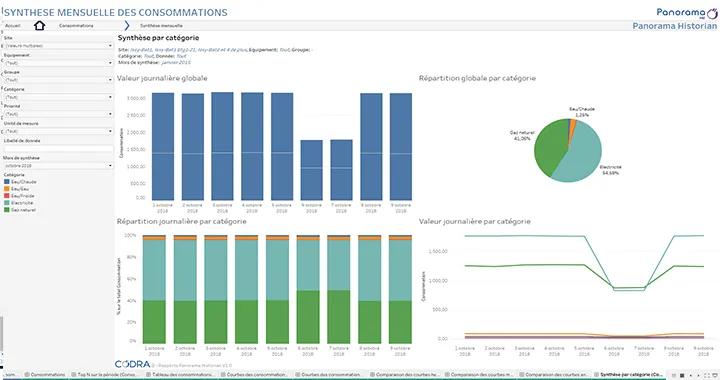
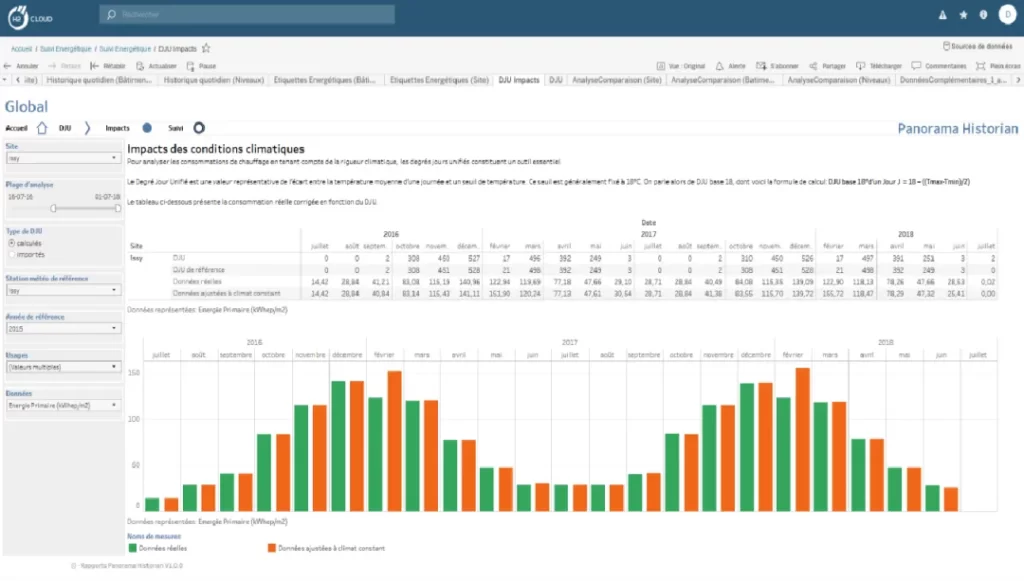
HOSCO Panorama SCADA Platform Adopting modular architecture and open communication interface, it can flexibly integrate architectural and industrial equipments, and open up the complete chain from data collection, visual display to energy consumption analysis, thus truly realizing energy transparency.

04 How to Identify "Hidden Energy Saving Potential"?

In complex commercial buildings, energy wastage is often the result of subtle deviations in a number of areas. For example:

  • Improper HVAC settings

  • Lighting not automatically adjusted according to occupancy

  • Data omissions lead to analytical bias

Modeling and algorithmic analysis through SCADA can reveal:

  • Energy efficiency KPI deviation

  • Energy flow imbalance between lighting and air conditioning systems

  • Early warning of potential waste through predictive algorithms

The Panorama SCADA platform enables cross-system energy consumption correlation analysis to help managers identify "deep inefficiencies" and continuously improve overall energy efficiency.

Other Articles

虹科 ELPRO 醫藥冷鏈實驗室技術人員操作 LIBERO 系列溫濕度記錄儀與監測設備。
Hongke Case

[Hongke Case Study] ELPRO LIBERO Series Temperature Loggers—Ensuring the Safety of High-Value Biopharmaceuticals

High-value novel biopharmaceuticals have extremely stringent cold chain temperature control requirements; even the slightest temperature deviation can result in losses of tens of millions of yuan and pose compliance risks. Using the example of a major domestic pharmaceutical group’s implementation of Hongke’s ELPRO LIBERO series temperature loggers, this article provides an in-depth analysis of how the system achieves zero-incident temperature control throughout the entire process (2°C to 8°C) and dual compliance with GSP and international standards through the automatic generation of tamper-proof PDF reports, SmartStart batch configuration, and standardized SOP services.

Read more
Hongke Dry Goods

[Hongke Solutions] Say Goodbye to Expensive Manual Annotation! aiData 4D Automatic Annotation Technology Enables a Closed-Loop ADAS Data System

In the development of ADAS and autonomous driving, the high cost and lengthy cycle of manual annotation severely hinder algorithm iteration. Hongke’s aiData Auto Annotator solution (developed by aiMotive) utilizes 4D environmental models and neural computing technology to achieve fully automated, high-precision annotation of dynamic 3D bounding boxes and static lane markings. Its annotation accuracy exceeds the human benchmark and can reduce annotation costs by more than 90%, providing an efficient and scalable closed-loop data system for autonomous driving R&D.

Read more
Hongke Dry Goods

[Hongke Solutions] Beyond Signals: Decoding Desite’s “Full-Stack” Technical Depth in the GNSS Field

In the GNSS field, many companies remain stuck at the “application-layer implementer” stage and struggle to meet challenges such as drone swarm coordination, high-precision positioning in extreme environments, and anti-jamming encrypted communications. Deste (a Hongke partner) has broken through the limitations of superficial integration to build end-to-end technical depth spanning “underlying technology—testing and validation—complex scenario applications.” This article provides an in-depth analysis of how Destar, through its strategic portfolio of patents and software copyrights, has built a GNSS technology moat from the “ground up.”

Read more

Contact Hongke to help you solve your problems.

Let's have a chat