
Search

Hongke's latest articles

HongKe

Lorem ipsum dolor sit amet, consectetur adipiscing elit. Ut elit tellus, luctus nec ullamcorper mattis, pulvinar dapibus leo.

Lorem ipsum dolor sit amet, consectetur adipiscing elit. Ut elit tellus, luctus nec ullamcorper mattis, pulvinar dapibus leo.

Hongke Solutions] Energy SCADA: How to gain insight into hidden energy waste problems in buildings?

With rising energy costs and increasingly stringent energy-saving and emission-reduction policies, building energy optimization has become a key aspect of digital transformation for enterprises. In the face of energy wastage and equipment inefficiency that are invisible to the naked eye, how can business managers accurately identify and tap into the "invisible energy-saving potential"? The answer is exactly:Energy SCADA System (Energy SCADA)The

01 What is Energy SCADA?

The core role of SCADA in energy management is to digitize the energy consumption of buildings. Real-time monitoring, analysis and optimizationIt can help enterprises to continuously improve energy efficiency and form a closed-loop energy efficiency improvement mechanism. It can help enterprises to continuously improve energy efficiency, form a closed-loop energy efficiency improvement mechanism, and truly implement smart energy saving.

Through the SCADA platform, the building's Electrical, HVAC, lighting, etc. systems The system can monitor and control all aspects of energy consumption, and provide automatic alerts and intelligent adjustments in the event of abnormal fluctuations or energy wastage. This data-driven energy management model not only effectively reduces costs, but also helps companies meet various energy-saving regulations (e.g., France's Tertiary Energy Efficiency Decree, China's "Double Carbon" standard, etc.).

02 Core Value of SCADA System

  • Quantifiable energy savings: Real-time data analysis can quickly locate energy consumption anomalies, reducing redundant operation and energy waste.
  • Compliance Enhancement::Helps enterprises to meet the requirements of energy saving or carbon emission related policies.
  • Efficiency and comfort at the same time: Ensure indoor comfort while realizing intelligent equipment operation.
  • Sustainable Optimization: Based on long-term data tracking and analysis, it provides a scientific basis for subsequent energy efficiency decisions.

03 Key Technologies for Realizing Energy Efficient SCADA

Building Management System (BMS)

BMS is the core infrastructure of energy SCADA, which collects building operation data through a network of distributed sensors and actuators, and regulates HVAC, lighting and other equipment in an automated manner.

A well-established BMS typically includes:

  • Environmental SensorsTemperature, CO₂, brightness, etc.

  • Enforcer: Valves, Thermostats, Lighting Control Modules

  • controllers: parsing data, triggering control logic

  • Communication Agreement: BACnet, Modbus, etc.

  • HMI Human Machine Interface: Visual monitoring and parameter setting

According to Energies Dev, intelligent BMS control can reduce energy consumption by as much as 30%This is especially true for high energy consumption scenarios such as HVAC.

Intelligent Sensing and Energy Monitoring

In the SCADA architecture, sensors and smart metering devices are the core of the "sensing layer" of energy monitoring.
High-frequency energy-consuming data collection and remote transmission can be realized through multiple types of sensors (power, heat, motion, etc.) and IoT communication technologies (LoRaWAN, Sigfox).

Focused control is required during deployment:

  • Accurate mapping of key energy consumption points

  • Sensors near major energy-consuming equipment to improve representativeness

  • Real-time data upload to SCADA to support predictive maintenance

This approach significantly reduces the risk of downtime and equipment failures, and enhances the reliability of energy management.

SCADA Energy Management Platform

Modern Energy SCADA platform integration:

  • Real-time monitoring

  • Trend Analysis

  • Data Modeling

  • Visualization

Helps managers to quickly pinpoint building energy consumption problems and develop improvement strategies.

An ideal SCADA system should have:

  • Real-time Alarms: Instant alerts for energy abnormalities

  • Multi-source data analysis: Electricity, gas and water analysis

  • Highly interoperable: Seamless integration with BMS/building equipment

  • Compliance Support: Compliance with EU BACS regulations, etc.

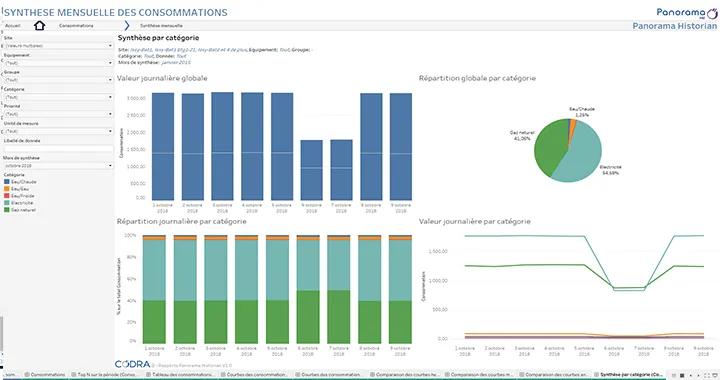
HOSCO Panorama SCADA Platform Adopting modular architecture and open communication interface, it can flexibly integrate architectural and industrial equipments, and open up the complete chain from data collection, visual display to energy consumption analysis, thus truly realizing energy transparency.

04 How to Identify "Hidden Energy Saving Potential"?

In complex commercial buildings, energy wastage is often the result of subtle deviations in a number of areas. For example:

  • Improper HVAC settings

  • Lighting not automatically adjusted according to occupancy

  • Data omissions lead to analytical bias

Modeling and algorithmic analysis through SCADA can reveal:

  • Energy efficiency KPI deviation

  • Energy flow imbalance between lighting and air conditioning systems

  • Early warning of potential waste through predictive algorithms

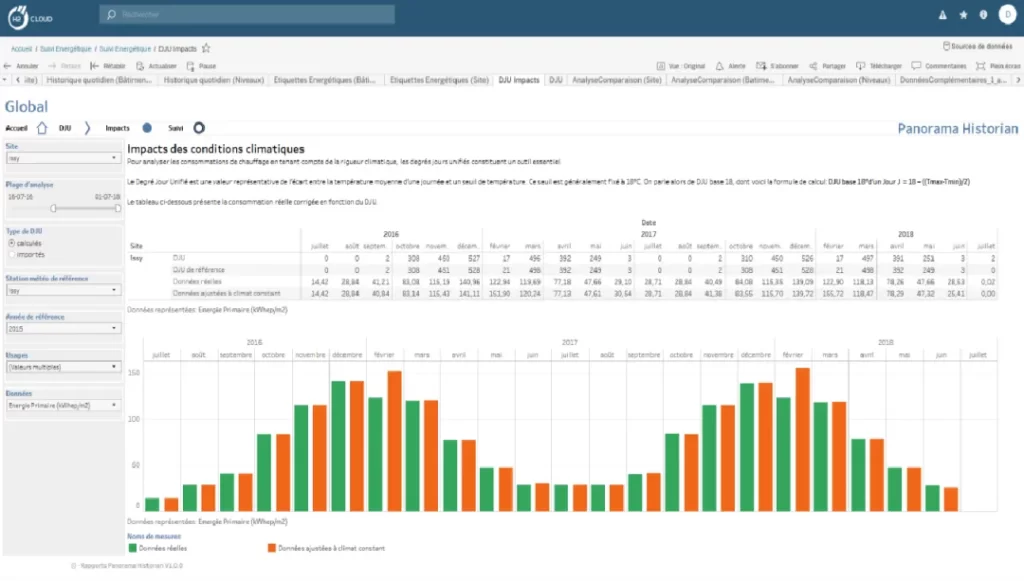
The Panorama SCADA platform enables cross-system energy consumption correlation analysis to help managers identify "deep inefficiencies" and continuously improve overall energy efficiency.

Other Articles

可配置的CAN FD模擬I/O模塊 功能概述: PCAN-MicroMod FD系列模塊是支持CAN FD的數采模塊。 PCAN-MicroMod FD 插入式板卡可以和即插即用的母板一起購買,母板提供了各種外設可滿足特定需要。對於CAN連接、I/O、和供電,可用彈簧端子連接器。 PCAN-MicroMod FD 數字版1和2著重於數字輸入和輸出,其上有相應的保護電路。數字1的數字輸出裝備了低邊開關,數字2的裝備了高邊開關。
Hongke Dry Goods

[Hongke Solutions] Can’t Read CAN Data? Not Enough Temperature Channels? A Comprehensive Guide to Integrating NVH and Battery Data Acquisition

Is your current NVH data logger unable to read the CAN bus? Are there not enough temperature channels for battery testing? Hongke offers the PCAN-MicroMod FD and MU-Thermocouple1 CAN FD modules to enable CAN(FD)-to-analog conversion and high-density thermocouple multi-module cascading expansion. No coding required—just unbox and use it right away, with no need to replace your existing system!


Read more
Hongke Dry Goods

[Hongke Solutions] AI Agent Implementation Case Study: Enterprise-Level Deployment Across Six Major Industries and the Logic Behind the Underlying Infrastructure

An in-depth analysis of how enterprises can transition from single LLM API calls to autonomous agentic systems. This article compiles real-world examples of AI agent deployments in production environments across six major industries, including retail and finance, and breaks down the underlying infrastructure logic—such as high concurrency, cross-interaction memory (Memory Infrastructure), and distributed state persistence.

Read more
Hongke Dry Goods

HONGKE SOLUTIONS] The Effect of Gaussian Noise on Positioning Effect in GNSS Simulation

In Global Navigation Satellite System (GNSS) radio frequency simulation testing, Gaussian white noise (AWGN) is typically regarded as the baseline configuration for replicating real-world electromagnetic environments. However, engineering practice has shown that the impact of noise on a receiver’s positioning performance does not follow a linear, monotonic relationship. Based on actual measurement data from the DST GNSS simulator, this paper analyzes the physical mechanisms of Gaussian noise in Kalman filters, correlator jitter, and phase-locked loops, and provides a scientific testing guide for configuring simulation noise.

Read more

Contact Hongke to help you solve your problems.

Let's have a chat