

Search

Hongke's latest articles

HongKe

Lorem ipsum dolor sit amet, consectetur adipiscing elit. Ut elit tellus, luctus nec ullamcorper mattis, pulvinar dapibus leo.

Lorem ipsum dolor sit amet, consectetur adipiscing elit. Ut elit tellus, luctus nec ullamcorper mattis, pulvinar dapibus leo.

HONGKE SOLUTIONS] Ampang Precision Test: How to Synchronize CAN Signals in NVH Road Test with Zero Development?

Avision PCAN Solution: Optimizing NVH Signal Acquisition

In the NVH (Noise, Vibration & Harshness) test, theSynchronized acquisition of CAN signalsOften it becomes a critical bottleneck.
In the face of this challenge, should we invest in costly in-house research and development, or should we look for mature and feasible off-the-shelf solutions?

The engineers at Ampang Precision gave the answer in a real road test--
Through deployment HongKe PCAN-MicroMod FD devicewith the words "Theready-to-use"The system upgrade is completed in the same way as the system upgrade of the car, and the car is successfully upgraded. Real-time conversion of CAN / CAN FD signals to analog voltage signalsIt is seamlessly integrated into the existing data capture system.

This article is compiled from the practical application experience of front-line engineers, and will provide an in-depth analysis of how to useinexpensiveEffective cracking NVH testing CAN signal synchronizationThe Government has been trying to address the long-standing pain points in the community.

Application Background

Core requirements for automotive NVH performance upgrades

With the rapid development of China's automobile industry in recent years, the market's demand for vehicle performance indicators and driving comfort continues to rise. As one of the important indicators of the overall quality of automobiles, theNVH PerformanceIncreasingly, there is a high level of concern.

Excellent NVH performance not only significantly enhances driving comfort and luxury, which in turn strengthens brand image and product competitiveness, but also helps maintain driving concentration, reduce fatigue, and has a direct impact on driving safety. Therefore, NVH has become one of the most important technological thresholds for automobiles to move towards premiumization and differentiation.

During automotive NVH testing.CAN signal acquisition is criticalFor example, through the acquisition of vehicle speed signals, wind noise, road noise and transmission noise can be analyzed under different speed conditions. For example, through the acquisition of vehicle speed signals, wind noise, road noise and transmission system noise can be analyzed under different vehicle speed conditions; while engine speed signals can be used for phase analysis and problem diagnosis to help pinpoint the phase characteristics of the noise source.

In addition, CAN signals such as throttle opening, drive torque and electrical system power also play a key role in NVH testing. These signals can correlate vehicle operating conditions with vibration and noise data, helping engineers pinpoint problems and continuously optimize the vehicle's NVH performance.

Collection bottleneck

Realistic Challenges of CAN Signal Reading

Professional NVH data acquisition devices on the market usually have powerful signal acquisition capabilities, which can synchronize the vibration and noise signals from accelerometers and microphone feedbacks for spectral analysis by NVH software.

However, this type of front-end equipment acquisitionMostly supports analog voltage signal input only.In addition, the CAN signal reading function is not equipped with the ability to read CAN signals directly by itself. If we develop additional CAN signal reading function, we will face high development cost and long time investment, and the practical feasibility is limited.

In this scenario, engineers are in dire need of a device that can:

  • Direct reading of vehicle CAN signals
  • Freely filter the type of signal you want.
  • and converts it to an analog voltage signal that is recognized by the NVH acquisition front-end.

The device must also be suitable for use in real-world road test environments, can be placed inside the vehicle, and its output interface must be compatible with the NVH acquisition system.

Programming on the ground

HTC PCAN Signal Conversion Integrated Solution

In response to these needs, HONGKE provides a set ofComplete and proven solutionsStable CAN signal acquisition and reading through standardized hardware. Through standardized hardware, CAN signal acquisition and reading are stabilized and output to NVH data acquisition equipment in the form of analog voltage.

Core Module:HongKe PCAN-MicroMod FD Data Acquisition Module

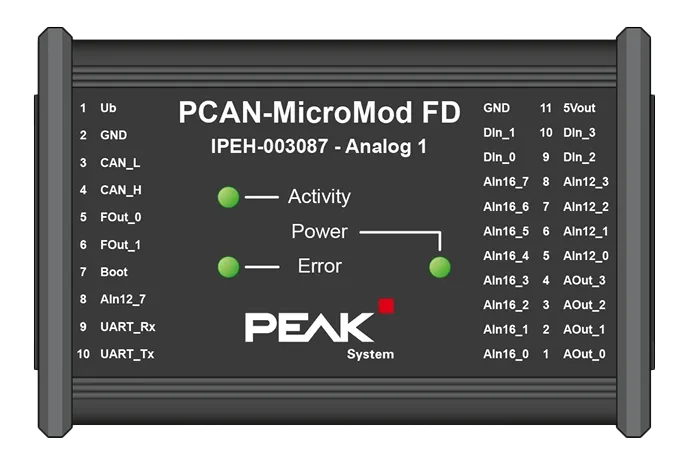
Avision PCAN-MicroMod FD Module Support CAN and CAN-FD signal reading and conversion.The maximum number of 4 output channelsOutput voltage range selectable ±5V or ±10VOutputs Outputs are preconfigured with Phoenix terminals and optional BNC Interface KitThe module can be powered directly from the vehicle's cigarette lighter for rapid deployment in real-world road test environments. The module can be powered directly from the vehicle's cigarette lighter for rapid deployment in real-world road test environments.

The PCAN series adapters can be used with Avision's configuration software to realize flexible configuration and management of PCAN-MicroMod FD modules.

Configuration Guidelines|Set once, reuse forever!

Before starting the test, it is necessary to set up the PCAN-MicroMod FD module as shown in the following figure.

Through the configuration software, users can flexibly select the CAN signals to be captured and set the corresponding output channels and voltage ranges. For example, the engine speed signal can be set to be output from channel 1, with a voltage range of ±5 V. Once the setting is complete, it can be saved and used directly for subsequent tests, requiring readjustment only when the signal selection is changed.

Configure engine speed signal reading
Configure the channel and amplitude of the output signal.

Road Tests|Simple Deployment, Simultaneous Collection

During the official road test, the system is connected as shown in the figure below, the NVH acquisition system maintains the original configuration, and the PCAN-MicroMod FD is powered by the cigarette lighter and connected to the vehicle CAN bus, reads the specified signals according to the pre-set parameters, and converts them into analog voltages for output to the acquisition equipment.

This allows the acquisition device to synchronize the recording of vibration and noise signals with the vehicle's CAN signals, providing a complete and consistent data base for subsequent NVH analysis. The graph below shows the actual engine speed signals captured via CAN, with stable data performance and real-time response.

Actual on-site connection: Cigarette lighter powered (left) and Hongke PCAN device connected to a computer (right).
Vehicle engine speed signal acquired by CAN.

Customer Testimonials|Professionalism and Quality

"From requirement communication, solution selection and matching, to final on-site commissioning and training, HONGKE continues to surprise us with its professional technical knowledge, enthusiastic service attitude, and mature and reliable products, and has successfully assisted us in solving our on-site CAN signal acquisition problems."

-- Dai Xiaoyun
Anpeng Precision Measurement Technology (Suzhou) Co.
Technical Application Manager, China

Proof of Value

This solution is based onRelatively low costIn addition, it effectively solves the technical problem that NVH acquisition equipment cannot read CAN signals by itself, so NVH hardware manufacturers do not need to invest additional resources to develop CAN reading function by themselves, and can quickly complete system integration through the standardized products of Avision, which greatly shortens the development cycle.

At the same time, the solution is highly flexible, allowing users to filter the CAN signals they need to collect and convert them into voltage signals for seamless integration with existing NVH collection systems. The overall configuration process is simple and efficient, and can be set up once for long-term use.

The equipment itself has excellent reliability and environmental adaptability, supports on-board power supply, and has anti-vibration and anti-shock characteristics, which is fully applicable to the actual vehicle road test scenarios, and can be used for Ideal expansion module for NVH-captured front-endsThe

Other Articles

Hongke Dry Goods

[Hongke Solutions] Human-Factors Risk Management in Cybersecurity: Case Studies and KnowBe4 Best Practices

Faced with human-related cybersecurity risks, how can enterprises effectively prevent data breaches? This article provides an in-depth analysis of the latest enforcement cases, covering vulnerabilities in public code repositories, data APIs, and malicious activities by former employees. By combining Hongke’s KnowBe4 phishing simulations, AIDA real-time coaching, and compliance requirements, we help Hong Kong enterprises build a robust defense system that integrates technology, policies, and personnel.


Read more
虹科 aiSim 智駕仿真平台軟體介面:支援 OpenDRIVE 與 Atlas 地圖格式轉換及非結構化道路場景編輯
Hongke Case

[Hongke Solutions] aiSim Intelligent Driving Simulation: A Comprehensive Guide to Unstructured Road Testing

An In-Depth Analysis of How Autonomous Driving Simulation Solves the Challenges of Unstructured Road Testing! Hongke’s aiSim solution integrates OpenDRIVE-to-Atlas map conversion and utilizes Unreal Editor and Blender to create high-fidelity terrain and road surface models, providing vehicle dynamics feedback and closed-loop testing of physical sensors to comprehensively accelerate the validation of Level 3 and Level 4 autonomous driving algorithms. Learn more about efficient scene construction now!

Read more
Hongke Dry Goods

[Hongke Solutions] Does AI Struggle to Understand Business Needs? Overcoming AI Context Disconnects and Real-Time Data Bottlenecks in Enterprises

Failed Enterprise AI Implementation? The Problem Isn’t the LLM Model! Hongke analyzes the devastating impact of the “Enterprise AI Context Gap” on Copilot and Agentic workflows and introduces the Redis Iris real-time context layer architecture to help B2B enterprises in Hong Kong and Southeast Asia build high-return AI systems.

Read more

Contact Hongke to help you solve your problems.

Let's have a chat