Search

Hongke's latest articles

HongKe

Add your title text here

I. Introduction: Strategic Changes at the Data Layer under the Critical Infrastructure Legislation

Add your title text here

[Hongke Solutions] Can’t Read CAN Data? Not Enough Temperature Channels? A Comprehensive Guide to Integrating NVH and Battery Data Acquisition

In complex application scenarios such as automotive engineering NVH (noise, vibration, and harshness) road testing, power battery temperature monitoring, electric vehicle charging, and power system monitoring, test engineers often face two major challenges:Existing analog data acquisition equipment cannot directly parse CAN/CAN FD bus data.as well asThe high density of testing sites has led to a severe shortage of testing channels.The

Replacing an entire, expensive data acquisition system to accommodate new CAN signals would not only be extremely costly but would also entail the risk of extensive secondary development and system restructuring. How can high-fidelity fusion of multi-source data be achieved without altering the existing architecture? How can data acquisition channels be expanded at a low cost? This article provides an in-depth analysis of Hongke’s PCAN-MicroMod FD and MU-Thermocouple1 CAN FD Technical Principles, Application Solutions, and Practical Guides for Modules.

Solving NVH and Energy Harvesting Challenges: CAN (FD) and Bidirectional Analog-to-Digital and Digital-to-Analog Conversion

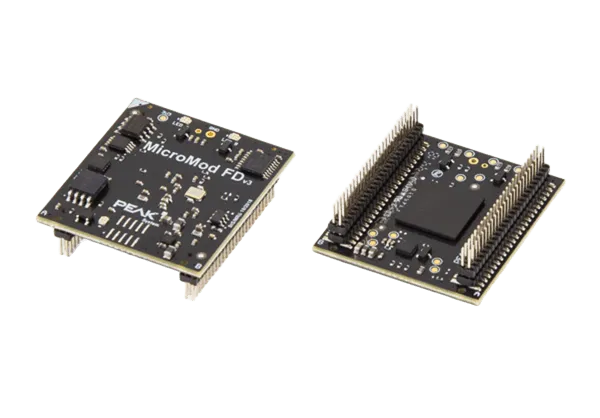
虹科 PCAN-MicroMod FD CAN/CAN FD I/O 模組正面與背面外觀,印有 MicroMod FD v3 與 PEAK-System 標誌,配備雙排連接針腳,用於數模訊號轉換與多源數據採集。

1. NVH Road Test Scenarios: Converts CAN signals to analog signals, ensuring full compatibility with existing test equipment

During whole-vehicle NVH testing, engineers need to simultaneously acquire vibration signals (analog data) and key vehicle status parameters—such as engine speed, vehicle speed, and pedal position—(CAN bus data).

  • Traditional Pain Points: The older NVH simulation data acquisition front end lacks the ability to parse CAN interfaces and cannot directly read CAN messages.

  • Hi-Tech Solutions: Take HongKe PCAN-MicroMod FD As an in-vehicle bridge node connected to the CAN bus,Accurately capture vehicle speed and RPM parameters according to the preset logic,It then converts this high-fidelity data into an analog voltage signal and outputs it directly to the existing NVH data logger.

  • Core Strengths: No secondary development required; plug-and-play; fully compatible with existing NVH test architectures; significantly improves test efficiency.

2. Power and Battery Management (BMS): High-Precision Analog-to-CAN/CAN FD Conversion

In power systems, high-speed train charging, and battery management systems (BMS), real-time monitoring of voltage and current parameters and fault diagnosis are critical.

  • Hongke PCAN-MicroMod FD Analog 1: Equipped with 8-channel, 16-bit high-precision analog inputs, with a flexible four-range adjustment of ±2.5 V, ±5 V, ±10 V, and ±20 V, and equipped with corresponding overvoltage protection circuits, it can accurately encapsulate the acquired voltage and current data into CAN/CAN FD messages for real-time transmission to a host computer or control module.

  • Hongke PCAN-MicroMod FD Digital 1/2: Designed for digital switching applications, it features a low-side switch (Digital 1) and a high-side switch (Digital 2) to meet flexible control and status monitoring requirements.

High-Density Temperature Monitoring for Power Batteries: Thermocouple Modules and Multi-Module Cascading Expansion

The temperature distribution within new energy vehicle battery packs during charging and discharging directly affects battery safety. How can fast and stable temperature monitoring be achieved when there are a large number of monitoring points?

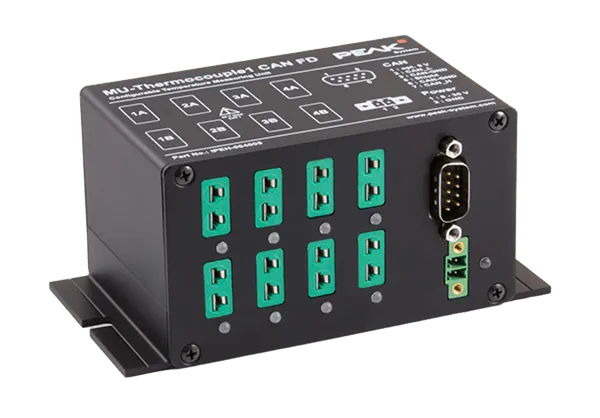
虹科 MU-Thermocouple1 CAN FD 熱電偶模組實物圖,展示 8 通道綠色熱電偶接線端子、D-Sub 9 針 CAN FD 接口與頂部線路定義圖,用於新能源電池高精度溫度監測。

1. High-Precision Thermocouple Data Acquisition: MU-Thermocouple1 CAN FD

To address the need for battery pack temperature monitoring,Hongke MU-Thermocouple1 CAN FD Thermocouple Module Provides highly reliable solutions:

  • High Collection Accuracy: Measurement accuracy up to 0.2%, with a temperature resolution of up to 1/16 °C...which can accurately detect even the slightest temperature changes in the battery.

  • Real-Time Data Stream: When used in conjunction with PCAN devices to form a network, it converts thermocouple temperature signals into CAN FD messages in real time and plots dynamic temperature change curves.

2. Seamless Cascading Expansion: Easily Overcome Channel Capacity Limits

When 8 temperature channels are not sufficient, the entire Hongke module series supports parallel expansion of multiple modules on a single CAN bus:

  • Hardware ID Settings: Set the device ID (0–15) using the onboard rotary switch.

  • Single-Bus Capacity: A single CAN bus supports up to Online Configuration of 16 Modules(If online configuration is not required,(Up to 16 modules can be connected during operation.)

  • Automatic Identification and Classification: The accompanying configuration software automatically distinguishes between individual nodes based on their device IDs,Easily scale up to hundreds of measurement points.

No-Code, Out-of-the-Box: Lowering the Development Barrier for Engineers

For engineering data collection projects,Development cycles and software learning costs are important evaluation metrics.Hongke's solution eliminates the need for complex coding right from the ground up:

1. Factory Presets and Plug-and-Play

The PCAN-MicroMod FD and MU-Thermocouple1 CAN FD come with default configurations out of the box and are ready to begin signal conversion and message transmission as soon as power is applied.

2. Free Graphical Configuration Tool

Available for the Windows platform PCAN-MicroMod FD Configuration and Thermocouple FD Configuration Software that supports flexible configuration of I/O mapping, CAN ID, transmission cycle, gain, and offset.

3. Deploy Once, Run Independently

Once the configuration parameters are downloaded to the module via the CAN bus in a single transmission, the module can operate as an independent CAN node without the need to write additional microcontroller code.

4. Extensive built-in processing capabilities

It supports simple I/O-to-CAN ID mapping and includes built-in data processing function blocks; the PCAN-MicroMod FD series also offers optional features CANopen Firmware, seamlessly integrates with existing CANopen industrial networks.

Frequently Asked Questions

Q1: Without replacing the existing NVH data logger, how can the CAN bus vehicle speed signal be integrated into the NVH data acquisition system?

A1:Using the Hongke PCAN-MicroMod FD as a CAN bus bridge node, the system captures vehicle speed and engine speed messages from the CAN bus, converts them into high-fidelity analog voltage signals, and outputs them to the existing NVH data acquisition system—without the need to replace the acquisition equipment or redevelop the system.

Q2: Battery pack testing requires dozens of temperature channels. How should multiple modules be cascaded?

A2: Hongke MU-Thermocouple1 CAN FD supports connecting multiple modules in parallel on the same CAN bus. By setting different device IDs (0–15) using the onboard rotary switch, the software can automatically identify and distinguish between each module; a single bus supports online configuration of up to 16 modules.

Q3: Do I need to write C/C++ or Python code to use Hongke I/O modules and thermocouple modules?

A3:No. Hongke provides free Windows-based graphical configuration software. Engineers simply need to set the CAN ID, transmission period, and scaling factor; once the configuration is sent to the module via the CAN bus, the module can operate independently.

To learn more about how to use Hongke PCAN-MicroMod FD and MU-Thermocouple1 CAN FD Can Modules Break the Deadlock on Data Integration and Multi-Channel Expansion?

Go NowHongke CAN / CAN FD / LIN Bus SeriesVisit the product page for more details and technical specifications.

Other Articles

Hongke Dry Goods

[Hongke Insights] Cybersecurity in Healthcare and Defense Strategies Against AI Agents – Digital Healthcare Security White Paper

Hackers Are Targeting Healthcare Organizations! An IBM report indicates that the cost of a healthcare data breach can reach as high as $7.42 million. This white paper analyzes the risks associated with telemedicine, AI agent prompt injection, and KnowBe4 cybersecurity training to help Hong Kong healthcare organizations strengthen their security defenses.

Read more
Hongke Case

[Hongke Case Study Details] 2015 Mercedes-Benz E260L Won’t Start? CAN Bus Troubleshooting and Pico Oscilloscope Diagnosis Case Study

An In-Depth Analysis of the 2015 Mercedes-Benz E260L Engine Failure to Start and Starter Motor Malfunction. Demonstrates how to use a Pico automotive oscilloscope to analyze CAN E-bus waveforms, accurately pinpointing a CAN L/H short to ground and water ingress in the A90 collision prevention control module, and provides professional B2B automotive circuit and CAN bus diagnostic solutions.

Read more
Hongke Case

[Hongke Solutions] Safety Solution for Long-Distance Ocean Transport of Lithium Batteries – Shengweino International Case Study

How Can Thermal Runaway and Impact Damage Be Prevented During Long-Distance Ocean Transport of Lithium-Ion Batteries? Shengweino International uses Hongke’s ASPION G-Log 2 shock recorder to precisely monitor container impacts (G-forces) and changes in temperature and humidity throughout the entire journey, creating a comprehensive transport environment history and improving the efficiency of logistics claims processing and quality tracking. Learn more about our B2B lithium-ion battery ocean freight safety monitoring solutions now!

Read more

Contact Hongke to help you solve your problems.

Let's have a chat