

Search

Hongke's latest articles

HongKe

I. Introduction: Strategic Changes at the Data Layer under the Critical Infrastructure Legislation

Add your title text here

HONGKE SOLUTIONS] The Effect of Gaussian Noise on Positioning Effect in GNSS Simulation

The Physical Definition and Necessity of Gaussian Noise in GNSS Simulation

In an ideal mathematical model, satellite signals are perfectly modulated BPSK sequences at a specific frequency. However, in the real world, satellite signals arrive at the ground with extremely low power (approximately -130 dBm) and are typically drowned out by thermal noise at the receiver’s front end. GNSS simulators introduce Gaussian noise primarily based on the necessity of the following two factors:

1. Accurate Recreation of the Physical Environment

By adding AWGN and precisely controlling the carrier-to-noise ratio (C/No), the simulator bridges the gap between “digital simulation” and “physical RF.”

2. The “Pressure Chamber” in the Receiver Algorithm

When no noise is added, the test evaluates the receiver’s “logical correctness” (code logic); when noise is added, the test evaluates the receiver’s “signal processing performance” (sensitivity, tracking accuracy, and loop bandwidth design) under strong noise interference.

Experimental Analysis: Nonlinear Effects of Gaussian Noise Under Two Special Operating Conditions

In actual testing, there is a complex nonlinear relationship between noise and localization performance, which is primarily evident in the following two extreme scenarios.

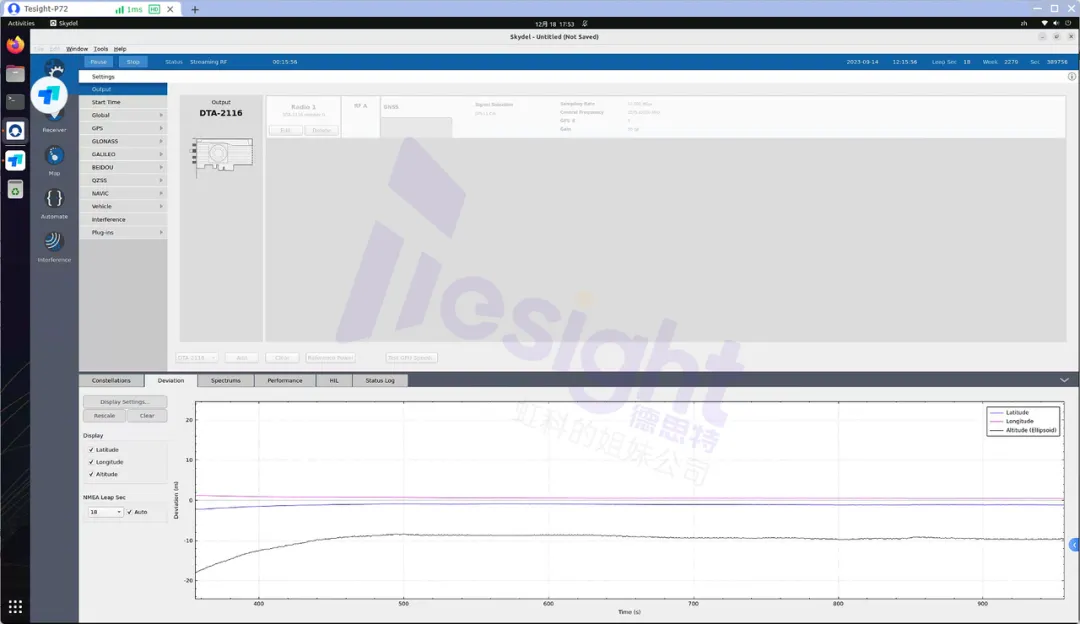
Special Case 1: Without Gaussian noise testing, the positioning performance is actually worse.

At standard signal power, with the simulator noise turned off, the receiver achieves a higher signal-to-noise ratio, but the positioning performance isConvergence is extremely slow (500 s), there is a clearSystematic error (altitude error of up to 10 m), with only the trajectory appearing extremely smooth.

Analysis of the Reasons Why Physical Limits Are the Dominant Factor:

1. The “deadlock” effect of the Kalman filter (KF)

KF relies on the observed noise covariance matrix (R) and the covariance matrix of the prediction errors (P) Calculate the Kalman gain (K). When the input signal is completely noise-free, the residuals of the observed values are extremely small or even zero, causing the filter to assume that the system has reached a perfect state. As a result, it excessively reduces the gain, rejects new observation updates, and ultimately becomes insensitive to system bias, significantly prolonging the convergence time.

2. “Dead Zone” and Quantization Error in Relays

A moderate amount of noise acts as dithering in signal processing, and through statistical averaging, the resolution can be improved beyond the quantization bit. Without noise, minute system errors (such as slight timing discrepancies between the simulator and the receiver) would fall within the phase detector’s “dead zone” and remain uncorrected, thereby accumulating as a fixed positional error.

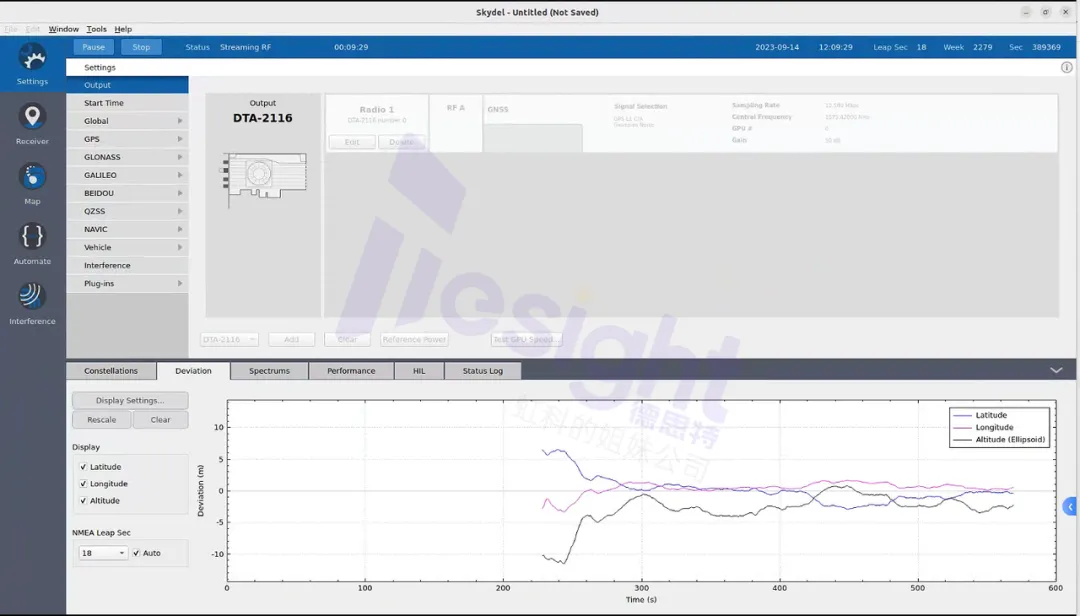
Special Case 2: In low-power environments, the addition of noise causes positioning errors to increase.

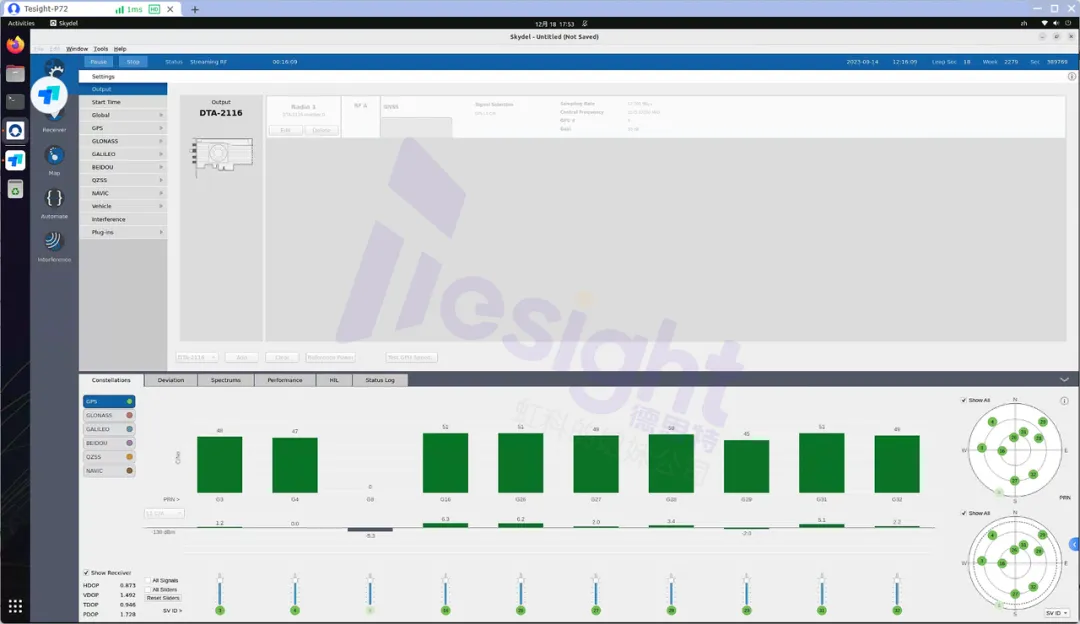
When simulating obstructions or indoor environments (with an additional 30 dB attenuation applied externally, reducing the output power to approximately -140 dBm), the addition of Gaussian noise causes a significant drop in the signal-to-noise ratio, resulting in azimuth and elevation errors of up to 3 m, altitude errors of up to 5 m, and severe jitter. If the power is reduced further, it may even cause the receiver to lose lock.

Analysis of the Reasons Why Physical Limits Are the Dominant Factor:

1. Fall below the detection threshold

When the signal itself is extremely weak, the superimposed Gaussian noise directly raises the noise floor, causing the C/No to fall below the receiver’s minimum detection signal-to-noise ratio, and the correlation peak cannot stand out from the noise.

2. Periodic Jumps in the Phase-Locked Loop (PLL)

At low carrier-to-noise ratios, the variance in phase jitter caused by Gaussian noise exceeds the linear tracking range of the phase detector, resulting in frequent cycle slips that render the carrier phase measurements completely unusable.

Comprehensive Comparison Matrix of the Effects of Gaussian Noise

To visually demonstrate the impact of Gaussian noise under different operating conditions, the overall performance under these conditions is summarized as follows:

GNSS 模擬器高斯噪聲對比矩陣:信號功率、C/N0與定位表現核心機制

Deste Practical Guide: How to Scientifically Configure GNSS Simulation Noise?

When conducting test projects using Tesight GNSS simulators (such as the Skydel engine), it is recommended to follow the "tiered testing" principle:

1. Algorithm Verification Level (Logic Verification)

  • Settings: Turn off Gaussian noise.

  • goal: Check whether the code logic, ephemeris calculations, and coordinate system conversions are correct, focusing on whether the position can be calculated.

2. Performance Benchmark

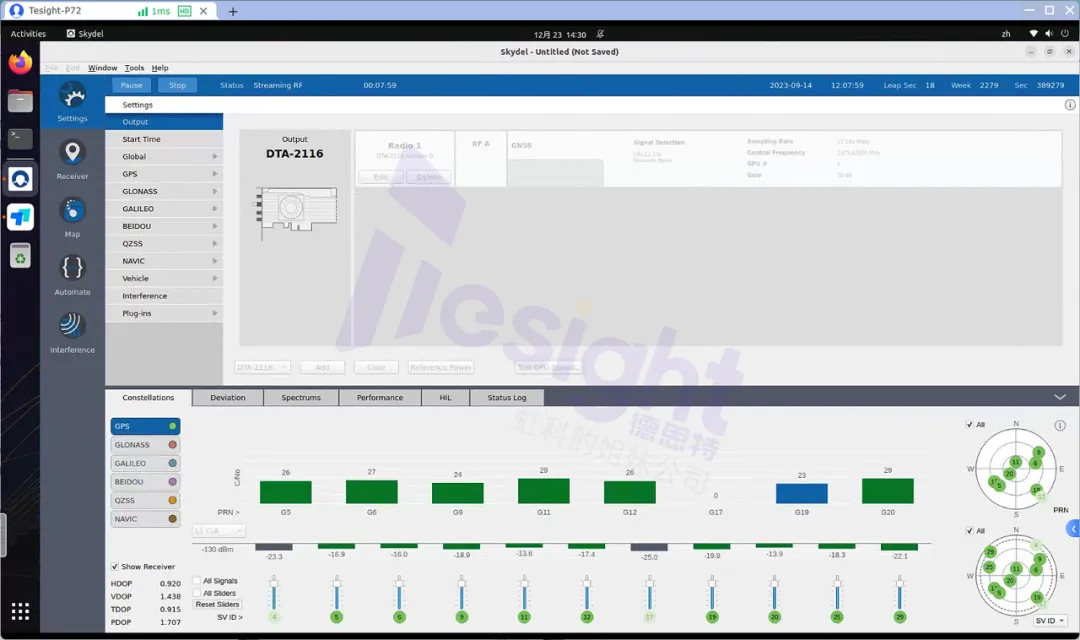
  • Settings: Enable Gaussian noise and calibrate C/No to the standard value (recommended C/No = 44 dB-Hz, which corresponds to -174 dBm/Hz in the Skydel interface).

  • goal: Most closely simulates real-world outdoor conditions, using RMS, CEP, and TTFF as acceptance criteria for receiver performance.

  • Compliance Notes: In standardized tests such as GB/T-45086.1, a direct connection using RF cable is typically used. Unless otherwise specified in the standard, Gaussian noise is not enabled to prevent the superimposed noise power spectral density from altering the total power at the antenna port and interfering with the accuracy of the power meter measurements.

3. Stress Testing

  • Settings: Keep the noise floor constant while reducing the signal power, or increase the noise density.

  • goal: Plot the C/No versus positioning error curve to determine the sensitivity threshold at which the receiver completely loses lock.

Frequently Asked Questions

Q1: Why does enabling Gaussian noise at standard power result in faster localization convergence than when noise is disabled?

A1: Modern GNSS receivers rely on Kalman filters for state estimation. A completely noise-free signal would cause the filter residuals to approach zero, leading to a gain “deadlock” and preventing the timely correction of initial errors; the dithering effect provided by an appropriate amount of noise helps the Kalman filter continuously update its state, thereby significantly reducing the convergence time.

Q2: When conducting conducted emission tests in accordance with national automotive standards (such as GB/T-45086.1), is it necessary to enable the simulator’s Gaussian noise?

A2:It is generally not recommended to enable this feature. National standard test requirements call for precise control of the signal power reaching the receiver antenna port. If the simulator’s Gaussian noise is enabled, the superposition of the noise power spectral density will alter the total power at the port, affecting the accuracy of the power meter and the test results.

Want to learn more about how you can continuously optimize your high-precision positioning devices and provide a rigorous, repeatable simulation environment using Deste's full-stack GNSS testing solutions? Visit us nowGNSS Main PageLearn more.

Other Articles

AR 遙距會診
Hongke Case

[Hongke Solutions] The New Normal in Telemedicine: How Are AR Smart Glasses Reshaping Remote Consultations and Surgical Collaboration Workflows?

Hongke’s AR Remote Consultation Solution combines Vuzix lightweight smart glasses with the S Med remote platform to enable high-definition, real-time first-person view sharing and hands-free voice control. Remote specialists can instantly freeze the screen to annotate and zoom in on lesions, effectively overcoming geographical barriers and improving the efficiency of emergency care and surgical collaboration. Learn more about AR smart medical guidance and its practical applications today!

Read more
Hongke Dry Goods

[Hongke Insights] Cybersecurity in Healthcare and Defense Strategies Against AI Agents – Digital Healthcare Security White Paper

Hackers Are Targeting Healthcare Organizations! An IBM report indicates that the cost of a healthcare data breach can reach as high as $7.42 million. This white paper analyzes the risks associated with telemedicine, AI agent prompt injection, and KnowBe4 cybersecurity training to help Hong Kong healthcare organizations strengthen their security defenses.

Read more
Hongke Case

[Hongke Case Study Details] 2015 Mercedes-Benz E260L Won’t Start? CAN Bus Troubleshooting and Pico Oscilloscope Diagnosis Case Study

An In-Depth Analysis of the 2015 Mercedes-Benz E260L Engine Failure to Start and Starter Motor Malfunction. Demonstrates how to use a Pico automotive oscilloscope to analyze CAN E-bus waveforms, accurately pinpointing a CAN L/H short to ground and water ingress in the A90 collision prevention control module, and provides professional B2B automotive circuit and CAN bus diagnostic solutions.

Read more

Contact Hongke to help you solve your problems.

Let's have a chat