
Search

Hongke's latest articles

HongKe

Lorem ipsum dolor sit amet, consectetur adipiscing elit. Ut elit tellus, luctus nec ullamcorper mattis, pulvinar dapibus leo.

Lorem ipsum dolor sit amet, consectetur adipiscing elit. Ut elit tellus, luctus nec ullamcorper mattis, pulvinar dapibus leo.

Hongke Solution] GNSS Simulator for Consumer Electronics, Navigation Chip and Positioning Terminal Tests

In today's rapidly advancing technology, Global Navigation Satellite Systems (GNSS), such as GPS, GLONASS, Galileo and BeiDou, have become an indispensable core technology in daily life. GNSS plays a key role in many areas, from map navigation in smartphones, precise control of drones, to safe positioning of self-driving cars.

To ensure the performance stability and positioning accuracy of these devices, a GNSS simulator is a precision instrument specifically designed for testing consumer electronics, navigation chips, and various types of positioning terminals. It is capable of generating simulated GNSS signals to provide a controlled and repeatable test environment during the R&D phase. With this simulator, engineers can test the responsiveness of equipment to different satellite signals, interference conditions and geographic location switches in the laboratory, and verify its positioning accuracy, time synchronization, and data reception and processing capabilities.

For the consumer electronics industry, GNSS simulators help manufacturers optimize product positioning services to ensure that users receive accurate location information in a variety of environments. For navigation chips, it provides a test platform to evaluate the robustness and performance of chips in complex signal environments. In positioning terminal designs, such as smart watches or IoT devices, GNSS simulators can quickly detect and fix potential problems, enhancing the overall experience of the terminal.

In addition, as the demand for high-precision positioning increases with the development of 5G and the Internet of Things, GNSS simulators continue to be upgraded to meet the need for higher precision and real-time testing. They not only improve R&D efficiency, but also reduce costs by eliminating the need for frequent and costly field testing.

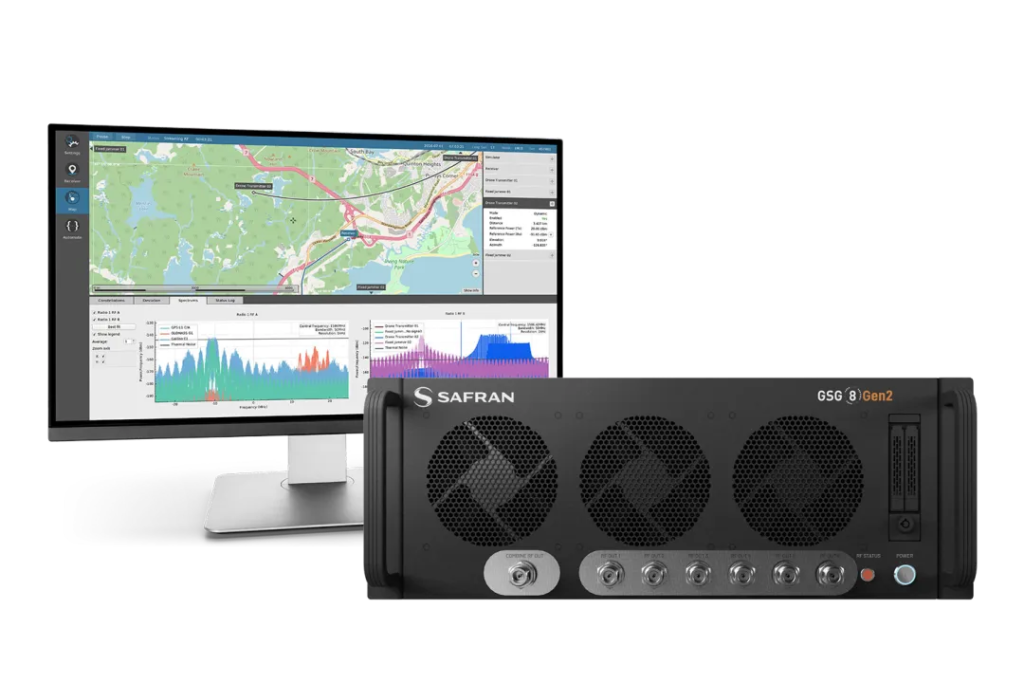
Safran GNSS simulators from Avision provide efficient support for consumer electronics, positioning and navigation chips and terminal testing -

(1) Controllability

The simulator allows precise control and adjustment of GNSS signal parameters such as frequency, pseudo-random code sequences, and satellite position, making the testing process more controllable and helping to reproduce a wide range of signal environments in the real world.

(2) Flexibility

Limited by weather or geography, the simulator can be tested anywhere, anytime, saving time and cost of field trials and allowing iterative testing and optimization to enhance R&D efficiency.

(3) Consistency

The signal generated by the simulator is stable and reliable, avoiding the uncertainty caused by fluctuations in the actual satellite signal and helping to ensure consistent performance under all ideal and extreme conditions.

(4) Security

For sensitive equipment or applications involving privacy, the use of simulators allows testing in a secure environment and safeguards data security.

(5) Efficiency

Through batch testing, you can quickly check the consistency and performance of a large number of products, reduce manual intervention and minimize error rates.

(6) Troubleshooting

Simulators can help identify and pinpoint problems, such as lack of receiver sensitivity or decoding errors, so that engineers can make targeted hardware or software improvements.

(7) Standardized Testing

A unified test methodology facilitates international interoperability and certification, compliance with industry standards, and streamlines the time-to-market process.

(8) Cost-effectiveness

In the long run, although the initial investment may be higher, the overall R&D cost is reduced by minimizing the number of field tests and shortening the development cycle.

Other Articles

Hongke Dynamic

[Hongke News] Why Rule-Intensive Businesses Are Better Suited for Low-Code: Making Decision Logic “Configurable” Instead of “Hard-Coded”

Many rule-intensive enterprises often face challenges during digital transformation, such as business rules being tightly coupled with underlying code, cumbersome tuning processes, and difficulties in unifying logic across systems. Low-code solutions can transform decision logic into visual configurations, shortening rule iteration cycles and clarifying the division of responsibilities between business and IT. The Decisions platform integrates a low-code environment with a rules engine to independently build a shared decision-making layer. It supports drag-and-drop rule management and cross-system integration and invocation, balancing operational flexibility with IT governance and regulatory requirements.

Read more
Hongke Case

[Hongke Case Study] Hongke Panorama SCADA System: Enabling Industrial Automation and IT/OT Convergence Through REST Web Services

Learn more about how Hongke Panorama Suite uses standard REST Web Services (REST APIs) to enable bidirectional data exchange, break down data silos on the industrial floor, and seamlessly connect SCADA systems with real-world weather, energy, and telemetry big data—thereby comprehensively accelerating the deep integration of enterprise IT and OT.

Read more
Hongke Case

[Hongke Solutions] SimData High-Fidelity Virtual Dataset Solution: Perception Training for Autonomous Driving Based on aiSim

Hongke has launched SimData, a high-fidelity virtual dataset built on the aiSim simulation platform and fully compatible with the nuScenes format. It provides high-quality multimodal training data for autonomous driving perception algorithms, LiDAR, and BEV models, effectively addressing the challenge of data collection in extreme scenarios (Edge Cases). Click now to learn about the development process and see real-world results!

Read more

Contact Hongke to help you solve your problems.

Let's have a chat