
Search

Hongke's latest articles

HongKe

Lorem ipsum dolor sit amet, consectetur adipiscing elit. Ut elit tellus, luctus nec ullamcorper mattis, pulvinar dapibus leo.

Lorem ipsum dolor sit amet, consectetur adipiscing elit. Ut elit tellus, luctus nec ullamcorper mattis, pulvinar dapibus leo.

[Hongke Insights] From “Cables” to “Starry Sky”: Skydel Anechoic Launches a New Paradigm for GNSS Real-World Physical Field Testing

In traditional Global Navigation Satellite System (GNSS) receiver testing, R&D and test engineers typically establish a “closed-loop” conductive connection between the simulator and the receiver using high-frequency RF cables. This traditional conductive testing method has proven highly effective in verifying performance metrics such as receiver sensitivity, satellite acquisition speed, and basic positioning algorithms, and remains one of the most widely used and mainstream standard testing methods in the global navigation and positioning industry today.

However, when dealing with Controlled Reception Pattern Antenna (CRPA) arrays that require spatial filtering to eliminate external interference sources, or in operating conditions where the installation environment—such as reflections from the aircraft fuselage surface, physical distortion of the antenna radome, conventional direct cable connection solutions prove inadequate and are fundamentally incapable of accurately reproducing the true, complex spatial physical field environment. How can we utilize anechoic chamber technology—commonly known in the industry as “starry sky” multi-antenna radiation testing—in a controlled laboratory setting to to precisely reconstruct the three-dimensional spatial geometry and phase relationships between satellite signals and interference sources, and to perform real-time closed-loop verification of the physical coupling and phase characteristics among antenna elements, has become a new core challenge in the field of high-precision navigation testing. In particular, with the rapid rise of the low-altitude economy (such as unmanned aerial vehicles (UAVs) and electric vertical takeoff and landing (eVTOL) aircraft) in Hong Kong and Southeast Asia in recent years, the industry has placed significant emphasis on physical field simulation technologies for such extreme environments.

In addition to providing standard GNSS simulator solutions, Hongke has collaborated closely with leading global partners to launch a brand-new, high-precision test system designed for simulating real-world GNSS environments and precise phase angles— Skydel Anechoic Simulation SystemThe

What is an anechoic chamber radiation simulation system?

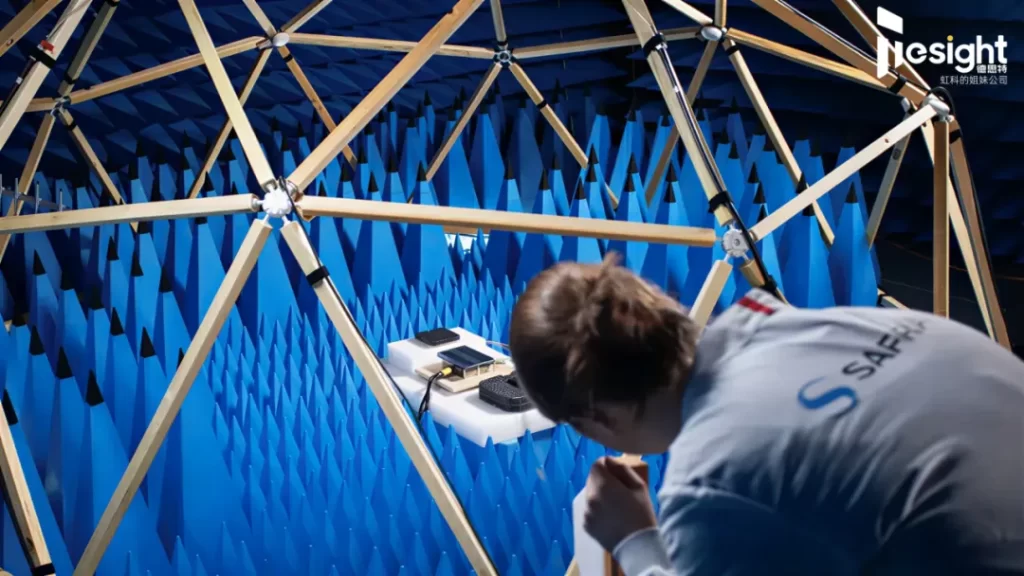
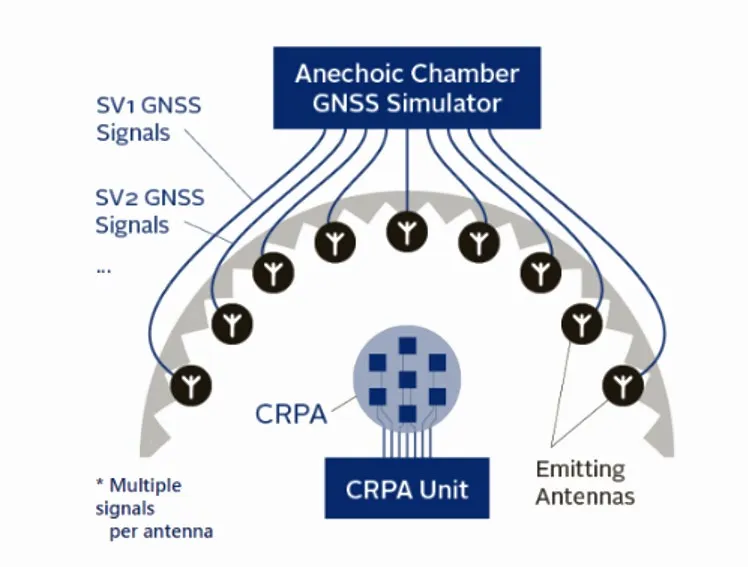
Skydel Anechoic This is an advanced GNSS radio frequency space simulation system designed to “perfectly replicate a three-dimensional sky” in a controlled indoor environment. It completely overcomes the physical limitations of traditional cable connections, by scientifically deploying a transmitter antenna array (Tx Array) in a professional microwave anechoic chamber, it realistically projects and transmits high-fidelity simulated satellite signals to the device under test (DUT) via over-the-air (OTA) transmission.

This system not only accurately represents, at the physical level, the precise angle of arrival (AoA) of each navigation satellite and complex interference sources, but also requires the simulated signals to realistically penetrate the protective antenna radome or bypass the complex airframe structure. This advanced “Wavefront Reconstruction Technology” enables the CRPA array’s spatial filtering and anti-interference capabilities, as well as the signal phase distortion caused by physical obstruction from the airframe, to be precisely captured and verified in the laboratory—just as they would be in the real-world airspace tens of thousands of miles above the ground.

Core Applications of Anechoic Chambers

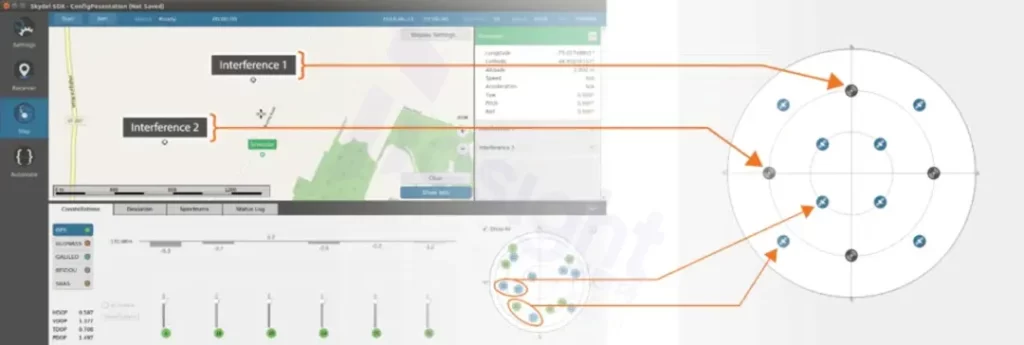
  • CRPA Immunity Limit Test: Test controlled reception pattern array (CRPA) antennas on high-value unmanned aerial vehicles (UAVs) or special-purpose vehicles. Thoroughly verify whether, when subjected to interference sources from different directions and at different frequencies, these antennas can physically and precisely “shield” the interference incidence angles using beamforming technology.

  • Testing for Obstruction by the Antenna Radome and Airframe Structure: Test GNSS antennas installed inside aircraft fuselages, drone skins, or high-specification antenna radomes to verify the effects of physical structures and material refraction on dynamic signal phase and gain distortion.

  • High-Precision OTA (Out-of-Band Testing): Comprehensively verify the phase center stability of smartphones, smart wearable devices, high-precision measurement antennas, or drones (including phase center offset (PCO) and phase center variation (PCV)). These micrometer-level physical parameters cannot be detected or measured using traditional cable testing methods.

  • Protection Against Spoofed and Deceptive Signals: In a simulated complex electronic warfare/signal countermeasures environment, test the receiver’s ability to accurately identify and filter out spoofing signals by determining the angle of arrival (AoA) of spatial signals.

New Anechoic Solution Architecture — Integrated Hardware and Software Design

complete Skydel Anechoic System Seamlessly integrated from the following precision components, which combine hardware and software and complement each other’s strengths:

  • Skydel Software Engine: Responsible for calculating and outputting, in real time and with ultra-high concurrency, satellite orbits for multiple navigation constellations, mathematical models of complex interference sources, and the highly dynamic trajectories and attitudes of spacecraft;

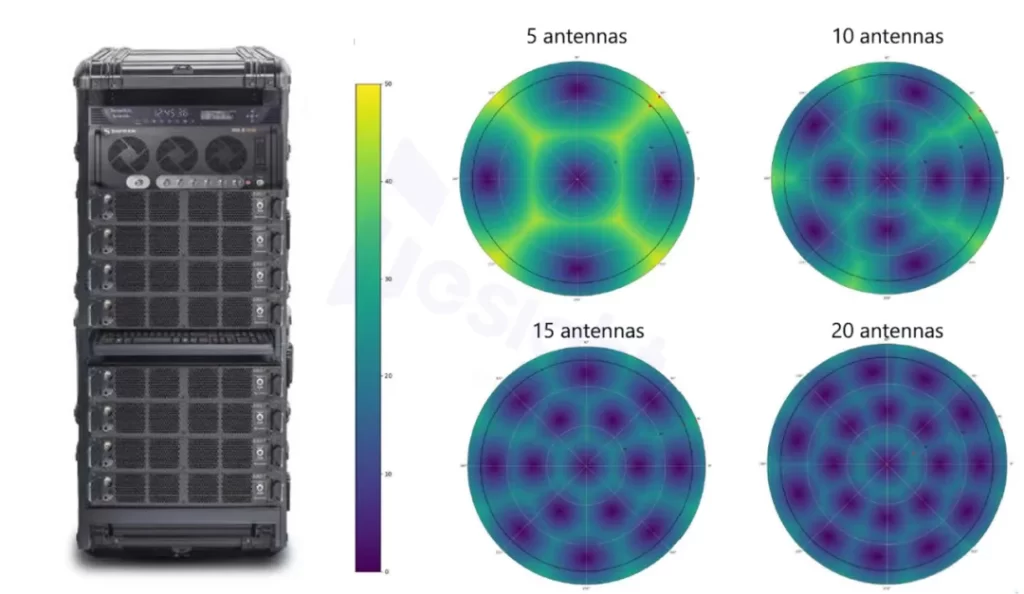
  • The Latest Generation of GNSS Simulators: The GSG Product Suite: Based on a leading commercial off-the-shelf (COTS) hardware architecture, it flexibly provides up to 21 or more fully independent RF physical outputs;

  • High-Precision Time and Clock Distribution System: By leveraging a high-precision clock source and a clock distribution network, it ensures that every RF signal transmitted by the GNSS remains highly synchronized at the picosecond level;

  • Transmit Antenna Array (Tx Array): Transmitter antennas precisely positioned around the perimeter of the anechoic chamber represent different three-dimensional geometric orientations and can flexibly support up to 21 “Sky Satellites”;

  • Automated Calibration Tool: The system’s core algorithm fully and automatically compensates for the delay and power loss that occur throughout the entire path—from the signal’s origin at the simulator, through complex cabling, and via air—until it reaches the device under test (DUT), without any manual intervention.

What does this solution offer?

  • Full System Closed-loop: Incorporate “physical antenna + RF front-end + baseband signal processing + positioning algorithm” into a single real-time HIL test loop;

  • Rapid Calibration: By significantly reducing the time required for dark-room phase calibration—a process that was originally extremely complex and often took several days—to just “a few minutes” and automating it, the testing throughput and development efficiency of R&D laboratories have been greatly improved;

  • Industry-leading fully automated technology: Full support for automatic antenna mapping, automatic cable and air-interface delay calibration, and automatic path power loss compensation;

  • A "turnkey" solution that's ready to use right out of the box: A turnkey product that can be deployed directly in a large, fixed microwave anechoic chamber or flexibly integrated into a multifunctional, portable anechoic chamber.

How to Choose the Most Suitable GNSS Test Solution for Your Application?

Given different R&D stages, technical requirements, and the scale of antenna testing, how should the optimal test path be planned when using conventional GNSS simulators and high-end anechoic systems?

  • GSG-7C: A highly integrated, standard-type multi-frequency, multi-constellation GNSS simulator.

  • GSG-8 Gen2: A high-end GNSS simulator that supports high-concurrency real-time simulation across multiple channels and scenarios.

For most scenarios involving the development, algorithm debugging, and consistency verification of positioning and navigation systems, choose the standard GSG Series GNSS Simulators It remains the mainstream, cost-effective solution of choice. Its core strengths lie in its exceptional flexibility and configurability; thanks to powerful software algorithms, standard conductive simulation is sufficient to perfectly cover the vast majority of routine testing needs, ranging from basic positioning to highly dynamic trajectories.

However, when your application scenario is extremely sensitive to carrier phase shifts and changes in angle of arrival (AoA)—such as in unmanned vehicles or eVTOLs—or involves highly precise antenna physical field simulations, physical interference immunity verification of CRPA arrays, and the pursuit of the highest testing standards,Hongke Skydel Anechoic System It will provide the most robust foundation for real-world physics verification—one that meets the highest international aerospace standards—for your space-based systems and physical interactions.

Other Articles

Hongke Dynamic

[Hongke News] Why Rule-Intensive Businesses Are Better Suited for Low-Code: Making Decision Logic “Configurable” Instead of “Hard-Coded”

Many rule-intensive enterprises often face challenges during digital transformation, such as business rules being tightly coupled with underlying code, cumbersome tuning processes, and difficulties in unifying logic across systems. Low-code solutions can transform decision logic into visual configurations, shortening rule iteration cycles and clarifying the division of responsibilities between business and IT. The Decisions platform integrates a low-code environment with a rules engine to independently build a shared decision-making layer. It supports drag-and-drop rule management and cross-system integration and invocation, balancing operational flexibility with IT governance and regulatory requirements.

Read more
Hongke Case

[Hongke Case Study] Hongke Panorama SCADA System: Enabling Industrial Automation and IT/OT Convergence Through REST Web Services

Learn more about how Hongke Panorama Suite uses standard REST Web Services (REST APIs) to enable bidirectional data exchange, break down data silos on the industrial floor, and seamlessly connect SCADA systems with real-world weather, energy, and telemetry big data—thereby comprehensively accelerating the deep integration of enterprise IT and OT.

Read more
Hongke Case

[Hongke Solutions] SimData High-Fidelity Virtual Dataset Solution: Perception Training for Autonomous Driving Based on aiSim

Hongke has launched SimData, a high-fidelity virtual dataset built on the aiSim simulation platform and fully compatible with the nuScenes format. It provides high-quality multimodal training data for autonomous driving perception algorithms, LiDAR, and BEV models, effectively addressing the challenge of data collection in extreme scenarios (Edge Cases). Click now to learn about the development process and see real-world results!

Read more

Contact Hongke to help you solve your problems.

Let's have a chat