Search

Hongke's latest articles

HongKe

Lorem ipsum dolor sit amet, consectetur adipiscing elit. Ut elit tellus, luctus nec ullamcorper mattis, pulvinar dapibus leo.

Lorem ipsum dolor sit amet, consectetur adipiscing elit. Ut elit tellus, luctus nec ullamcorper mattis, pulvinar dapibus leo.

HONGKE Solutions] For POC Validation and Replacement Vehicles: CAN / CAN FD Communication Solution for Efficiently Bridging Old and New EE Architectures

HTC PCAN Router Equipment Enables Rapid EE Architecture Validation for Heterogeneous EE Architectures

In vehicle replacement or cross-platform integration projects, there is often a co-existence of old and new EE Architecture, resulting in CAN / CAN FD communication protocol incompatibilityThe traditional solution usually involves coordinating multiple teams from the network and software vendors. Traditional solutions often require coordinating multiple teams from the network, software, and vendors, and going through modifications. DBC files, updating ECU softwareThis is a long and costly process.

In the recent "Hundred Wisdom" technology sharing session, an engineer with 8 years of EE architecture R&D experience from one of the leading automobile manufacturers in China shared how his team has been working on EE architecture through Hongke PCAN RouterinNo modification of any ECU softwareUnder the circumstance of the new model, it can quickly complete the cross-frame signal routing, and successfully promote a replacement model's POC (Proof of Concept) VerificationThe solution is to provide a reusable solution for rapid cross-platform integration.

Core Challenge

CAN Communication Barriers in the Mix of Old and New EE Architectures

At the pre-project stage (e.g. POC validation or prototype stage), vehicles often need to use a mix of ECUs with different EE architectures due to cost, cycle time and supply chain factors, e.g. in one replacement model, about 80% controllers come from a new platform, while the battery pack and the Battery Management System (BMS) are still on the old architecture.

This leads to a critical problem at the communication level: the two architectures have differences in functional logic, signal definitions, message IDs, and data structures that make direct CAN communication impossible.

If we follow the traditional development process, we need to go through: definition of functional requirements → communication matrix adjustment → generation of new DBC → ECU software update; the whole process involves multi-party collaboration, which usually takes weeks or even months, and the modification of the mass-production ECU software is only required at the validation stage, which is less feasible in practice.

Solutions

HTC PCAN Router as CAN / CAN FD Smart Gateway

To solve these problems, the engineering team introduced Hongke PCAN Router act as CAN / CAN FD Smart GatewayIn addition, the CAN channel deployed between the BMS and the VCU realizes signal forwarding and protocol conversion.

The core idea is to complete the signal mapping and logic processing within the Router without modifying the BMS or VCU software.

Implementing processes (rapid deployment)

  • Signal analysis: For critical scenarios such as "high pressure", compare DBCs of different structures to identify the signals that need to be converted and their locations.
  • Logic development: based on PEAK-DevPack Development KitIn addition, we use C language to realize signal processing and routing logic. For example, extract the signal "High Voltage Contactor Status" from the BMS report and map it to the VCU recognizable report.
  • Brushing and verification: by PCAN-USB ToolAfter completing the firmware flashing, the device is plug-and-play and takes effect immediately after connecting to the CAN network of the car.

This approach transforms an otherwise complex system-level communication adaptation problem into a logic development problem on a single device:

  • No need for inter-departmental coordination
  • No ECU modification required
  • Significantly shorten the development cycle

Application Scenarios

Ideal for rapid verification and testing environments

The HONGKE PCAN Router is especially suited for scenarios that require high flexibility and efficiency:

  • POC Validation: Rapidly build a runnable system to validate technical feasibility.
  • Pilot Vehicle Testing: Quickly Compensate for Missing Signals in Non-Production Configurations
  • Test Bench: Flexible simulation and forwarding of CAN telegrams to create complex test environments.
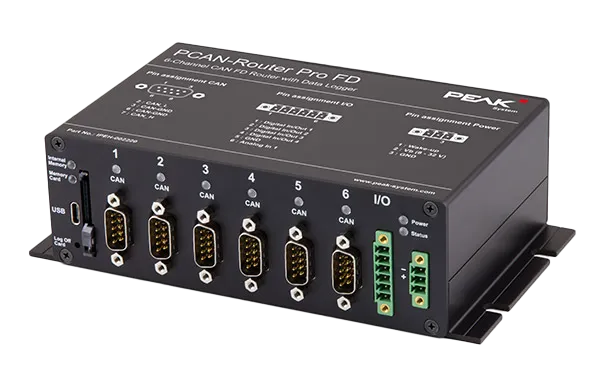
  • 6-channel CAN FD gateway
  • Supports CAN FD and CAN CC
  • Pluggable Transceiver Modules
  • Built-in 16GB eMMC + SD Expansion
  • Support for report logging and error analysis
  • DB9 interface, simple deployment
  • For automotive electronics and industrial control

Development Experience

Lightweight Rapid Development (Embedded Development)

Avision provides a complete development toolchain, including:

  • Driver
  • Development Kits (SDK)
  • Compiler
  • Flash tools

Developers can use the VS CodeRapid development and deployment.

Core Development Process

  • Defining CAN Messages and Signals
  • Logic is handled in the main loop (while).
  • Cycle control with system clock
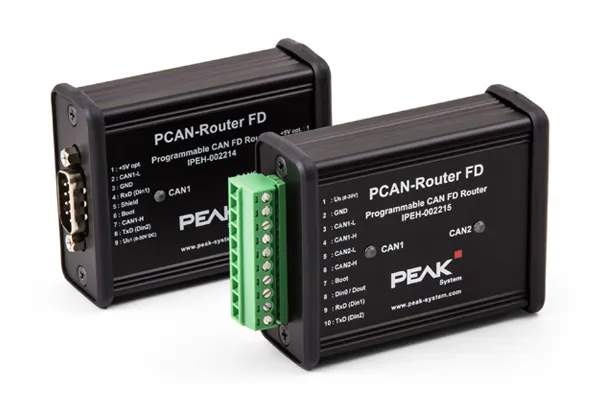
Hongke PCAN-Router FD

Conclusion

In the face of the integration challenges brought about by the rapid evolution of automotive electronic and electrical architectures.Avision PCAN Router provides an efficient, non-intrusive CAN communication bridge solution.The

Without affecting existing ECUs and project progress, the engineering team can quickly open communication links and dramatically shorten the time it takes to complete the project. POC Validation and Trial Production Test CycleIt is a reliable tool to address the need for cross-platform integration and rapid development.

Other Articles

Hongke Case

HongKeys Solution] How to land CRA compliance? Network security engineer perspective to bring you to understand the logic of compliance and ONEKEY security and compliance platform value.

With the EU's Cyber Resilience Act (CRA) coming into force, product security and supply chain transparency have become mandatory requirements for companies entering the European market, with the CRA requiring manufacturers to establish security mechanisms throughout the entire product lifecycle and to provide SBOM, vulnerability management, and evidence of compliance. With the gradual implementation of the EU Cyber Resilience Act (CRA), product security and supply chain transparency has become a mandatory requirement for enterprises to enter the European market, and the CRA requires manufacturers to establish a security mechanism throughout the product lifecycle and provide SBOM, vulnerability management, and evidence of compliance. The ONEKEY Safety and Compliance Platform helps enterprises to quickly complete compliance diagnosis and vulnerability management, and establish a traceable and verifiable product safety and compliance system.

Read more
Hongke Case

Hongke Solution] Making Compliance Training a "Quantifiable Line of Defense": Using KnowBe4 to Connect the Safety Awareness + Compliance Training Chain

In the context of digital transformation and increasing regulatory requirements, it is often difficult for enterprises to truly reduce human risk if they still manage compliance training and information security awareness training separately, KnowBe4 establishes a closed-loop management model of "test, train, retest, and data feedback" through simulated phishing tests, security awareness training, and the Compliance Plus compliance training library. Enterprises can integrate compliance courses and safety training into end-to-end training governance, and establish a quantifiable, traceable and auditable compliance training system.

Read more
Hongke Case

From 60% to 5%: How Anglo-Eastern built a network security defense in a year's time

Anglo-Eastern Ship Management is a global ship management company managing more than 750 vessels. Faced with more than 32,000 seafarers around the world and the ever-increasing risk of cyberattacks, the company deployed the KnowBe4 HRM+ security awareness training platform to implement continuous employee cybersecurity education and simulated phishing tests. In just one year, the susceptibility rate to phishing attacks dropped from 60% to 5%, the training completion rate exceeded 90%, and employees proactively reported about 200 suspicious emails per day.

Read more

Contact Hongke to help you solve your problems.

Let's have a chat