

Search

Hongke's latest articles

HongKe

[Hongke Solutions] aiSim Intelligent Driving Simulation: A Comprehensive Guide to Unstructured Road Testing

With the rapid advancement of intelligent and autonomous driving technologies today, the industry’s evaluation framework has shifted from a sole focus on “test mileage” to a more comprehensive assessment of “scenario coverage” and “edge cases.”. Statistics show that the validation of a mature autonomous driving algorithm typically follows "99.91 TP3T simulation testing + 0.091 TP3T closed-course testing + 0.011 TP3T public road testing" The Golden RatioThe

However, as autonomous driving systems advance to Levels 3 and 4, or when operating in special areas such as mining sites, rural areas, and mountainous regions, the lack of clear lane markings and uneven road surfacesUnstructured Roads, becoming a key bottleneck that hinders the system's actual implementation and reliable operationThe

虹科 aiSim 智駕仿真平台軟體介面:支援 OpenDRIVE 與 Atlas 地圖格式轉換及非結構化道路場景編輯

1. Why is the unstructured road test essential?

In the traditional definition of the Operational Design Domain (ODD), unstructured roads are often classified as specific scenarios; however, in real-world traffic environments, rural roads, mountain roads, temporary construction zones, and industrial park roads account for a significant proportion.The

Structured roads provide prior information from high-definition maps (HD Maps) and defined lane markings, whereas unstructured roads lack such information, requiring the system to rely entirely on its own perception and decision-making capabilities.::

  • Missing or Faded Lane Markings: Vehicles rely on multiple sensors, such as cameras and LiDAR, to determine in real time which areas are safe to drive in.The

  • The road has a complex geometric configuration: Featuring sharp turns, a series of curves, and steep slopes, this course places higher demands on vehicle dynamics control and trajectory planning.The

  • There is a significant coupling between topography and environmental factors: Undulations, potholes, and mixed materials create a three-dimensional structure that directly affects a vehicle's maneuverability and handling stability.The

2. Two Major Challenges in Traditional Unstructured Road Simulation

Currently, mainstream simulation map generation relies heavily on standard formats such as OpenDRIVE. These formats are primarily designed for structured road networks and are particularly effective at describing lane topology and intersection connections.. When encountering dirt roads built along mountainsides or with damaged surfaces, the following challenges arise::

Limited terrain modeling capabilities

When traditional maps are imported into simulations, they are typically flat projections that lack elevation and road surface details; the dynamic feedback is still based on the assumption of a flat road surface.The

Lack of flexibility in scene editing

If you build a scene from scratch using professional 3D modeling tools, it often lacks pathfinding information, making it difficult to test scene interactions.The

This creates a dilemma:Either use "ideal roads" that lack realistic terrain, or use "purely visual scenes" that are difficult to integrate with test logic.The

3. aiSim: A High-Performance Solution for Unstructured Road Simulation

To overcome the aforementioned bottleneck,aiSim Intelligent Driving Simulation Platform By integrating external 3D editing tools, we have established an efficient workflow that seamlessly combines logical road networks with highly realistic terrain.The

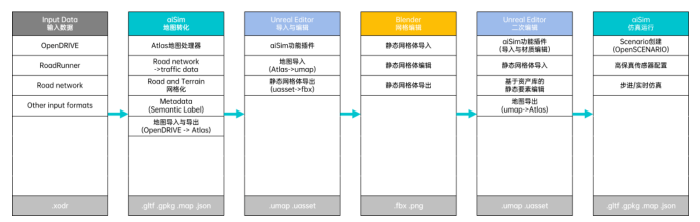
Basic Data Conversion: From OpenDRIVE to Atlas

aiSim supports direct import of industry-standard OpenDRIVE Format the map and convert it to the built-in Atlas Map Format. The Atlas format preserves road networks, semantic labels, traffic information, and topographic data, enabling maps to be expanded and edited further.The

Flexible Terrain Editing: Integration Between the Unreal Editor and Blender

With the aiSim plugin, users can Unreal Editor Directly access map resources within the application, and with the help of Blender Perform grid editing::

  • Large-Scale Terrain Reshaping: Redistribute the terrain grid to generate varied terrain undulations and mountain slopesThe

  • Detailed Rendering of the Road Surface: Simulates road surface features such as cracks, bumps, and ruts, and assigns them realistic physical collision properties and material characteristicsThe

Closed-Loop Test Validation: High-Fidelity Sensors and Physical Simulation

Edited unstructured maps can be imported directly into aiSim for physical closed-loop testing.::

  • Vehicle Dynamics Feedback: Road surface irregularities and changes in gradient will directly affect the vehicle model's attitude and wheel responseThe

  • Sensor Simulation: To reproduce the point cloud patterns captured by radar on gravel roads and the rolling shutter effect observed by cameras under bumpy conditions, thereby providing accurate ground truth for the validation of perception algorithms.The

4. Conclusion

aiSim Intelligent Driving Simulation Solution It provides an efficient approach to testing autonomous driving in complex road environments. Through the logical conversion from OpenDRIVE to Atlas, combined with the terrain editing capabilities of the Unreal Editor and Blender, the testing team can easily replicate various edge-case scenarios in a virtual environment without incurring the high costs of on-site data collection and high-risk real-world vehicle testing, thereby accelerating the iteration and safety validation of autonomous driving algorithms.The

Go NowaiSim PageLearn more.

Other Articles

PCB 電路板組裝視覺檢測與測量示意圖:陣列排列的印刷電路板(PCBA)在藍光光源下展示晶片、元件與金屬焊盤細節,適用於 SMT 表面貼裝自動光學檢測(AOI)與品質管控。
Hongke Dry Goods

[Hongke Solutions] How Can AI-Powered Industrial Vision Inspection Overcome Quality Bottlenecks? A Comprehensive Analysis of Multi-Camera PTP Synchronization and Defect Detection

An In-Depth Analysis of AI Industrial Vision Inspection Technology! Explore how high-resolution industrial cameras, AI deep learning algorithms, and IEEE 1588 PTP microsecond-level multi-camera time synchronization precisely overcome bottlenecks in PCB component measurement and lithium-ion battery defect detection, and SMT Automated Optical Inspection (AOI), thereby improving production line yield!

Read more
可配置的CAN FD模擬I/O模塊 功能概述: PCAN-MicroMod FD系列模塊是支持CAN FD的數采模塊。 PCAN-MicroMod FD 插入式板卡可以和即插即用的母板一起購買,母板提供了各種外設可滿足特定需要。對於CAN連接、I/O、和供電,可用彈簧端子連接器。 PCAN-MicroMod FD 數字版1和2著重於數字輸入和輸出,其上有相應的保護電路。數字1的數字輸出裝備了低邊開關,數字2的裝備了高邊開關。
Hongke Dry Goods

[Hongke Solutions] Can’t Read CAN Data? Not Enough Temperature Channels? A Comprehensive Guide to Integrating NVH and Battery Data Acquisition

Is your current NVH data logger unable to read the CAN bus? Are there not enough temperature channels for battery testing? Hongke offers the PCAN-MicroMod FD and MU-Thermocouple1 CAN FD modules to enable CAN(FD)-to-analog conversion and high-density thermocouple multi-module cascading expansion. No coding required—just unbox and use it right away, with no need to replace your existing system!

Read more
Hongke Dry Goods

[Hongke Solutions] AI Agent Implementation Case Study: Enterprise-Level Deployment Across Six Major Industries and the Logic Behind the Underlying Infrastructure

An in-depth analysis of how enterprises can transition from single LLM API calls to autonomous agentic systems. This article compiles real-world examples of AI agent deployments in production environments across six major industries, including retail and finance, and breaks down the underlying infrastructure logic—such as high concurrency, cross-interaction memory (Memory Infrastructure), and distributed state persistence.

Read more

Contact Hongke to help you solve your problems.

Let's have a chat